
‘Peak Pain’ Happens at a Younger Age Than Many of Us Think
/By Pat Anson
We often think of pain as a symptom of old age. Aching muscles and sore joints don’t heal as quickly as we grow older, and chronic painful conditions like arthritis, neuropathy and spinal degeneration become more common as we age.
A large new international study published in Nature Medicine debunks that common belief, finding that many types of pain begin earlier and reach their peak before the age of 55.
Led by researchers at McGill University in Montreal, the study looked at self-reported pain data collected between 1990 and 2025 from over 6 million people in 118 countries and territories.
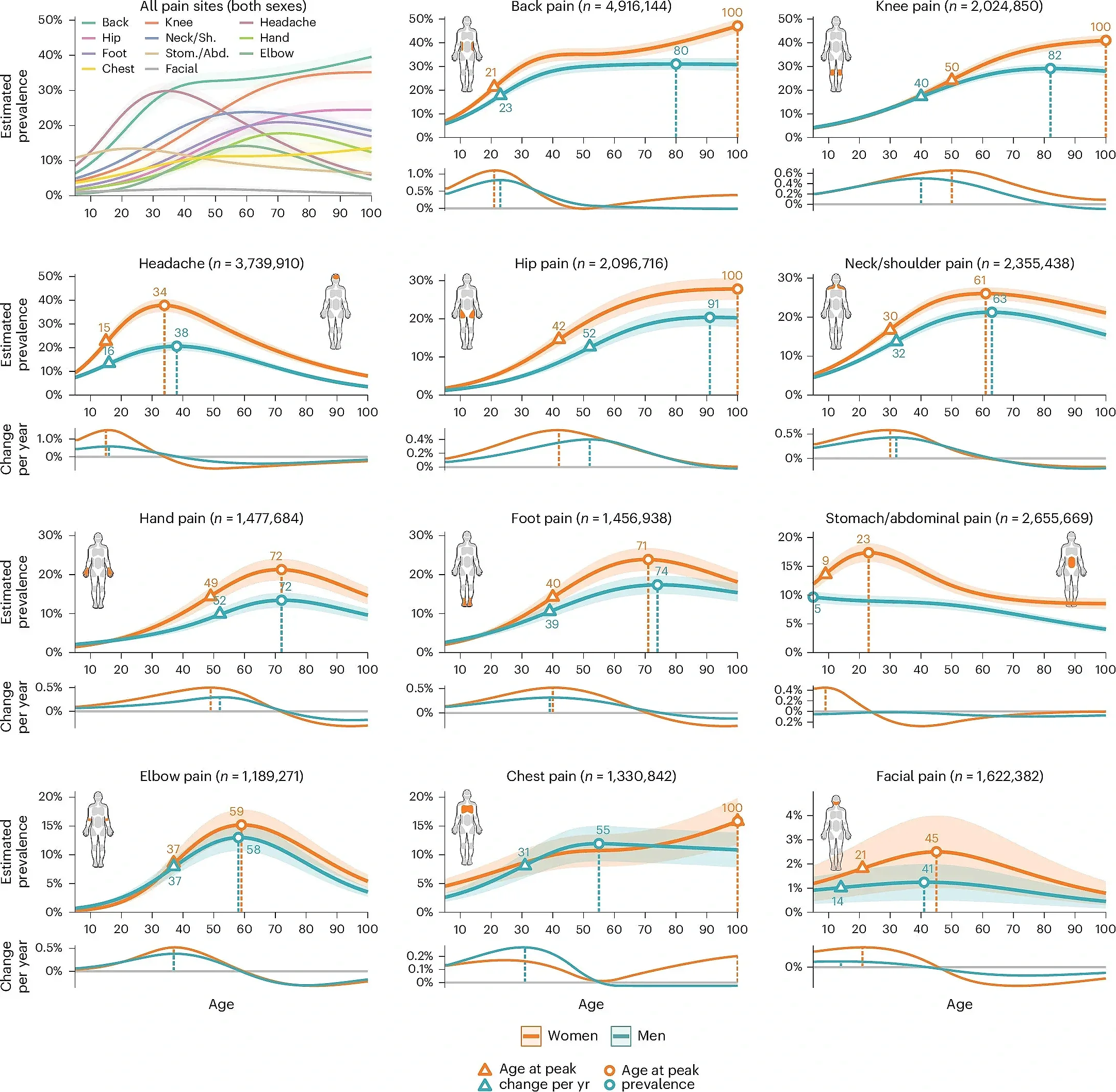
Of the 11 body areas studied, pain prevalence varied considerably depending on location, age and sex. Women reported pain in nearly every location more often than men. The one exception was chest pain, which occurs slightly more often in middle-aged men.
Headaches often peaked for both men and women in their 30’s, while stomach pain peaks for women at the age of 23 and males at age 5. Pain in those locations tends to decline as people grow older.
The universal curse of back pain often begins for men and women in their 20’s, and tends to keep growing worse as we grow older. Knee pain and hip pain follow a similar upward trajectory.
Lifespan Pain Projections for 11 Body Areas
NATURE MEDICINE
“The global lifespan trajectories show that pain is not a single epidemiological phenomenon but, rather, a set of distinct nonlinear patterns that differ in their timing and anatomical distribution,” wrote lead author Matt Fillingim, PhD, a data scientist and researcher at McGill University who now works for Johnson & Johnson.
“Across most phenotypes, pain did not increase monotonically with age; instead, the steepest rises occurred before age 55 years, indicating that a substantial share of lifetime pain burden develops during working-age adulthood.”
There is a fair amount of regional variability in pain prevalence. Headaches were most likely to peak in North America and Western Europe in early adulthood, while headaches in East and Southeast Asia were less common and have a flatter trajectory over time.
Eastern Europe and Sub-Saharan Africa had some of the highest rates of back, joint and overall body pain. If you live in those regions, pain prevalence really is associated with age and just keeps growing worse the older you get.
Not surprisingly, smoking, obesity and coming from a low-income household are also contributing factors that significantly raise the risk of pain.
By age 80, overall pain prevalence is about 31% higher in less developed countries and low back pain was nearly twice as common
Interestingly, the risk of having facial pain is significantly higher for female smokers, while pain in the foot, ankle, knee and hip — weight-bearing joints — is often linked with obesity.
What all this data tells us is that life-style changes, pain prevention and pain management need to start at an early age. And pain is a universal experience that knows no borders.