
Kratom and 7-OH Bans Create New Patients for Addiction Treatment
/By Pat Anson
With dozens of states, cities and counties banning kratom and concentrated versions of the kratom alkaloid 7-OH, there are growing reports about people who use kratom products going into withdrawal and seeking addiction treatment.
Those reports are likely to increase when the DEA classifies 7-OH products as illegal Schedule One controlled substances, which would effectively be a nationwide ban.
“Addiction clinics see rising cases of kratom and 7-OH withdrawal” is the headline of a recent STAT article.
“Gas station kratom, an emerging addiction crisis in Montana,” warns an op/ed in the Independent Record.
“Tennessee’s kratom ban brings wave of withdrawal patients to treatment centers,” reported NewsChannel5 in Nashville.
"We’re seeing more people seeking treatment from 7-hydroxymitragynine (7-OH) or kratom addiction than we do fentanyl addiction these days," said Dr. Chapman Sledge, who runs an addiction treatment center in Nashville.
But many of these reports about an “addiction crisis” and people needing treatment for kratom and/or 7-OH withdrawal are anecdotal. And there is little evidence that addiction treatment providers are being overwhelmed with new patients.
Millennium Health, a drug testing company that works with addiction treatment centers nationwide, says only 3.9% of its urine drug screens tested positive for kratom alkaloids in June 2026. That’s up marginally from the 3.1% that tested positive in 2025.
“I don’t know that more clinicians are submitting urine samples with a request for testing for kratom. I don’t know that that’s the case. But you certainly see among those that are tested for kratom higher positivity rates,” says Eric Dawson, PharmD, Vice President of Clinical Affairs at Millennium Health.
Kratom Alkaloids Detected in Urine Screens
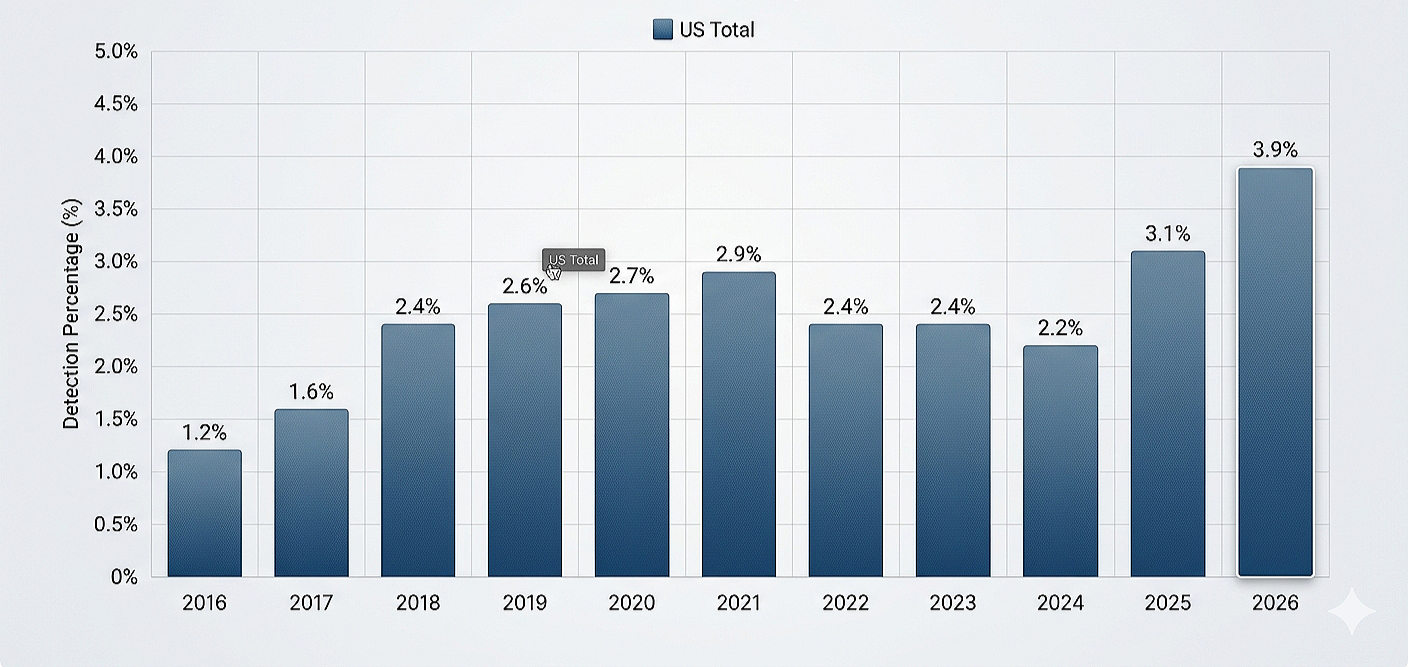
MILLENNIUM HEALTH
By comparison, that 3.9% positivity rate for kratom alkaloids is well below the 13% that tested positive for fentanyl and the 11% positivity rate for stimulants. Only about 2% of urine screens for patients undergoing addiction treatment tested positive for prescription opioids, an all-time low.
Kratom comes from the leaves of a tree that grows in Southeast Asia, where it has been used for centuries as a stimulant and pain reliever. The 7-OH alkaloid occurs naturally in kratom leaf in trace amounts, but manufacturers have developed ways to concentrate 7-OH in tablets, gummies and shots, making them potent pain relievers.
Estimates vary, but over 5 million Americans have used kratom in their lifetime. There are no reliable estimates for how many have used 7-OH products.
‘Kratom Use Disorder Isn’t a Diagnosis’
Robert Levy, MD, an addiction specialist in Minneapolis and past-president of the Minnesota Society of Addiction Medicine, says kratom use disorder varies depending on what part of the state patients are from.
“I think in the metro area there is some kratom and 7-OH use disorder, but mostly it's still fentanyl. Rurally, you're certainly seeing more of it, and in certain areas of Minnesota that's all that you will see is 7-OH kratom use disorder coming in,” Levy told PNN, adding that other substances are almost always involved when someone seeks treatment.
“Polysubstance use disorder is still the highest intake, so it's mostly stimulants and opioids together, or alcohol and opioids, or alcohol and stimulants. Those are the ones that are still king.”
Levy says many patients who use kratom or 7-OH don’t even bring it up during their initial consultations. They mention other drugs they use, but not kratom because many consider it a natural substance that won’t lead to addiction.
“They tell me about other substances they use, but often don’t talk about kratom for whatever reason. Either they don’t view it as a problem or it's legal,” he said.
That makes it difficult to determine the true extent of 7-OH or kratom use disorder, terms that Levy is reluctant to use because there is no diagnostic code for them.
“In medical parlance, that diagnosis doesn’t exist,” says Levy. “I think the people who come in and need treatment, I would call it opioid use disorder, because kratom use disorder isn’t a diagnosis.”
7-OH and mitragynine, the two most active ingredients in kratom, are alkaloids, not opioids. But because they act on opioid receptors in the brain and have opioid-like effects, the medical establishment often calls them opioids.
That makes it possible to check the “opioid-use disorder” box on diagnostic forms, making a visit from a patient who uses kratom a billable event for insurance purposes. It also makes it easier for a provider to prescribe Suboxone or methadone off-label, medications that are used to treat opioid addiction.
Many patients going through kratom withdrawal say the symptoms are mild, not unlike someone trying to give up coffee. Others say it’s the worst withdrawal they’ve ever experienced. A lot depends on the amount of kratom or 7-OH that someone has been taking.
Addiction specialists say Suboxone (buprenorphine) should only be prescribed when a kratom user is going through severe withdrawal and needs help. There are no high-quality clinical studies of Suboxone for kratom or 7-OH dependence, only anecdotal reports and case studies.
For a kratom or 7-OH user with little or no prior history of using opioids, buprenorphine presents a problem of its own. As an opioid itself, buprenorphine can create opioid dependence – in effect exchanging one addiction for another – and resulting in a lifetime of Suboxone use.
Nevertheless, despite the risks and a lack of evidence, prescribing Suboxone has become the de facto treatment for kratom and 7-OH withdrawal. According to STAT, nearly a third of the new patients prescribed Suboxone last month by a telehealth addiction clinic were using kratom or 7-OH.
“That really is quite an explosion,” Ayesha Appa, MD, Head of Medical Affairs at Boulder Care told STAT. “I think we’re really seeing and feeling what happens when people lose access and need to seek care in unprecedented numbers.”
“An increasing number of addiction specialists are winding up having to treat patients who've been using kratom with buprenorphine,” said Andrew Kolodny, MD, President of Physicians for Responsible Opioid Prescribing (PROP), an anti-opioid activist group. “I've had to prescribe buprenorphine as well for some of these patients.
“Ideally, not everyone who's addicted to kratom is going to need to be treated with buprenorphine, but certainly there appears to be a substantial subset of people addicted to kratom with severe opioid use disorder who are winding up on the same treatment that we use for these other opioids.”
Unintended Consequences
Kolodny recently began practicing addiction medicine again, after taking a hiatus to testify as a paid expert witness in opioid litigation cases. He said during a recent webinar that he sees similarities to the early years of the opioid crisis.
“We don't have good surveillance data on addiction involving kratom yet, but I believe that as kratom consumption is going up, we're seeing an increase in addiction involving kratom,” Kolodny claimed.
“This is what happened with the prescription opioid crisis. As prescription opioid consumption exploded because doctors were massively overprescribing, it led to an epidemic of opioid addiction and deaths, and to the opioid crisis. And I believe that what we're looking at here is happening with kratom today.”
There were many unintended consequences for patients due to the crackdown on opioids, including untreated pain, abrupt tapers, withdrawal, and suicides. Drug cartels also began mass-producing counterfeit oxycodone and other medications laced with fentanyl after access to prescription opioids was reduced.
Those same unintended consequences are reappearing as kratom and 7-OH products become harder to get.
In Maryland, where 7-OH was banned in July, state health officials say illicit 7-OH products are already appearing on the black market.
“Typically, when substances are regulated, like the banning of 7-OH sales in Maryland, it causes dysregulation in the unregulated drug market,” they wrote in a quarterly newsletter on Maryland’s illicit drug supply.
What have they seen so far? Three illicit 7-OH products have been found in Maryland so far this year. One contained only 7-OH. The other two were laced with fentanyl, a veterinary sedative, and methamphetamine.
Meanwhile, in Connecticut, which banned kratom and 7-OH products in March, two employees of a smoke shop have been arrested for selling cannabis gummies laced with 7-OH and pseudoindoxyl, a potent semi-synthetic kratom alkaloid. At least one customer who consumed the gummy had "a severe adverse reaction," according to police.