
Can Old Injuries Be Shocked Into Feeling Better?
/By Madora Pennington
I have an old knee injury. You probably have one, too.
Or maybe it’s your hip, ankle or elbow. Something that flares up from time-to-time and makes you say in frustration, “This old thing. Again?”
Decades ago, I slipped. Wearing heels as I was climbing into an SUV in the rain, my kneecap came down on the running board, stretching out the tendon. My knee swelled to the size of a baseball. Tendons stretched like that do not snap into their old shape. I have been limping ever since.
There is no simple surgery for a patella alta (high kneecap) injury. Over the years, I tried physical therapy, knee braces, taping the kneecap in place, prolotherapy (sugar injections) and platelet-rich plasma injections (PRP therapy).
All of those helped to some degree. But still my knee continued to bother me, often when I did activities that I love, like tennis and running.
It became so annoying, I thought it was time to work on it again.
Healing Shocks That Reduce Pain
In looking around for new modalities, I found something I had never heard of: Extracorporeal Shockwave Therapy (ESWT).
ESWT is a noninvasive treatment that uses a device applied at the skin of injured areas to emit high-energy acoustic sound waves that promote healing and repair tissue.
Shockwave therapy was originally developed to break up kidney stones without surgery. Once shattered into smaller sizes, kidney stone fragments pass out of the kidneys easier and exit the body with the urine.
The treatment on kidney stones was successful, but there were concerns that the shock waves were so intense they might damage nearby bones. It turns out the shocks actually stimulate new bone formation. Later investigations showed that shockwaves at a different dose could also stimulate cellular regeneration in soft tissue.
In 2000, the FDA approved a shockwave device for chronic plantar fasciitis (pain in the soles of the feet). And in 2002, the FDA approved another device for the treatment of tennis elbow, a repetitive strain injury common to tennis players.
Like nearly all technology, today’s ESWT devices are smaller, cheaper and easier to operate effectively. Most protocols suggest several sessions separated by about a week.
ESWT can be used on a wide variety of conditions that would normally send a patient to physical therapy, such as tendon injuries, slow-healing bones, arthritis, calcific tendonitis of the shoulder, and more.
Shockwave therapy can encourage bone formation, new blood vessels, growth factors, healing in tendon cells, and collagen remodeling, while lowering inflammation and pain signaling.
Shocking My Knee
Studies on ESWT for a kneecap injury such as mine showed mixed results and were not very promising. But that did not deter me.
I was happy to try something besides an injection, especially something that could reawaken dormant healing processes. Having physical therapy along with ESWT was also recommended, so I did that, too.
Shockwave therapy sounded like it could be painful. A few times during my treatments, it has been. The tech can turn down the machine if the zaps are too much. Because stronger pulses are more effective, I tried to endure them.
The shocks were oddly pleasant, giving me a bit of an adrenaline rush and immediate relief. The tech did not isolate her treatment to just the joint. She used it around the neighboring tissue and muscles.
After my second treatment, to my utter delight, going up and down many flights of stairs was easy for my knee. It actually felt good. My kneecap held firmly in place, not snapping around as it can.
This was a faster, more significant improvement than any treatment I have had in the past.
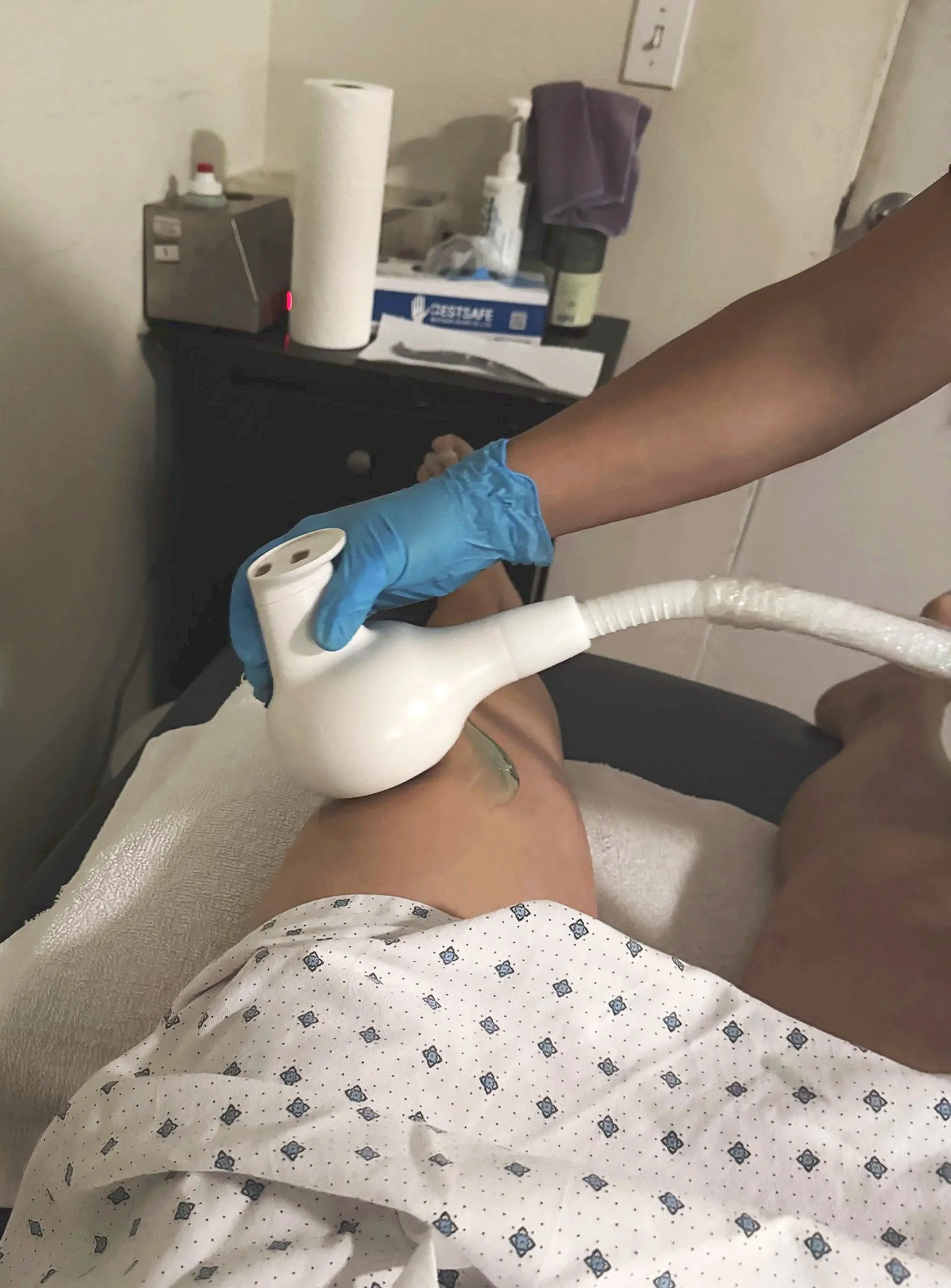
I purchased a package of shockwave treatments, as insurance plans do not cover it. I had more sessions to use up, but my knee felt like it didn’t need any more shocks, so I switched to having ESWT on overworked areas that have helped my body compensate for the deficiencies in my knee. The muscles in my pelvis and neighboring hamstring helped keep me balanced as I unconsciously favored the injured knee.
The shockwaves flowing through my overworked back and glute muscles were intense, but just as soothing as they were on my knee. I could feel them all the way through to my hip joint. The treatment lifted feelings of stress that I was not aware of, perhaps by allowing more flow through the nerves caught under all this musculoskeletal stress.
This other-side treatment accelerated my physical therapy progress. In fact, my physical therapist’s assessment was that the knee itself was in good shape — it was the old compensatory muscle patterns that were causing me pain, like the shortened thigh muscle pulling the kneecap and causing discomfort.
Those other modalities I pursued in the past may have been effective, but I never had the full course of physical therapy the injury needed until now. Perhaps this is why the studies I read recommend physical therapy in addition to ESWT in order to get the best result.
Time will tell if my old knee injury and the package of dysfunction surrounding it can be resolved. I am optimistic. My tennis has never been better, as formerly tight, overworked muscles are free to support my swings. Running is not bothering my knee at all.
I would try ESWT again on other unhappy joints and tissue in the future.