
Gabapentinoids Nearly as Risky as Opioids in Back Pain Study
/By Pat Anson
Being prescribed gabapentinoids for low back pain increases the risk of overdosing or developing opioid use disorder (OUD) nearly as much as taking opioid pain medication, according to a large new study.
Researchers at Columbia University and New York University analyzed how nearly 400,000 Medicaid patients were initially treated for acute low back pain, to see which treatments increased the risk of OUD or an opioid related overdose.
Their findings, published in JAMA Network Open, show the overall risk is relatively low, with just 2.3% of patients having OUD or surviving an overdose after 12 months. That includes patients who were treated with chiropractic care, physical therapy and other non-pharmacological treatments, as well as patients who took opioids and other medications for their low back pain.
Risk of OUD or Overdose After 12 Months
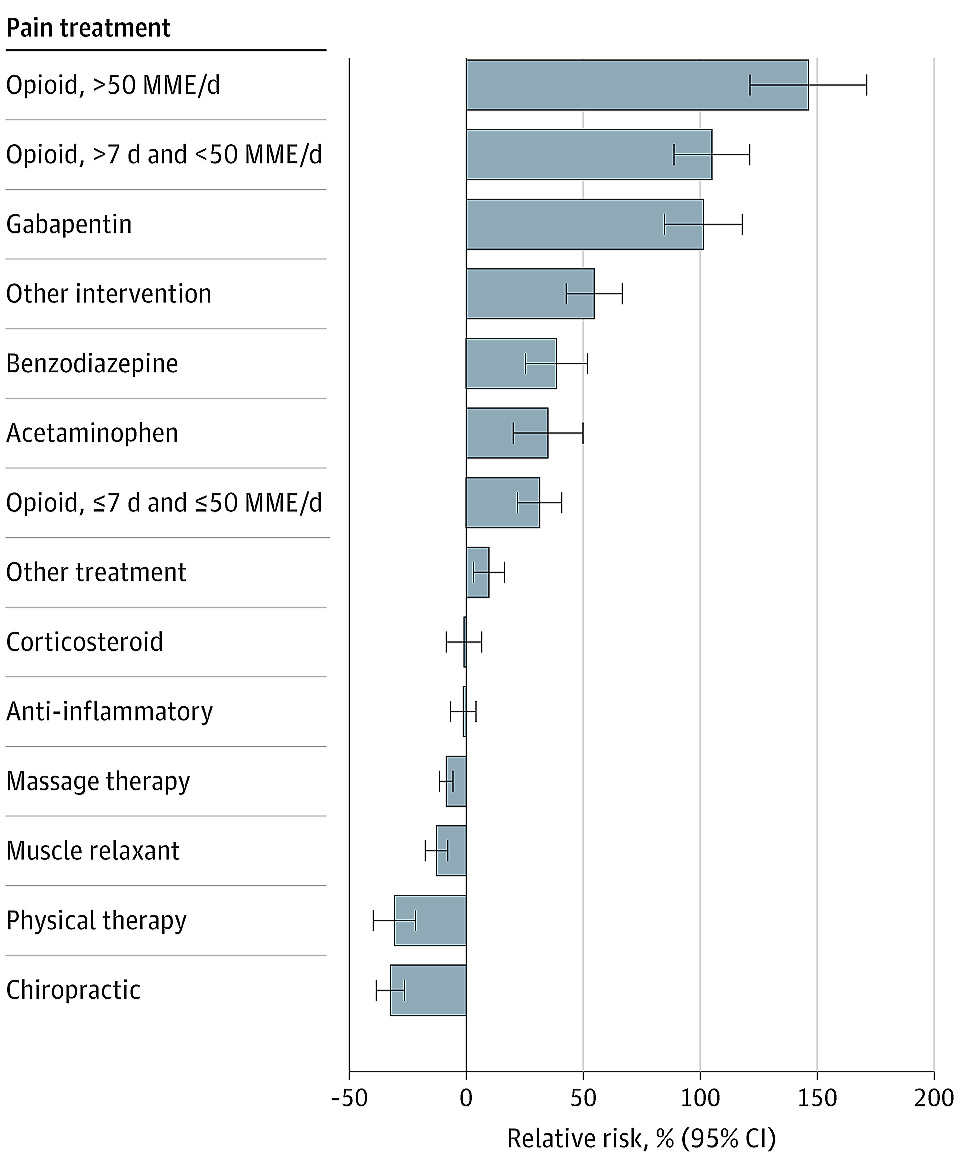
JAMA NETWORK OPEN
When broken down into individual treatments, the degree of risk varied considerably.
Patients who took daily opioid doses of 50 morphine milligram equivalents (MME) or more had a 146% greater chance of OUD or overdose, while those who took less than 50 MME for more than 7 days had a 105% higher risk.
What’s surprising is that patients prescribed gabapentinoids had a 101% higher risk of OUD or overdose. That is significantly higher than those taking benzodiazepines, acetaminophen, steroids or other medications.
Gabapentinoids such as gabapentin (Neurontin) and pregabalin (Lyrica) are a type of nerve medication originally developed to prevent seizures. They are now widely prescribed off-label for both acute pain and chronic pain, even though there is little evidence supporting their use in pain management.
“Gabapentinoids were also associated with a higher risk of OUD or overdose diagnoses. Although sometimes perceived as safer alternatives to opioids, emerging evidence suggests important safety concerns,” wrote lead author Lisa Doan, MD, Associate Professor of Anesthesiology at NYU Langone’s Interdisciplinary Pain Research Program.
“Evidence supporting gabapentinoids for LBP (low back pain) is limited, with a systematic review and meta-analysis finding that gabapentin did not provide significant pain improvement compared with placebo, pregabalin was less effective than other active comparators, and gabapentinoids increased the risk of adverse effects.”
What’s also clear from the study is that many of the doctors treating Medicaid patients weren’t following clinical guidelines for acute low back pain.
The American College of Physicians recommends chiropractic care and other nonpharmacologic therapies as first-line treatments for low back pain, but less than 50% of patients in the study received those therapies as part of their initial care.
Anti-inflammatory medications and muscle relaxants are also recommended – and were frequently prescribed. But opioids were used as the initial treatment in 21% of cases and gabapentinoids in nearly 6% of them. Neither is recommended for acute low back pain.
Of particular concern to researchers is the co-prescribing of opioids and gabapentinoids, which is increasing despite the documented risks. A recent study found that nearly 60% of patients on long-term opioid therapy were also prescribed gabapentinoids, which increase the risk of sedation and respiratory depression, particularly for elderly patients.
In 2024, gabapentin was the fifth most prescribed drug in the U.S., with prescriptions nearly tripling since 2010. The number of patients prescribed gabapentin reached 15.5 million in 2024.
The off-label prescribing of gabapentin is legal and, in some cases, appropriate. But it has reached extreme levels, with studies estimating gabapentin is prescribed off-label up to 95% of the time.