
Can Prayer Reduce Pain and Anxiety?
/By Crystal Lindell
One of the strangest things about developing a chronic illness was realizing just how many people would suggest prayer to me as a medical treatment. They would say it as though they were suggesting surgery or a new medication.
New research seems to show that they may have been on to something. Not only that, the amount of relief is significant and could last two weeks or longer.
Having someone pray for you, which the study dubs “proximal intercessory prayer” – PIP for short – helped both pain and anxiety. Unfortunately, despite patients reporting lower pain scores, the researchers found that the pain relief did not result in reduced use of pain medication.
The study, which was published in The Annals of Family Medicine, was led by researchers at the University of Maryland and involved 180 patients with moderate-to-severe pain and/or anxiety.
Half the participants received 5 minutes of Christian prayer from a trained volunteer prayer practitioner, which included a “laying-on-of-hands.” The other half listened to Christian-themed piano music intended to promote meditation and relaxation.
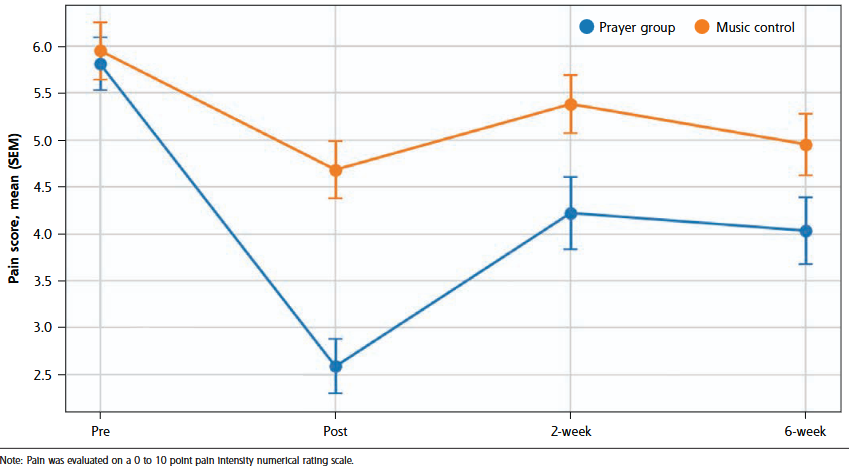
At the start of the study, both groups had pain scores that averaged about 5.8 on the zero to ten pain scale.
Those who received prayer reported large reductions in pain immediately after, with pain scores falling to about 2.6 on average. Pain levels rose to 4.22 after two weeks and leveled off at 4.03 after six weeks.
Patients who listened to music also said their pain levels were reduced, although not as significantly.
Pain Levels Before and After Treatment
THE ANNALS OF INTERNAL MEDICINE
Participants reported similar reductions in anxiety immediately after PIP, but anxiety levels edged up again in the following weeks.
Interestingly, researchers found that the religious affiliation of patients and the intensity of their religious beliefs had no major effect on outcomes. Whether or not participants believed statements like “God heals through prayer” or “I expect to receive some healing through prayer” did not predict the amount of relief they felt.
“Our findings suggest that PIP may be effective for a wide range of patients, including non-Christians and those who do not expect the intervention to be effective,” researchers concluded. “The results suggest that PIP may be a safe, quick, effective intervention that can be performed in medical settings as an adjunct to standard health care.”
Participants reported no adverse events, and most said they would want in-person prayer to be offered at future medical visits.
It’s great that many of the patients experienced significant pain relief, and it’s even better than it lasted multiple weeks. However, as with all studies involving unconventional pain treatments, such as mindfulness and cognitive behavioral therapy, my concern is that in-person prayer will be forced onto patients who aren’t interested.
Anyone who has ever been in true pain will tell you that they are willing to try just about anything to find relief. That includes atheists being offered prayer. So if it works, that’s great.
We just need to make sure that prayer is not used as a substitute for opioids and other conventional treatments. In the grand scheme of things, who’s to say that pain medication isn’t just God’s way of answering prayers for relief in the first place?