
How ‘Toxic Narratives’ Fueled the Opioid Crisis
/By Pat Anson
Dr. Lynn Webster has a unique perspective on the opioid crisis. As a pain management expert and prolific researcher, Webster was elected by his peers as president of the American Academy of Pain Medicine (AAPM) and developed the first Opioid Risk Tool, a questionnaire designed to assess a pain sufferer’s risk of opioid abuse.
Like many other doctors involved in pain management, Webster was also named as a defendant in dozens of lawsuits, alleging he was a “key opinion leader” in helping drug companies use deceptive tactics to market opioids – allegations that Webster says are inaccurate and misleading.
All of this happened over a decade ago, but many of the myths about the causes of the opioid crisis still persist today – what Webster calls “toxic narratives.” And they are still harming patients and doctors.
“A toxic narrative is a narrative that, when repeated continuously, can lead to harm. And the example here is that our opioid crisis was entirely due to excessive supply or overprescribing opioids,” Webster explains.
“As a result, the policies that were implemented led to patient abandonment, patients not having access to medicine, and in some cases patients committing suicide or going to the street to get more harmful substances. So it is a narrative that is incomplete, sometimes false, but it takes on such a hold that it leads to harmful outcomes.”
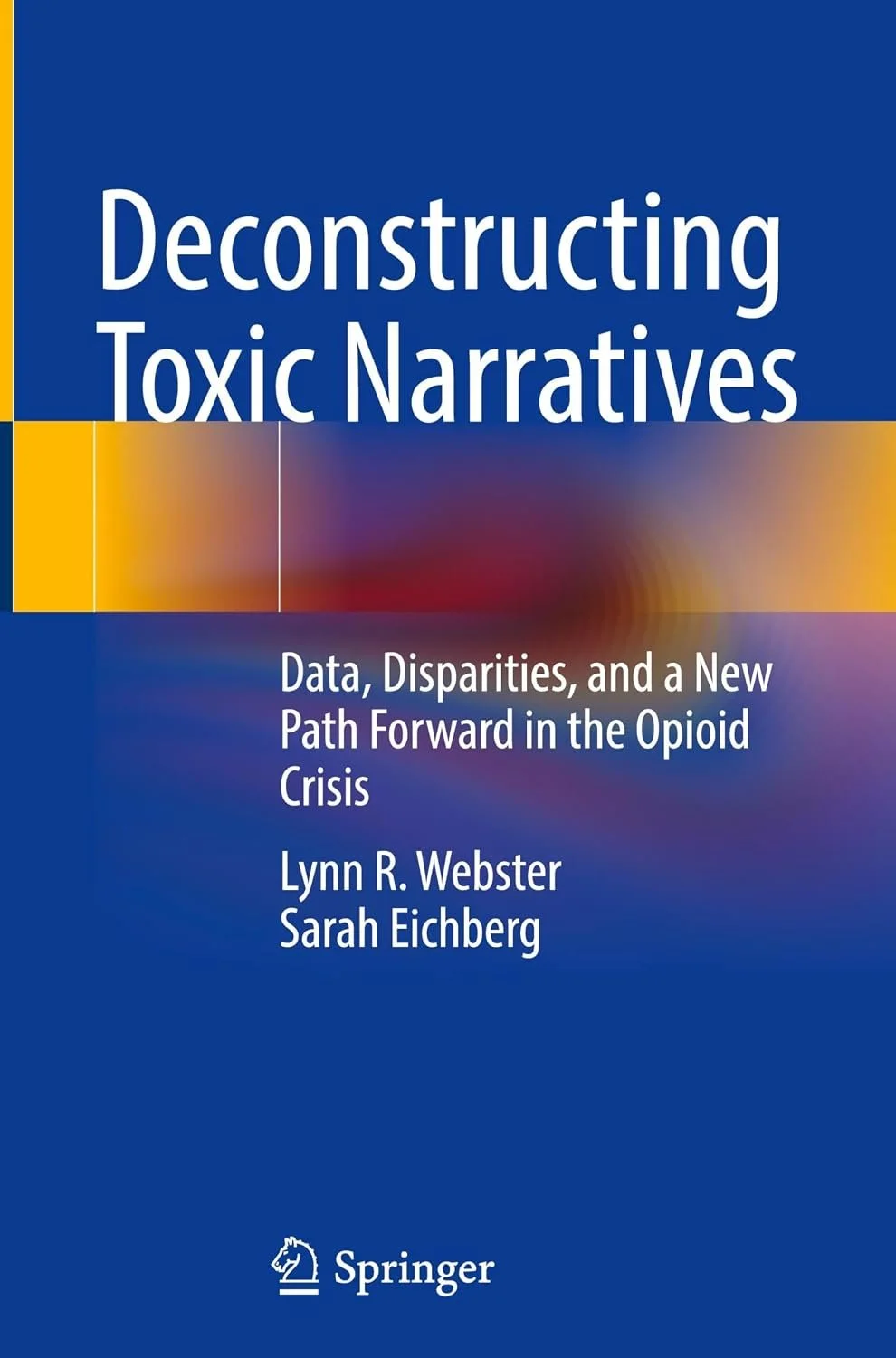
Dr. Webster and co-author Sarah Eichberg, PhD, recently released a new book called “Deconstructing Toxic Narratives: Data, Disparities, and a New Path Forward in the Opioid Crisis.”
As the name suggests, Webster and Eichberg analyze how we got to where we are today, with the pain of millions of patients going untreated, doctors reluctant to prescribe opioids, and an overdose crisis largely fueled by illicit fentanyl and stimulants, not pain medication.
Behind it all is the simple fact that many people who struggle with addiction are trying to escape from a changing and challenging world that doesn’t seem to have a place for them.
These are complex issues that have been poorly explained by the media, regulators, politicians and litigators – who all latched onto the theme that opioid pain medication was the root cause for soaring rates of addiction and overdoses.
“Everyone wanted a simple answer. And if people want a simple answer, then pharmaceutical companies are a good target and physicians are a good target, and they're pretty identifiable,” Webster told PNN. “As I write in my book, it's easier to say something that is kind of interesting, sexy, and fits a narrative that people want to believe, and then it becomes repeated without any challenge or with very little challenge. It's a simple way to address a very complex problem, which has been harmful.”
Asked to explain who was most responsible for spreading this incomplete narrative, Webster identifies two: the Center for Disease Control and Prevention (CDC), which released its disastrous opioid prescribing guideline in 2016, and Physicians for Responsible Opioid Prescribing (PROP), an anti-opioid activist group that played an influential role in the drafting the CDC guideline.
“The CDC is very much responsible for initiating the narratives. I mean, the head of the CDC said this was a physician-driven crisis exclusively, and then the Surgeon General at the same time basically was focusing on physicians and overprescribing without taking a look at the more complex part of the problem,” says Webster.
“There are other organizations, like PROP, that continued that narrative because it fulfilled their belief. I don't think most of the people in PROP intentionally meant to harm people, but it led to harm because of the incomplete story that their position took.”
‘That’s How You Make Money’
Others with financial interests took advantage of the situation, such as medical device makers and drug companies who hurriedly developed and marketed “non-opioid” pain treatments that were often more expensive and don’t work nearly as well.
“I think it really gets back to a deeper issue, which is free market capitalism and the lack of guardrails, basically free market capitalism. I call it neoliberalism, and that started back in the 1980s, primarily where the incentive is to make money,” said Webster. “The money to be made on finding an alternative to opioids was certainly an incentive to create and help sustain the toxic narrative.
“We've learned that false narratives are reinforcing to the people who want to believe them, and that's how you make money. It is not that we've been able to convey more accurate stories or truth. It is a means by which people can elevate themselves, be promoted, and make money.”
Free market capitalism also extended to the news media, which discovered that the opioid crisis was catnip for readers, viewers and listeners.
“Without a doubt, that's what's happened. There are thousands of examples where people see what was written in the Washington Post, New York Times, Time Magazine, Newsweek, anywhere, and because of the stature of those platforms, people just assume everything that they said has been researched and is accurate. But it's not,” says Webster, who adds that it was common for news organizations to conflate illicit opioids with prescription opioids, without explaining the difference.
“That was repeated in every publication that talked about this. I cannot think of an exception where they separated the two. And in fact, I remember reviewing a couple of medical journal articles for publications, academic publications, where they did the same thing.”
Webster and Eichberg’s book is deeply researched and fact-based. Chapters explore various aspects of the opioid crisis; from addiction trends, patient stigma, and the criminalization of medicine to socioeconomic factors, childhood trauma, and the CDC’s misclassification of illicit fentanyl.
In effect, they’re trying to set the record straight on decades of incomplete and inaccurate information – and hoping clinicians, researchers, journalists and public health experts will learn from a more nuanced view of the opioid crisis.
“The way in which we have been addressing it is to look at how to reduce access to drugs. That’s not going to solve the problem. The only way that we can dramatically reduce harm is for us to look upstream, to look at those factors that really contribute to the vulnerability of people,” Webster explained.
“We're at a difficult time, you know. The country is divided politically, and that feeds into almost every topic. We want to be emotionally rewarded for our anger about different things, rather than trying to understand the nuance and the truth behind a topic, and that's very, very much true with regard to addiction and pain treatment.”


