
Damaged Nerve Cells May Cause Shingles 

By Andrew Bubak

Shingles can cause pain that is notoriously difficult to manage and can last for months to years for some people. The pain can be so severe that it causes a significant decline in quality of life and can be accompanied by suicidal thoughts and emotional distress.

If the pain lasts longer than three months, doctors call the condition post-herpetic neuralgia. Because the underlying mechanisms driving this persistent pain are unknown, treatment options are centered on relieving symptoms but largely fall short. Less than 50% of patients achieve meaningful pain relief.

However, new research from my team published in the journal Annals of Neurology uncovered that microparticles circulating in the blood called exosomes may provide an explanation for some of the most puzzling features of this neuropathic pain condition as well as new targets that could lead to new treatments.

Chickenpox Virus Reawakens

The varicella zoster virus that causes chickenpox (herpes zoster) has infected over 90% of the world’s population. Most people contract the virus during early childhood in temperate regions, but in tropical regions, initial infection typically occurs later in adolescence and early adulthood.

After this first infection, the virus enters a state of dormancy within pain-sensing neurons. Even children vaccinated for varicella, such as those in the United States since 1995, still have dormant virus in their neurons, since the vaccine uses a live but weakened strain.

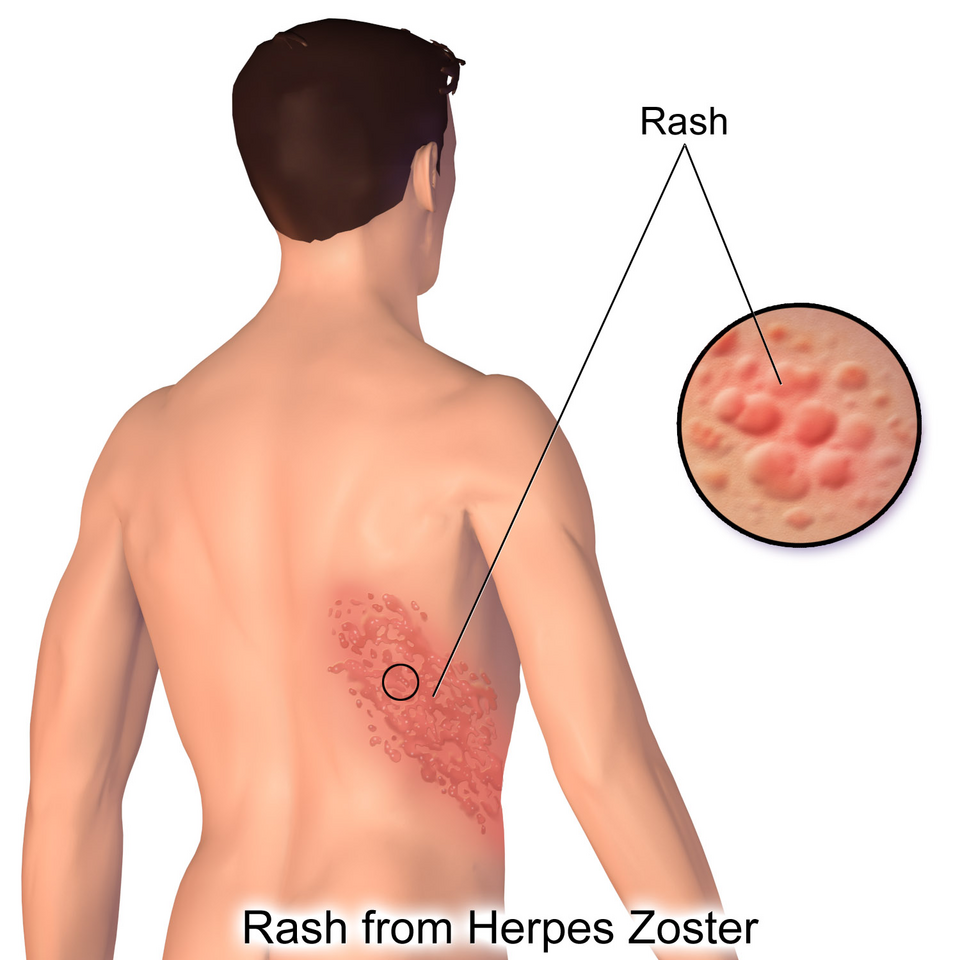
In approximately a third of the world’s population, the virus will reactivate decades later to cause the infamously painful shingles rash; for reasons yet unknown, rates of shingles are increasing worldwide. 

For most people, the pain will resolve in a couple of weeks. However, about 10% to 18% of patients will progress to post-herpetic neuralgia months after the rash has cleared. In some cases, the pain can persist for years or the rest of their lives.
While anyone who has shingles is at risk of developing post-herpetic neuralgia, the risk rises significantly with age.

Exosomes and Irritated Neurons

Researchers and clinicians do not fully understand what causes post-herpetic neuralgia. In patients with post-herpetic neuralgia, while the shingles rash has cleared with seemingly normal-looking skin, skin biopsies show a puzzling reduction in sensory nerve fibers in the painful areas. 

Counterintuitively, this decrease in nerve fibers in the skin can lead to heightened pain in many patients. What prevents these nerve fibers from repairing after the infection has cleared is unknown.

Researchers have proposed that ongoing or intermittent viral replication within sensory neurons is likely continuing to damage or kill these cells months after the virus reactivates. However, antiviral treatment that shuts down viral replication does not reliably prevent or reduce post-herpetic neuralgia. Thus, neurovirologists like me have been looking for noninfectious contributors to this condition.

In our newly published research, my team and I investigated the role that noninfectious microscopic particles circulating in the blood called exosomes may play in the development of post-herpetic neuralgia. 

Exosomes are released from every type of cell in the body. They carry bioactive cargo – material such as proteins and nucleic acids that can change a recipient cell’s behavior or specific cellular process – and shuttle them from one cell to another. This process helps cells communicate with each other and is essential for normal bodily functions.

My laboratory previously discovered that exosomes in the blood of patients with an active shingles rash can increase stroke risk and inflammation. Thus, we hypothesized that circulating exosomes in the blood of post-herpetic neuralgia patients may also be contributing to their severe pain.

My team and I isolated exosomes from the blood of seven patients with post-herpetic neuralgia and compared them to those in the blood of seven patients without the condition. The contents of the exosomes of those with post-herpetic neuralgia had significantly higher concentrations of proteins known to suppress the growth of neurons. 

Did this finding mean that patients with post-herpetic neuralgia have particles in their blood that are preventing their pain sensory neurons from fully regenerating?

To test this assumption, we exposed human sensory neurons in a petri dish to exosomes isolated from the blood of people with or without post-herpetic neuralgia. Using live-cell imaging, we tracked and measured the ability of these neurons to extend and interact with each other in the petri dish. 

As suspected, neurons exposed to post-herpetic neuralgia exosomes were significantly stunted and unable to form a strong network with other neurons. In comparison, neurons exposed to the exosomes of people without the condition saw no measurable disruptions to their function.

When we measured the genetic activity of pain sensory neurons following exposure to post-herpetic neuralgia exosomes, we found that these neurons underwent changes that actively prevent the formation of growth cones – structures neurons need to grow and repair themselves.

Furthermore, we found evidence that post-herpetic neuralgia exosomes keep pain-sensing neurons in an overactive state, rendering them hypersensitive to pain signaling.

Future of Neuropathy Treatment

Our findings suggest that targeting the underlying cause behind nerve irritation and failed regeneration could help lead to more effective treatments for post-herpetic neuralgia by targeting the source of the pain.

Furthermore, my team and I believe this phenomenon is not unique to post-herpetic neuralgia. It could likely extend to other painful neuropathies, such as diabetic neuropathy, which is also associated with failed nerve regeneration.

Currently, my team is collecting sequential blood samples for up to a year from patients with shingles who later develop post-herpetic neuralgia, as well as from patients with shingles that resolves with no lingering pain. This comparison will be crucial to determine specifically what cargo exosomes are carrying that contribute to this debilitating chronic pain condition.

Andrew Bubak, PhD, is an Associate Professor of Neurology at University of Colorado Anschutz.

He studies viral-contributions to multi-system disease states, including Alzheimer’s disease, cardio- and cerebrovascular disorders, diabetes, cancer, and pain. 

This article originally appeared in The Conversation and is republished with permission.  

Shingles and My 10-Year-Old Bottle of Vicodin      

By Cynthia Toussaint

A few years ago, a friend who’d been through a rowdy case of shingles tried to spook me.

“You of all people, Cynthia, have to get the shingles vaccine. You couldn’t go through this level of pain with all you’ve got going on,” she said.

Yeah, yeah, I thought, normies who don’t live with the flame-broiler called Complex Regional Pain Syndrome can’t hack the small stuff.

While Laura’s warning was well-intentioned, I decided to skip the shot because I’d heard it was a real ass kicker. That, and I’m already an Olympic-level pro at neuropathic pain. I’d be fine without getting the shingles vaccine.      

I bet on the wrong horse.    

In early August, a mysterious pain on the side of my left leg woke me. I’d never had aching pain that hurt so much, and rousted my partner John in alarm. Muscling through my day, the ache turned lava hot while I moaned and yelped. By bedtime, I was writhing and screaming. No position offered a smidge of relief and I ended up pretzelled against the foot board after only a couple hours of sleep.   

I couldn’t make heads or tails of this new pain. It burned something fierce like CRPS, but was unfamiliar. Terrified, I pointed out to John the places on my thigh where piercing pain, like striking arrows, were erupting. Worse, there was a “hatchet” in my groin.

42 years into CRPS, could this be a different kind of pain rearing its ugly head? The new version came complete with a high fever and wipe-out fatigue.

No amount of my old standby’s – rest, heat, distraction, kitty cuddling – offered relief. In fact, the pain kept amping higher, rendering me useless.

Soon, a bright-red, ghoulish rash appeared and began to spread by the hour. It felt like I was starring in my own horror film, with no pause button on the remote.

The next day, it hit me. This is goddamn shingles and I scooted off to an immediate care clinic.

I was disappointed to get a young male doctor and, true to form, he dismissed my symptoms by announcing that I’d burned myself with a heating pad. His only advice was for me to take a picture of the rash for reasons unknown. 

That night, while the rash continued to march on, the redness turned to bubbling blisters, and the next day I found myself back at immediate care.   

This time at the clinic I hit the jackpot, as a skilled and caring female doctor took about three seconds to diagnose shingles. Livid over the previous day’s dismissal, as treatment time was now of the essence, she instructed me to immediately pick up anti-viral medication and start them as soon as I got home.

Before leaving the room, she gave me a major fright. She looked into my eyes and told me that my shingles might become chronic, especially with my long CRPS history. At that moment, I had no doubt I was in for a world of unchartered hurt.                

For the next two months, except for doctor appointments, I lived between my bed and the couch, surviving one minute at a time. The blisters spread from the top of my thigh down to my knee, and up onto my left buttocks. Mixed with exquisite pain were patches of numbness, and my dermatologist gently warned that this might indicate nerve death.        

My allodynia was so severe I couldn’t bear anything touching the rash, and the never-ending pain kept me awake nights. I despised hearing from doctors, again and again, that I had the worst case of shingles they’d ever seen. Their biggest concern was that the rash would spread to my right side, in which case they suspected it would travel to my eyes and I’d likely lose my sight.   

Vicodin to the Rescue

The pain got so bad, John pleaded with me to take a Vicodin from a 10-year-old bottle he’d asked me to keep, just in case. In the past, this was unthinkable as my primary physician warned me that, due to being on a benzodiazepine, combining both medications might suppress my breathing. Despite that, I didn’t hesitate and got my first taste of blessed relief.

Soon my frantic pain doctor directed me to up my dose to four 5mg Vicodin tablets a day. Scared due to being opioid-naïve, I went on three instead. I could survive the pain then, but had zero quality of life. During this miserable time, I gulped laxatives to keep the pipes flowing, and for 10 days hobbled no further than our condo balcony. I was slowly cancelling my life and couldn’t even tolerate a visitor.

I ruminated over worst case scenarios. What if my pain stays chronic at a level ten? Also, my dermatologist told me I might be scarred forever.

Even if my pain improves, could I ever show my disfigured leg in public? Upon seeing the angry rash, my sister-in-law innocently chirped, “You can’t get in the pool with that, Cynthia. It’ll frighten the other swimmers.” I knew she was right and wanted to sob.

Mercifully, in the last month, the pain and rash (four tubes of scar gel and counting!) started to retreat, bit by bit. With great trepidation, I successfully weaned off the Vicodin, but sure enough, I’m left with post-herpetic neuralgia, the chronic pain I so dreaded.

While my numbness and allodynia are improving, the hatchet pain in my groin hasn’t dissipated. I’m over-the-moon happy to be swimming again with no problem, but for the first time this former ballerina is less than limber on her left side, which makes Pilates and Feldenkrais movement therapy formidable challenges.

While there are no guarantees, I remain optimistic for total healing because I take such good care of my body and mind. Three cheers for self-care!

Hands down, shingles at its apex was the worst pain experience of my life, and because of my CRPS, it was far, FAR worse than what a healthy person would have experienced. My doctors and I suspect the immunotherapy I took for cancer care over two years ago played a major role in getting shingles now, as it’s been the root of three prior serious pain complications.                   

While I can’t go back in time and take Laura’s sage advice about getting the almighty shingles vaccine, I can share my cautionary tale in hopes you’ll do so. With a caveat, I shuddered to learn the vaccine – which I’ll be getting in February – isn’t full proof. Inoculated folk can still get shingles, but those cases are rare and usually less severe, which is especially beneficial for those already wrangling with neuropathic pain.          

While I’m slowly moving my shingles nightmare (albeit with PTSD) into the rearview mirror, I’m haunted by a horrific question. Because my pharmacy refused to fill my pain doctor’s new prescription for Vicodin, what would have happened to me if not for my 10-year-old bottle?

In the grips of the worst pain and torture I’ve ever experienced and the absolute hopelessness of relief, in desperation what might I have done?

I don’t know, but am glad as hell I didn’t have to find out. My god, where is the mercy for people with pain?

Cynthia Toussaint is the founder and spokesperson at For Grace, a non-profit dedicated to bettering the lives of women in pain. She has lived with Complex Regional Pain Syndrome (CRPS) and multiple co-morbidities for over four decades, and has been battling cancer since 2020. Cynthia is the author of “Battle for Grace: A Memoir of Pain, Redemption and Impossible Love.”