
Trump Administration Takes Credit for Reducing ‘Unnecessary Opioid Prescribing’
/By Pat Anson
Just days before the midterm elections, the Trump administration is taking full credit for a recent decline in drug overdoses, while linking it to steep cuts in opioid prescribing.
“President Trump has attacked the opioid crisis from every direction — rightsizing opioid prescribing, disrupting the fentanyl supply chain, and expanding treatment and recovery,” Health and Human Services Secretary Robert F. Kennedy, Jr. said in a HHS press release.
“Those actions are saving lives and driving opioid deaths to the lowest in nearly a decade. We will keep pressing forward until every American struggling with addiction has a real path to recovery and a chance to rebuild a healthy life.”
While it’s not unusual for any administration to exaggerate its accomplishments during a political campaign, the HHS press release is particularly misleading. It cites two recent reports showing the U.S. death rate is now the “lowest ever reported” and attributes much of that decline to a reduction in "unnecessary opioid prescribing.”
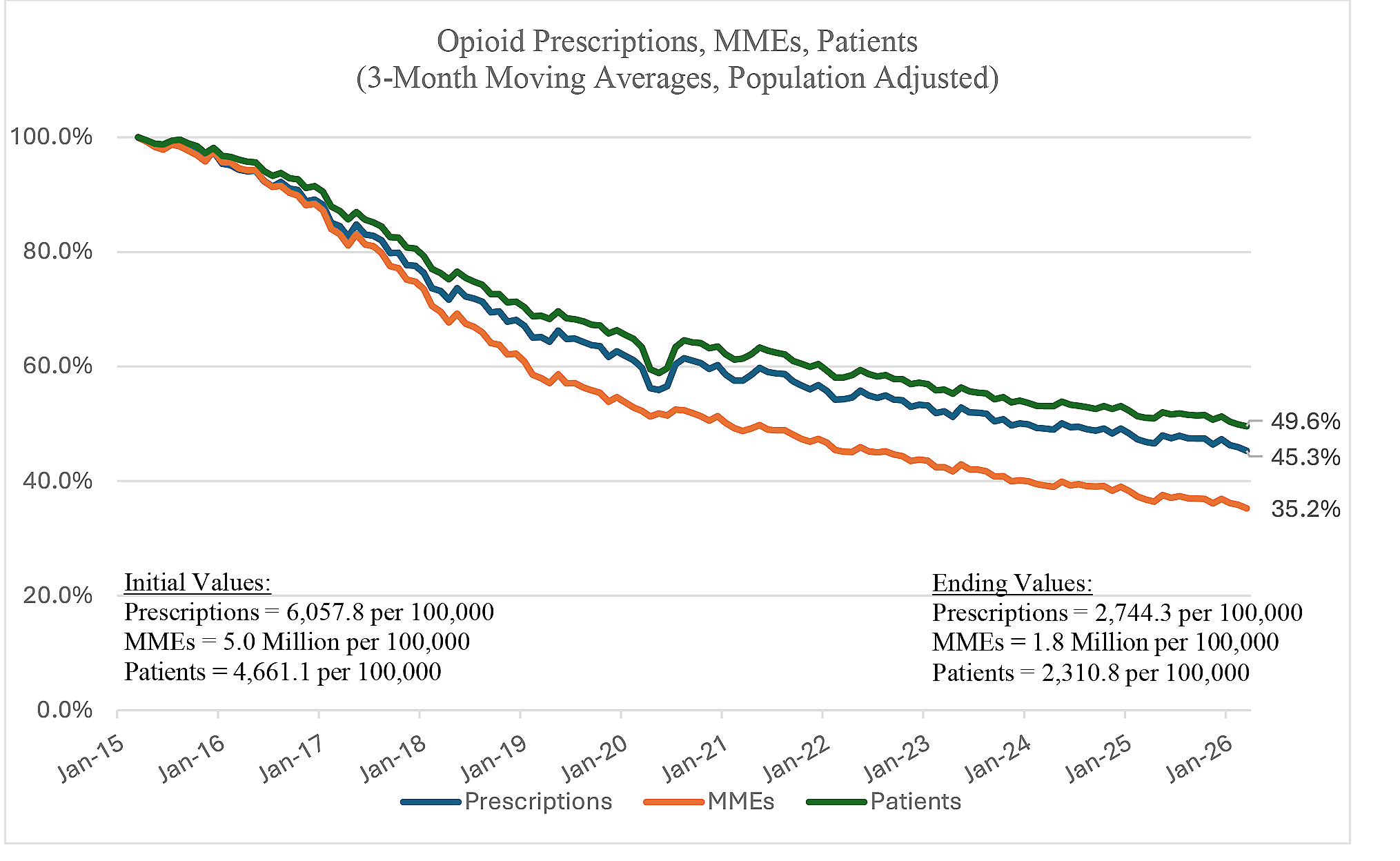
Since 2015, the number of patients getting opioid prescriptions at retail pharmacies has been cut in half, while opioid prescriptions have fallen by over 45 percent and the strength of opioid dosages in morphine milligram equivalents (MME) has dropped by 35 percent.
HEALTH AFFAIRS
While acknowledging “the possibility” that some pain patients may have been harmed by cuts in opioid prescribing, federal health officials say the reduced supply of opioids has been beneficial for the rest of the population.
“In sum, fewer people are using prescription opioids, and those who do are exposed to smaller doses on average. This does raise the possibility that some people may be undertreated for pain. But several studies suggest that, in general, reduced opioid prescribing is associated at the population level with health benefits,” a team of HHS staffers wrote in an op/ed published in the journal Health Affairs.
Critics say it's wrong to take a “victory lap” for reduced prescribing when millions of people who lost access to opioids suffer from poorly treated pain.
“The decline in overdose deaths is welcome news. Every life saved matters. But I find it difficult to understand how anyone can celebrate our current situation as a public health success,” said Dr. Lynn Webster, a pain management expert and Senior Fellow at the Center for U.S. Policy
“Evidence suggests that aggressive opioid tapering and discontinuation have been associated with increased risks of overdose and mental health crises among patients receiving long-term opioid therapy. We must not ignore the possibility that some prescribing restrictions have contributed to harm rather than prevented it.”
In addition to poorly treated pain, Webster says millions of people live with addictions that are going untreated. He cites a recent study showing that only 15.7% of people with opioid use disorder (OUD) receive medications for their condition.
“Real progress should be measured not only by how many fewer people die, but by how many receive effective treatment, have access to mental health care, can obtain life-saving naloxone, and find relief from the underlying conditions that contribute to substance use disorders,” Webster told PNN,
“We should not be congratulating ourselves while tens of thousands continue to die and millions remain without treatment. The appropriate response is not a victory lap. It is a renewed commitment to addressing the causes of addiction and preventing avoidable deaths.”
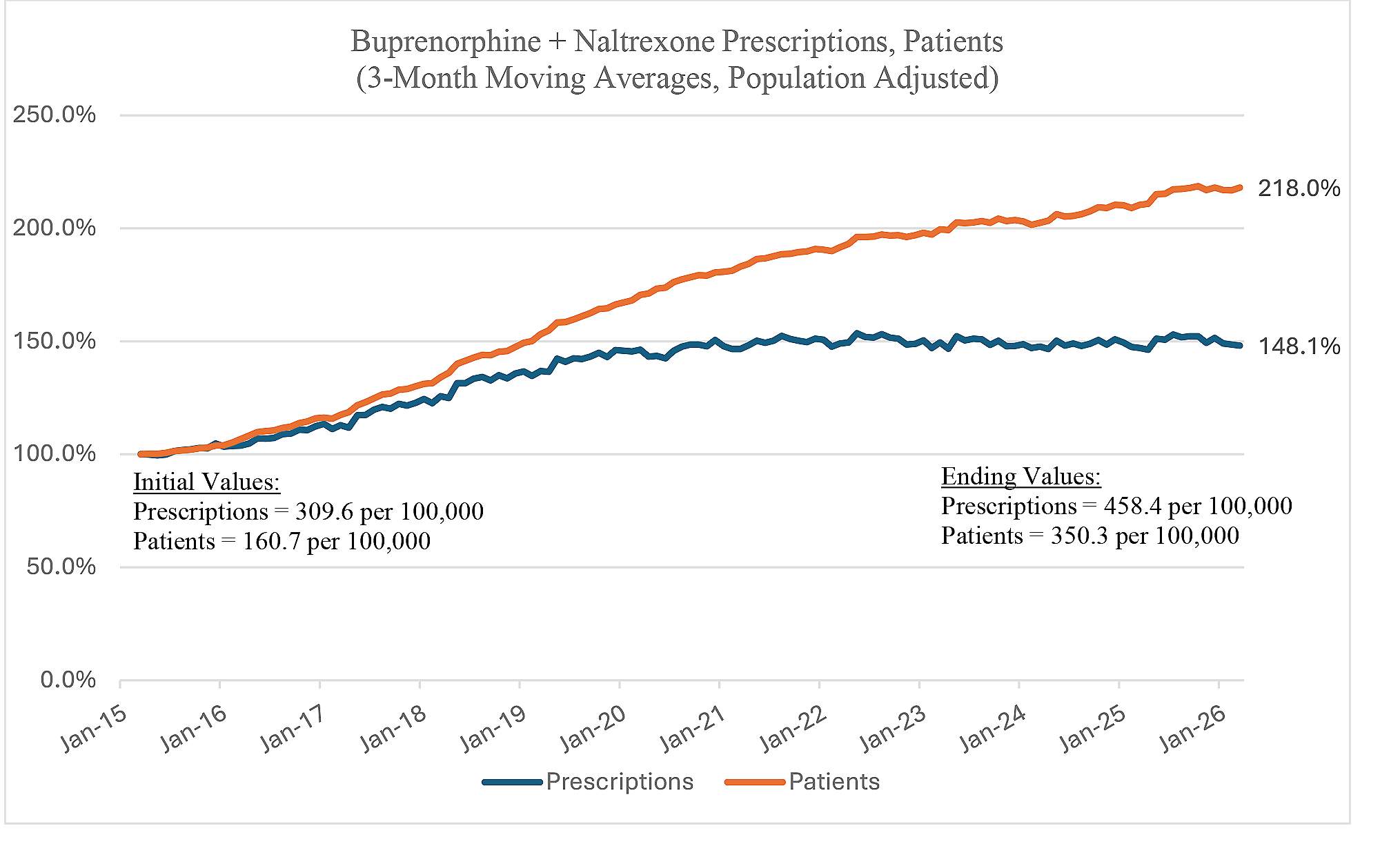
The Health Affairs op/ed shows the number of patients taking OUD medications like buprenorphine (Suboxone) and naltrexone has increased by 218% since 2015. But federal health officials admit the growth has been uneven in recent years, when “patient counts rose much faster than prescription counts.”
HEALTH AFFAIRS
Reductions in the U.S. opioid supply began under President Obama in 2016, with the release of the CDC opioid guideline and the first cuts in opioid production quotas by the DEA. But there is no mention of that in the HHS press release. The opioid cuts are instead attributed to President Trump’s first term, which began in 2017.
“His Administration also pursued a plan to reduce nationwide opioid prescription fills by one-third within three years. In 2018, the Justice Department and DEA proposed lowering 2019 manufacturing quotas for six frequently misused opioids by an average of 10%. Together, these policies led to the first reduction in drug-related deaths in nearly three decades.”
Here again, the tendency is to equate reduced opioid prescribing with a decline in overdose deaths. A recent analysis points to how wrong that is. It found that most overdose deaths in 2024 involved illicit fentanyl and other synthetic opioids (60%), while prescription opioids were linked to only 13.6% of overdoses.
Another recent study ranked illicit fentanyl as the most harmful drug in the United States, followed by methamphetamine, crack, heroin, alcohol, and cocaine. Prescription opioids ranked as the 7th most harmful drug.
“We should reject the unsupported narrative that reductions in prescription opioid dispensing explain the recent decline in overdose deaths. Opioid prescribing has fallen dramatically for more than a decade, while overdose deaths rose to unprecedented levels. The recent decline is largely associated with fewer deaths involving illicit fentanyl, not prescription opioids,” says Webster.
Also unmentioned in the HHS press release is that the Trump administration will soon classify 7-hydroxymitragynine (7-OH) and other concentrated kratom alkaloids as illegal Schedule One controlled substances.
Although federal health officials consider 7-OH and synthetic alkaloids to be opioids, users of those products worry that banning them will only worsen the opioid crisis by forcing them to seek pain relief on the black market.
“Those who keep using 7-OH anyway will not be safer,“ said Jeff Smith, National Policy Director for the Holistic Alternative Recovery Trust (HART), a 7-OH advocacy group. “Instead, it will push consumers toward unregulated supply chains, unknown products, and sellers no regulator can inspect.”