U.S. Overdose Deaths Down Significantly

By Pat Anson

The number of fatal drug overdoses fell sharply in the U.S. in 2024, led by a significant decline in deaths involving illicit fentanyl, according to a new analysis.

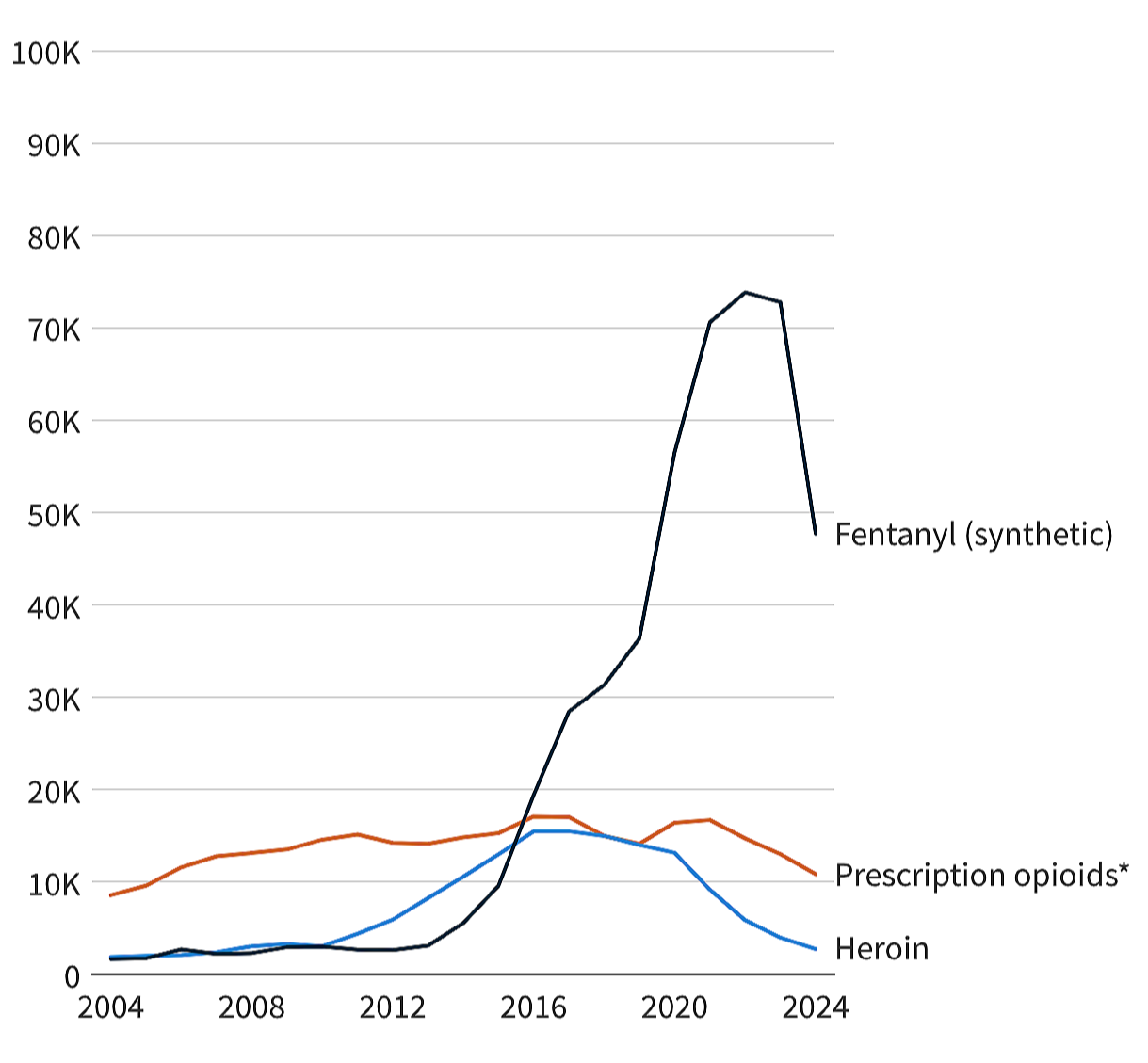
Over 79,000 Americans lost their lives to a drug overdose in 2024, compared to 105,000 in 2023, a 24.5% decline in one year. Over 54,000 of the deaths in 2024 involved an opioid of some kind. 

The analysis by KFF further demonstrates the declining role of prescription opioids in the nation’s drug crisis. Prescribed opioids are now involved in about one in seven (13.6%) drug overdoses. 

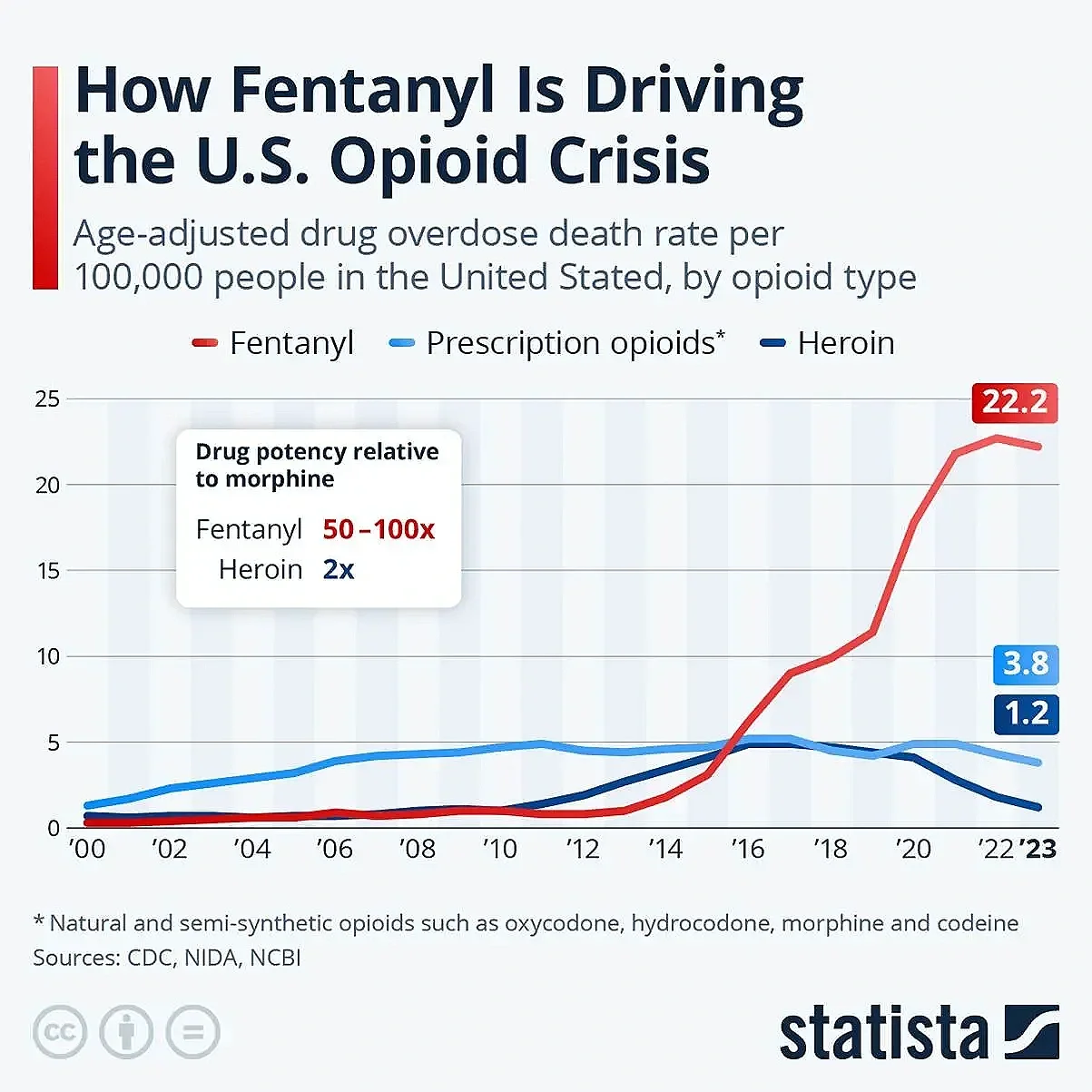
In 2024, 10,851 Americans died from an overdose involving a natural or semi-synthethic prescription opioid, compared to 47,735 deaths involving synthetic opioids, mostly illicit fentanyl. 

Deaths from prescription opioids peaked at 17,029 in 2017 and have steadily declined.

U.S. Opioid Overdose Deaths 2004-2024

SOURCE: KFF

“Since the opioid epidemic was declared a public health emergency in 2017, it has claimed more than half a million lives. While the epidemic was initially driven by prescription opioids and heroin, it has evolved in recent years, to be dominated by illicit synthetic fentanyl — a substance significantly more potent than morphine,” KFF said. “Provisional CDC data suggest opioid deaths have continued to decline through 2025.”

The KFF analysis also looked at deaths involving alcohol, suicide and firearms.

In 2024, 48,824 American lives were lost to suicide, down slightly from the previous year. Firearms accounted for 57% of those deaths. There were 46,714 “alcohol-induced” deaths in 2024 caused by health conditions attributed to excessive alcohol use.

Those deaths greatly outnumber fatal overdoses involving prescription opioids.

U.S. Deaths in 2024

Source: KFF

As PNN has reported, a recent study ranked alcohol as the 5th most harmful drug In the United States, behind illicit fentanyl, methamphetamine, crack and heroin. Prescription opioids ranked as the 7th most harmful drug in the U.S.

The analysis not only looked at the direct harm to drug users, but the indirect harm to families, communities and society at large caused by excessive drug use.

A panel of experts said the analysis shows how misdirected U.S. drug policy is, which is focused on crime and punitive measures to stop drug use, rather than public health measures to address substance use disorders. Criminalizing drug use may also be making the drug crisis worse, by taking legal drugs away from people who benefit from them.   

“All drugs have benefits to people who use them at least initially, and some may have ongoing benefits. For legal drugs, there may be social benefits like employment in related industries and taxation to fund public services,” the panel concluded.

“Redirecting resources towards harm reduction may reduce social harms by reducing the economic cost of policing and surveilling people who use drugs. Concurrently, PWUD (people who use drugs) could remain contributing members of their families and communities.”

Weight Loss Drugs May Help Fight Addiction 

By Dr. Ziyad Al-Aly 

A patient of mine, a veteran who had tried to quit smoking for over a decade, told me that after he started a GLP-1 drug for his diabetes, he lost interest in cigarettes. He didn’t use a patch. He didn’t set a quit date. He simply lost interest. It happened without effort.

Another patient on one of these drugs for weight loss told me that alcohol had lost its pull – after years of failed attempts to quit.

People struggling with many addictions, ranging from opioids to gambling, are reporting similar experiences in clinics, on social media and around dinner tables. None of them started these drugs to quit. This pattern of people losing their cravings across a broad range of addictive substances has no precedent in medicine.

But my patients were giving me an important clue. People taking GLP-1 drugs often talk about “food noise” vanishing: the constant mental chatter about food that dominated their days simply goes quiet. But my patients were reporting that it wasn’t just food: They were noticing that the preoccupation with smoking, drinking and using drugs that drives people back despite their best intentions to stop was going quiet too.

As a physician whose patients are often on GLP-1 drugs, and as a scientist who works on answering pressing public health questions from long COVID to medication safety – I saw a problem hiding in plain sight: Many addictions have no approved treatment.

The few medications that exist are massively underutilized, and none works across all substances. The idea that a drug already taken by millions might do what no addiction treatment has done before was too important to ignore.

My team and I set out to test whether GLP-1 drugs – medications like semaglutide (Ozempic and Wegovy) and tirzepatide (Mounjaro and Zepbound), originally developed for diabetes and then approved for obesity – could do what no existing addiction treatment does: curb craving itself.

Our evidence strongly suggests they can.

Reduced Cravings

The hormone that these drugs mimic – GLP-1 – is not only produced in the gut. It is also active in the brain, where the receptors it binds to cluster in regions governing reward, motivation and stress – the same circuitry that gets hijacked by addiction

At therapeutic doses, GLP-1 drugs cross the blood-brain barrier and dampen dopamine signaling in the brain’s core reward center, making addictive substances less rewarding.

GLP-1 drugs seem to inhibit cravings for several different substances in multiple animal models. For instance, rodents given GLP-1 drugs drink less alcohol, self-administer less cocaine and show less interest in nicotine

When researchers gave semaglutide to green vervet monkeys – primates that voluntarily drink alcohol much like humans do – the animals drank less without showing signs of nausea or changes in water intake. This suggests the drug lowered the reward value of alcohol rather than making the animals feel sick.

Fewer Overdoses

To find out whether these drugs have a similar effect on people, we turned to the electronic health records of more than 600,000 patients with Type 2 diabetes at the U.S. Department of Veterans Affairs – one of the largest health care databases in the world.

We designed a study that applied the rigor of randomized controlled trials – the gold standard in medicine – to real-world data. We compared people who started GLP-1 drugs to people who did not, adjusting for differences in health history, demographics and other factors, and followed both groups for three years.

My team and I asked two questions: For people already struggling with addiction, did the drugs reduce overdoses, drug-related hospitalizations and deaths? And for people with no prior substance use disorder, did GLP-1 drugs reduce their risk of developing one across all major addictive substances: alcohol, opioids, cocaine, cannabis and nicotine?

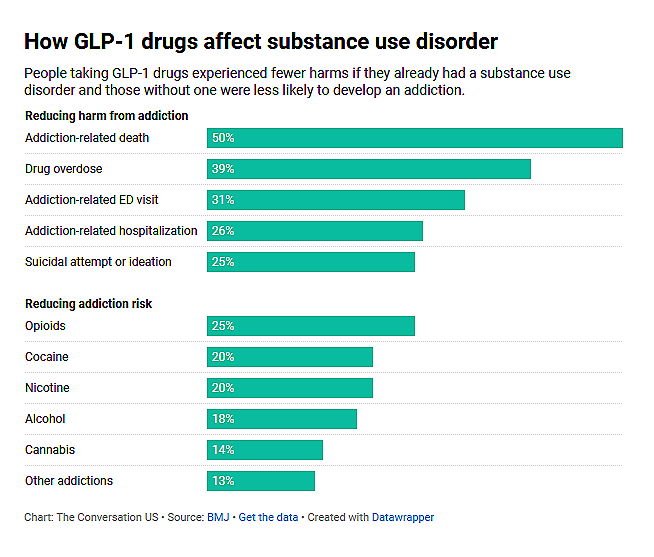
What we found was striking. In the group already struggling with addiction, there were 50% fewer deaths due to substance use among those taking GLP-1 drugs compared with those who were not. We also found 39% fewer overdoses, 26% fewer drug-related hospitalizations and 25% fewer suicide attempts. Over three years, this translated to roughly 12 fewer serious events in total per 1,000 people using GLP-1 drugs – including two fewer deaths.

Reductions of this magnitude are rare in addiction medicine – and what’s remarkable is that the finding came from drugs initially designed for diabetes, later repurposed for obesity and never intended to treat addiction.

The drugs also appeared to prevent addiction from developing in the first place. Among people with no prior substance use disorder, those taking GLP-1 drugs had an 18% lower risk of developing alcohol use disorder, a 25% lower risk of opioid use disorder and an approximately 20% lower risk of cocaine and nicotine dependence. Over three years, this translated to roughly six to seven fewer new diagnoses per 1,000 GLP-1 users.

With tens of millions of people already using GLP-1 drugs, the reductions in deaths, overdoses, hospitalizations and new diagnoses could translate into thousands of prevented serious events each year.

Our findings align with a growing body of evidence.

A Swedish nationwide study of 227,000 people with alcohol use disorder found that those taking GLP-1 drugs had 36% lower risk of alcohol-related hospitalizations. This is more than double the 14% reduction that the same study found with naltrexone, which was the best-performing medication approved for treatment of alcohol use disorder in that analysis.

Other observational studies have linked GLP-1 drugs to lower rates of new and recurring alcohol use disorder, reduced diagnoses and relapse in cannabis use disorder, fewer health care visits for nicotine dependence and lower risk of opioid overdose.

Meanwhile, randomized controlled trials that directly test whether these drugs help people with addiction also show promise. In one trial, semaglutide reduced both craving and alcohol consumption in people with alcohol use disorder. In another, dulaglutide reduced drinking. More than a dozen additional trials are already underway or actively enrolling, and several more are planned.

The Future of Addiction Treatment?

GLP-1 drugs are the first type of medication to show potential benefit across multiple substance types simultaneously. And unlike existing addiction medications, which are prescribed by specialists and remain vastly underused, GLP-1 drugs are already prescribed at enormous scale by primary care doctors. The delivery system to reach millions of patients already exists.

The consistency of GLP-1 effectiveness across alcohol, opioids, cocaine, nicotine and cannabis suggests these drugs may act on a shared vulnerability underlying addiction – not on any single substance pathway. If confirmed, that would represent a fundamental shift in how society understands addiction and how doctors treat it.

Some unanswered questions remain, though, about how these drugs would affect addiction. Many people who take GLP-1 drugs to treat obesity or diabetes discontinue them; afterward, their appetite typically returns and they regain the weight they lost.

Whether the same rebound would occur with addiction, and what it would mean for someone in recovery to face the roar of craving again, is unknown. Nor is it clear whether the benefits persist over years of continuous use, or whether the brain adapts in ways that dampen those effects.

Also, because GLP-1 drugs engage the brain’s reward circuitry – the same system that governs not just craving but everyday motivation – prolonged use could, in theory, dampen motivational drive in some people. Whether that might affect real-world outcomes, such as initiative, competitive drive or performance at work, remains an open question.

GLP-1 drugs have not been approved for addiction, and there is not yet enough evidence to prescribe them solely for that purpose. But for millions of people already weighing whether to start a GLP-1 drug for diabetes, obesity or another approved indication, it is one more factor worth considering.

A patient living with diabetes who is also trying to quit smoking might reasonably choose a GLP-1 drug over another glucose-lowering medication, not because it is approved for smoking cessation, but because it may help them quit, a benefit that other diabetes drugs do not offer. Similarly, for people living with obesity who also struggle with alcohol, the potential for benefit beyond weight loss could be one more reason to consider a GLP-1 drug.

If additional trials confirm that they effectively curb cravings across addictive substances, these drugs could begin to close one of the most consequential treatment gaps in medicine. And the most promising lead in addiction in decades will have come not from a deliberate search but from patients reporting a benefit no one anticipated. Like my patient who quit smoking after a lifetime of trying, it happened without effort.

Ziyad Al-Aly, MD, is a Clinical Epidemiologist at Washington University in St. Louis. He also directs the Clinical Epidemiology Center, and serves as the Chief of Research and Development Service at the VA Saint Louis Health Care System. 

This article originally appeared in The Conversation and is republished with permission.

California Leads Crackdown on Kratom and 7-OH

By Pat Anson

California isn’t waiting for the federal government to classify a potent synthetic form of kratom as an illegal drug. In fact, it’s going a step further.

The California Department of Public Health (CDPH) is warning consumers that products containing kratom or the alkaloid 7-hydroxymitragynine – known as 7-OH -- are illegal to sell or manufacture in the state. In recent months, six fatal overdoses linked to 7-OH have been reported in Los Angeles County, although alcohol, medication and illicit substances were also involved in those deaths.

7-OH occurs naturally in kratom in trace amounts, but some retailers are selling concentrated synthetic versions of 7-OH that boost its potency as a pain reliever and mood enhancer.

In July, the FDA said it would ask the DEA to classify 7-OH as an illegal Schedule One controlled substance, but specifically noted that the move was “not focused on natural kratom leaf products.” 

California health officials are focused on both, claiming natural kratom and 7-OH cannot legally be marketed or sold in the state as drugs, dietary supplements or food additives. In recent weeks they’ve been removing kratom and 7-OH products from retail outlets and manufacturing locations across California.  ​

“We are still finding kratom and 7-OH products for sale in gas stations, smoke shops, online and other retailers. While these products are sometimes marketed as natural remedies, they are dangerous and can result in fatal overdoses,” Dr. Erica Pan, CDPH Director and State Public Health Officer, said in a statement. “The best way to protect yourself is to avoid using 7-OH and kratom-related products.”  

7-HOPE Alliance, a nonprofit that advocates for continued sales of 7-OH, calls the crackdown “unlawful” because there is no California or federal law that bans kratom or 7-OH.

“This is government overreach at its worst,” Jackie Subeck, founder of 7-HOPE Alliance, said in a statement. “When the FDA is already under fire from both Democrats and Republicans for politicizing science, from vaccines to dietary supplements, it’s reckless for California to take cues from them without peer-reviewed evidence and taking action that will put lives at risk.”

Alabama, Arkansas, Indiana, Rhode Island, Vermont and Wisconsin have already classified natural kratom as a controlled substance. Dozens of cities, counties and local jurisdictions have also banned its sale. In August, Florida classified synthetic 7-OH as an illegal controlled substance.

Ohio’s governor recently sought to have all forms of kratom and 7-OH banned in his state, but postponed action after reportedly getting a call from HHS Secretary Robert F. Kennedy Jr.

In 2016, the DEA and FDA tried unsuccessfully to classify 7-OH and the kratom alkaloid mitragynine as illegal drugs, only to drop those efforts after a public outcry. A top federal health official later said the FDA withdrew its scheduling request because of “embarrassingly poor evidence & data” about the harms posed by kratom.

“Policymakers across the spectrum have questioned whether the current FDA can be trusted to put science over politics,” said Subeck. “Californians deserve the medical freedoms that they were promised. Not fear campaigns and knee-jerk bans.”

Kratom and 7-OH are not even mentioned in the DEA’s 2025 National Drug Threat Assessment, an annual report that highlights threats to public health posed by illicit drugs.

Kratom products are usually sold as powders, tablets, shots, capsules and gummies. Consumers typically take them to relieve pain, anxiety, depression or withdrawal symptoms from other substances.

Critics call kratom “gas station heroin” and often claim it’s an opioid. But kratom actually comes from a tropical tree native to southeast Asia that belongs in the same botanical family as coffee. Natural opioids are derived from poppy plants, not kratom.

Like coffee, cheese, chocolate and many other food items, kratom acts on nerve receptors in the brain that trigger the release of endorphins and other “feel good” hormones that relieve pain naturally and have other opioid-like effects. Kratom’s effects are usually mild, depending on the amount consumed.

How Trump’s False Claim That 300 Million People Died From Drugs Impacts Pain Patients

By Crystal Lindell

President Donald Trump recently claimed that "300 million people died” from drug-related causes last year.

If that were true, it would mean that nearly the entire population of the United States – 342 million people –  died from a drug overdose in 2024.

Trump’s claim is so absurd, that it’s difficult to know what he was trying to say or what he may have meant.

The comment came during a Q&A with reporters, when he was asked about the U.S. strike on a supposed drug-smuggling boat off the coast of Venezuela, an attack the president of Venezuela called "illegal."

"What's illegal are the drugs that were on the boat and the drugs that are being sent into our country. And the fact that 300 million people died last year from drugs. That's what's illegal," Trump said.

In a community note on X/Twitter, the site’s fact checkers noted that 62 million people worldwide died from all causes in 2024, which “makes it impossible for 300 million people to have died of one single cause.” 

Obviously, the real numbers for drug-related deaths are significantly lower than 300 million. In reality, there were about 80,000 U.S. overdose deaths in 2024. Globally, 600,000 deaths were attributed to drug use in 2019, the most recent data available.

The World Health Organization reported there are 3 million deaths annually due to alcohol and drug use. But a majority of those — 2.6 million — were attributed to alcohol consumption.

So, Trump may have seen the “3 million” and misremembered it as "300 million," while also ignoring the fact that most of those deaths were related to alcohol.

It’s also possible he meant 300-thousand drug deaths. The president has actually used that number in the past, while adding that he doesn’t believe the overdose numbers the government produces. .

“We don’t want drugs killing our people. I believe we lost 300,000. You know, they always say 95, 100,000. I believe they’ve been saying that for 20 years. I believe we lost 300,000 people last year,” Trump said earlier this month. 

Regardless of where the “300 million” statistic came from, it’s troubling that Trump said it at all, and that there was little correction from the media. There also doesn’t seem to have been any correction from the White House, as far as I can tell.

Slips like this aren’t just annoying, they have very real implications – especially for pain patients – who already know what happens when prescription opioid deaths are exaggerated. The supply of opioid pain medication gets cut.

When people hear it from the president or White House, it carries weight. 

The Trump administration is not alone in this. In 2016, during the Obama administration, the CDC and the White House Office of National Drug Control Policy released three different estimates in one week on the number of Americans that died from prescription opioids. The numbers ranged from a low of 12,700 to a high of 17,536 deaths in 2015.

Aside from the fact that it literally impacts government policies, the wildly inflated numbers also affect how people respond to them in their day-to-day lives..

While medical professionals and policy makers might recognize that “300 million” or “300 thousand” deaths is an exaggeration, they also may assume that it can’t be that too far off if the president is saying it. 

Such a toll would be catastrophic and signal that the U.S. overdose crisis is getting worse, when the actual number of drug deaths is declining.

This false information perpetuates the idea that all opioids, both legal and illegal, are an extremely deadly problem and need to be restricted.  

Then, when a doctor who saw the clip of Trump on the news goes to treat a patient, he may think twice before writing a hydrocodone prescription because he vaguely remembers something about millions of people overdosing.

Loved ones of patients in pain can also be negatively swayed by such fake statistics. For example, say a mother is prescribed 5 mg doses of Norco for cancer pain. Their adult child may assume that even such a low dose has the potential to be deadly, because of what the president said, and they may discourage their mom from taking it.

Ideally, the White House Communications Office would issue some sort of correction of Trump’s statement. But seeing how this happened a few days ago, and they have yet to address it, I assume such a correction is unlikely to ever happen. And they’re hoping we’ll all forget about it.

Any single drug-related death is too many, and we absolutely should be looking into policies that address overdoses in ways that are proven to help. But when advocates have to instead spend time combating misinformation, it just takes time and resources away from the real problem.

Opioids do cause deaths, but they also give millions of people their lives back by alleviating their pain and allowing them to actually function. 

When we only focus on one side of the equation — especially when that focus is marred by widely inaccurate information — the result is just more pain and suffering.

Are 1 in 10 Americans Really Using Illicit Opioids?

By Crystal Lindell

A new study claims to have found that nearly 11% of Americans reported using illicit opioids in 2024, with 7.5% of them using illicit fentanyl.

It's a startling claim, in large part because those numbers are significantly higher than what's been reported in previous research. When the National Survey on Drug Use and Health asked about illicit fentanyl use in 2022, they found that just 0.3% of American adults used it in the past year

The study by researchers at the RAND corporation and USC led to a number of splashy headlines, including one in U.S. News and World Report reading: "U.S. Illicit Opioid Use Could Be 20 Times Higher Than Previously Estimated"

That is indeed a pretty striking claim – which is a large reason I am so skeptical of the research.

How did the study authors arrive at those figures? They developed and fielded a survey with Respondi, an online platform often used in academic research. So essentially, they did an online survey of 1,515 adults.

Participants were asked about their use of nonprescription opioids within the past 12 months, with heroin and illicitly manufactured fentanyl given as examples.

Among the respondents, they found that 166 (10.96%) reported illicit opioid use and 114 (7.5%) said they used illicit fentanyl. 

While I understand that population data is often collected with a relatively small sample size, it feels rushed to claim that 7.5% of adults used illicit fentanyl based on responses from 114 people in an online survey.

It feels equally rushed to claim that because 166 people reported illicit opioid use, that must mean that 11% of the population did so. 

There are about 262 million adults in the United States. If those survey numbers are accurate, that would mean 19.7 million Americans are using illicit fentanyl. And 28.8 million are using illicit opioids. That’s a lot of people. 

Overdose Deaths Declining

Keep in mind that the CDC just reported that U.S. overdose deaths fell by nearly 27% in 2024, the largest annual decline since they started tracking overdoses 45 years ago. 

Of the 80,391 drug deaths reported in 2024, the CDC estimates that 48,422 of those deaths involved synthetic opioids, primarily fentanyl. That’s nearly 28,000 fewer fentanyl deaths than the year before.

How can fentanyl deaths be declining when so many Americans claim they used the potent and often deadly street drug?     

The numbers just don’t add up. They suggest that illicit fentanyl isn’t nearly as dangerous as we’ve been led to believe, although I doubt that that’s the point the study authors were hoping to make. 

The RAND and USC researchers say their findings add to evidence that the CDC may significantly underestimate illicit drug use and that new methods are necessary to keep better track of them.  

“Estimates of illicit opioid use are rare and typically are available only years after the information is collected, limiting our ability to monitor trends on a near-term basis,” says lead author David Powell, PhD, a senior economist and Professor of Policy Analysis at RAND. “Our study offers a method to quickly and repeatedly monitor illicit opioid prevalence at low cost.”

All of this matters because studies like this are often used to punish people who use any opioids – both legal and illegal. 

For example, if 11% of the population truly is using illicit opioids, then the medical community may use that statistic to claim that opioid prescribing is still too high and that too many prescription opioids are finding their way onto the black market. 

They might also claim more public funding is needed for the addiction treatment industry. Or that the overdose reversal drug naloxone should be required for anyone getting an opioid prescription. 

There’s also the prevailing myth that prescription opioids are what lead people to use fentanyl and other street drugs, a claim that the RAND/USC researchers believe is true.

“As the opioid crisis has evolved, attention to the role of prescription opioids has waned, even though overdose deaths from prescription opioids remain high and prescription opioids may operate as critical pathways to illicit opioid use,” they reported.  

That’s why it is so important for researchers to be more cautious in how they frame their results, and it’s also important for the media to be skeptical of research that shows extreme outlier data. 

Maybe 11% of people are using illicit opioids, and 7.5% are using illicit fentanyl. Both of those things could very well be true. But I think additional research replicating those results is needed before regulators and opioid prohibitionists act on them – especially if that means further restricting access to pain medication. 

Fatal Overdoses Show First Decline in 5 Years

By Pat Anson, PNN Editor

There’s good and bad news in the latest report on the overdose crisis in the United States.

Preliminary data released by the CDC show that there were an estimated 107,543 drug deaths in 2023, a 3.1% decline from 2022 and the first annual drop since 2018. The rate of confirmed overdoses fell even more -- by 5.1 percent – a number subject to change as lagging data and toxicology reports come in.

“We are encouraged to see the preliminary data that shows a decrease in the overdose death rate for the first time in five years, especially following the period of rapid double-digit increases from 2019-2021,” said White House Drug Control Policy director Dr. Rahul Gupta, in a statement.

That’s the good news.

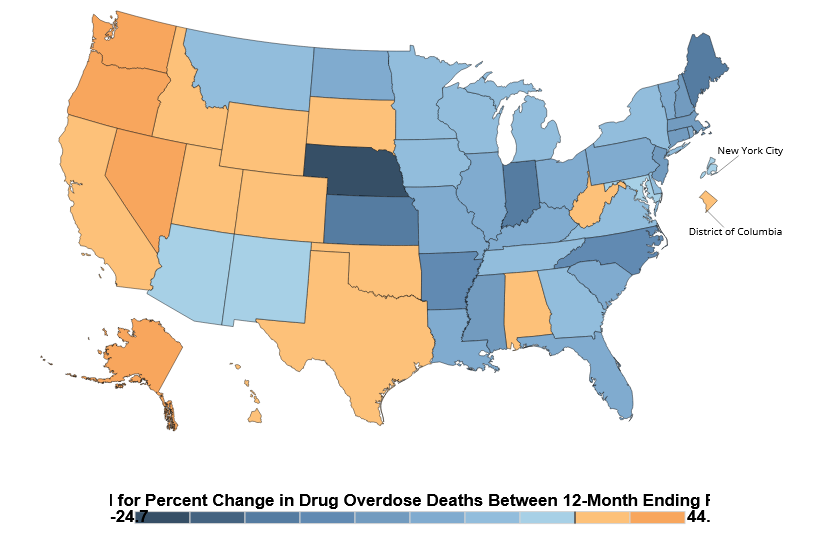
The bad news is that drug deaths kept rising in several western states, with Alaska (+44%), Nevada (+29%), Oregon (+30%) and Washington (+28%) showing substantial increases.

In contrast, overdoses declined in the East and Midwest, with significant decreases in Nebraska (-25%), Indiana (-18%), Kansas (-16%) and Maine (-16%).

The report did not offer any explanation for the wide variation between states and regions.

Percent Change in Drug Overdose Deaths 2022-2023

SOURCE: nchs

The National Center for Health Statistics (NCHS) said over 74,000 deaths last year involved fentanyl – most of it illicit – and more than 36,000 deaths were attributed to methamphetamine.

Most overdose deaths involve multiple drugs, according to the NCHS, so “a single death might be included in more than one category” and be counted multiple times.

Although the numbers remain somewhat unreliable, this report and others suggest that fentanyl and other illicit drugs play a far greater role in the nation’s drug crisis than prescription opioids.

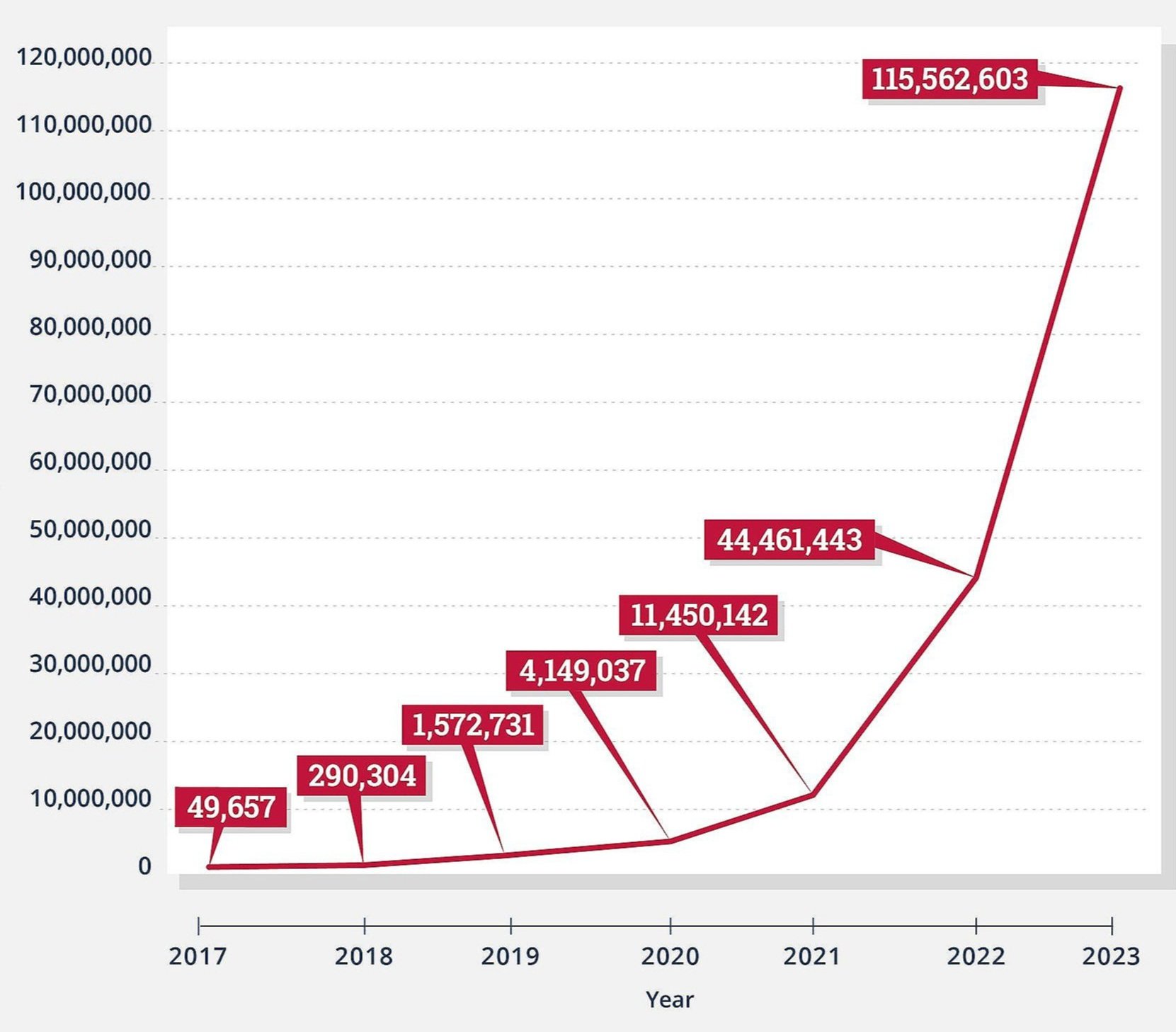
A study published this week in the International Journal of Drug Policy reported that law enforcement seized a record 115 million counterfeit pills containing fentanyl last year. That compares to only 4 million prescription opioid pills that were reported lost or stolen by the DEA in 2023.   

Fake Pills Containing Fentanyl Seized by Law Enforcement

International Journal of Drug Policy

“Availability of illicit fentanyl is continuing to skyrocket in the U.S., and the influx of fentanyl-containing pills is particularly alarming,” wrote lead author Joseph Palamar, PhD, an Associate Professor in the Department of Population Health at the NYU Grossman School of Medicine.

“Both the number and size of drug seizures containing fentanyl have increased in the US between 2017 and 2023, with the majority of seizures –– particularly in pill form –– occurring in the West.”

Prescription opioids are mentioned only a handful of times in the DEA’s recent National Drug Threat Assessment, mainly within the context of their theft and diversion falling to the lowest levels in 12 years. That report also warns that counterfeit pills are increasingly being found with xylazine, a potent animal tranquilizer, and nitazenes, a synthetic opioid that is 40 times stronger than fentanyl  

Oregon Medical Board Has ‘No Limits’ on Prescription Opioids

By Pat Anson, PNN Editor

The Oregon Medical Board has come full circle in its regulation and enforcement of pain management guidelines. After years of taking disciplinary action against doctors for prescribing high dose opioids without a “legitimate medical purpose,” the board has acknowledged that its policies had a chilling effect on doctors who no longer felt safe treating chronic pain with opioids.

“The Board is well aware some number of clinicians have shied away from long-term pain management in part or in whole for fear of Board sanctions. We wish it weren’t so, and the Board is hopeful the realignment in prescribing guidance will provide reassurance to those licensees caring for patients with long-term pain,” David Farris, MD, Medical Director of the Oregon Medical Board (OMB), recently wrote in the board’s newsletter.

The board’s “realignment” came a year after the Centers for Disease Control and Prevention revised its own opioid guideline to give doctors more flexibility in treating pain patients.

In 2016, the CDC initially recommended that daily opioid dosages not exceed 90 MME (morphine milligram equivalents), which was widely seen as a mandatory dose limit.

But after numerous reports of patients being rapidly tapered, going into withdrawal and dying by suicide, the CDC guidance was revised in 2022 to eliminate any dose thresholds. Physicians were instead urged to prescribe opioids cautiously at the “lowest possible effective dose.”   

There are no set regulatory limits on the daily dosage of opioids that can be prescribed in Oregon. There is also not a requirement to rapidly taper or discontinue opioids for patients.
— Oregon Medical Board

In a “Statement of Philosophy” adopted in January, the OMB urged doctors to read the CDC guideline and heed its advice about treating patients individually and to allow “shared decision making” about their treatment.

“In alignment with this statement and CDC guidelines, there are no set regulatory limits on the daily dosage of opioids that can be prescribed in Oregon. There is also not a requirement to rapidly taper or discontinue opioids for patients on existing opioid doses. The Board wants to ensure licensees accepting new patients on existing chronic opioid therapy do not feel pressured to rapidly change a patient’s current opioid dose,” the OMB said.

‘More Harm Than Good’

Opioids have been a contentious issue in Oregon for several years. In 2018, the state considered rule changes to its Medicaid program that would have limited coverage of opioids to just 90 days for patients with neck or back pain. The proposal, which would have forcibly tapered thousands of patients on long-term opioid therapy, was supported by Physicians for Responsible Opioid Prescribing (PROP), an anti-opioid activist group.     

The plan was scrapped after pain management experts signed a joint letter warning that Oregon’s tapering plan was unsupported by treatment guidelines and would do “substantially more harm than good.”

The Medical Board’s decision to give more leeway to doctors reflects a growing awareness that the crackdown on opioids is harming pain patients and may be worsening the drug crisis.    

“The Board wishes to reassure and encourage licensees to assume the prescribing responsibilities for such patients, regardless of MME level, at least temporarily, in order to avoid patients going into withdrawal or turning to illicit sources,” Farris wrote.

“It is gratifying to see the OMB finally recognize that their arbitrary opioid dosing policies harmed people with chronic pain and the providers caring for them. It seems as though the Board may have been adversely affected by advice received from home state clinicians aligned with PROP, and, inevitably, the chickens have come home to roost in that regard,” said Bob Twillman, PhD, former Executive Director of the Association of Integrative Pain Management, who signed the 2018 joint letter.

“I hope this change in stated policy will be reflected in changes to Board investigations and to the state-developed CME (Continuing Medical Education) program on pain management that is mandated for all prescribers in the state. It's going to take years to repair the damage done so far, but I'm hoping the pendulum can finally come to rest somewhere near the midpoint of the extremes we've seen over the last 30 years.”

Opioid prescribing in Oregon has been falling for nearly a decade – as it has nationwide – but overdose deaths in the state keep rising. According to CDC data, Oregon has one of the lowest rates of fatal overdoses involving prescription opioids in the country. Deaths linked to illicit fentanyl, stimulants, methamphetamine and heroin are far more common in Oregon.  

Stimulants Involved in Growing Number of Fentanyl Overdoses

By Pat Anson, PNN Editor

The number of drug deaths involving both fentanyl and stimulants has soared in recent years, according to a new UCLA study that highlights the complex and changing nature of the U.S. overdose crisis.

Stimulants such as cocaine and methamphetamine are now involved in nearly a third of fentanyl-related overdoses, the most of any other drug class. Fentanyl is a synthetic opioid up to 100 times more potent than morphine and 50 times as potent as heroin.

In 2010, researchers say there were only 235 fatal overdoses in the U.S. involving illicit fentanyl and stimulants. In 2021, there were 34,429 drug deaths linked to fentanyl and stimulants, a 14,550% increase in a little over a decade.

"We're now seeing that the use of fentanyl together with stimulants is rapidly becoming the dominant force in the US overdose crisis," said lead author Joseph Friedman, PhD, an addiction researcher at the David Geffen School of Medicine at UCLA. "Fentanyl has ushered in a polysubstance overdose crisis, meaning that people are mixing fentanyl with other drugs, like stimulants, but also countless other synthetic substances. This poses many health risks and new challenges for health care providers.

“We have data and medical expertise about treating opioid use disorders, but comparatively little experience with the combination of opioids and stimulants together, or opioids mixed with other drugs. This makes it hard to stabilize people medically who are withdrawing from polysubstance use."

People who overdose on stimulants and other non-opioid substances mixed with fentanyl may not be as responsive to naloxone, which only works as an antidote to opioids.

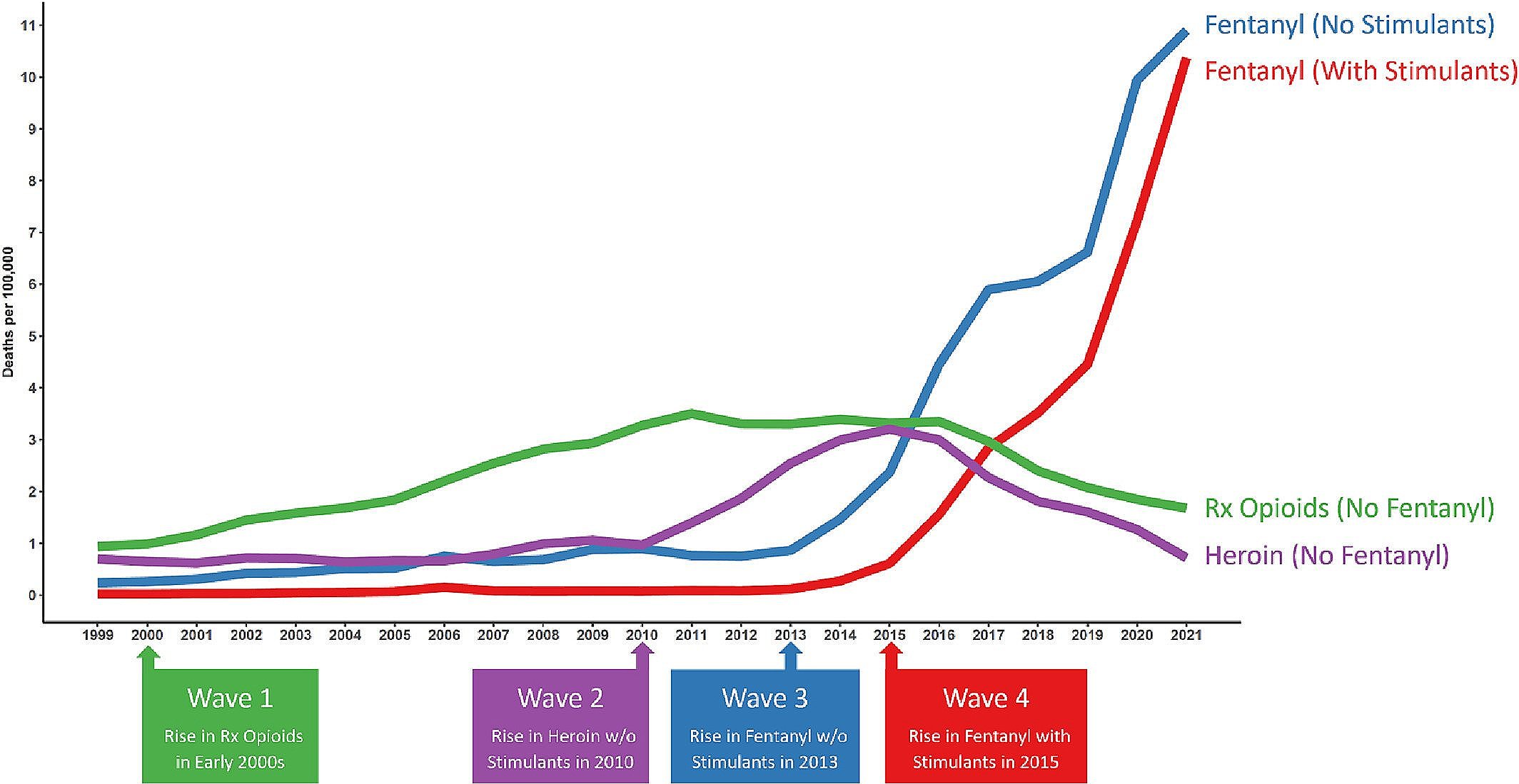
The study findings, published in the journal Addiction, highlight the four “waves” of the overdose crisis, which began with an increase in deaths from prescription opioids (Wave 1) in the early 2000s, followed by a rise in heroin deaths (Wave 2) in 2010, and fentanyl-related overdoses in 2013 (Wave 3). The fourth wave — overdoses from fentanyl and stimulants — began in 2015 and continues to escalate.

The Four Waves of Overdose Crisis

SOURCE: ADDICTION

Since cocaine, methamphetamine and other stimulants are not opioids, the findings undercut the long-held theory that the overdose crisis started with prescription opioids and is still being fueled by people addicted to them. Deaths involving prescription opioids and heroin have been in decline for several years.

Researchers found that fentanyl/stimulant deaths disproportionately affect African Americans and Native Americans. There are also geographical patterns to fentanyl/stimulant use. In the northeast US, fentanyl is usually combined with cocaine, while in the south and western US, fentanyl is most commonly found with methamphetamine.

"We suspect this pattern reflects the rising availability of, and preference for, low-cost, high-purity methamphetamine throughout the US, and the fact that the Northeast has a well-entrenched pattern of illicit cocaine use that has so far resisted the complete takeover by methamphetamine seen elsewhere in the country," Friedman said.

In addition to its low cost, drug users say methamphetamine helps prolong fentanyl’s “high” and delays the onset of withdrawal symptoms.  

Counterfeit pills laced with fentanyl – which are frequently made to look like oxycodone or alprazolam (Xanax) – represent about a quarter of all illicit fentanyl seizures. Researchers say it is difficult to track deaths involving counterfeit pills because they are often mistaken for legitimate medication, so the data is not completely reliable.

In its most recent update on the overdose crisis, the CDC estimates there were a record 111,355 drug deaths in the 12-month period ending April 2023 -- about a thousand more deaths than the year before. Fentanyl and its analogues were involved in nearly 70% of the overdoses, stimulants were linked to about a third of them, and cocaine was involved in about a quarter of the drug deaths.

CDC Report ‘Likely Underestimated’ Deaths Linked to Counterfeit Drugs

By Pat Anson, PNN Editor

A new report from the Centers for Disease Control and Prevention found that fatal overdoses in the U.S. from counterfeit medication more than doubled in recent years, with 93% of those deaths involving illicit fentanyl.

Deaths from counterfeit pills rose from 2% of all overdoses in the third quarter of 2019 to 4.7% of drug deaths in the last quarter of 2021, according to the CDC’s Morbidity and Mortality Weekly Report (MMWR). The overdose rate from fake medication was three times higher in western U.S. states (14.7%). 

However, due the unreliability of death certificates, witnesses and coroner investigations, as well as other flaws in the study’s methodology, the MMWR report acknowledges that the number of deaths involving counterfeit medication is “likely underestimated.”

CDC researchers only looked at overdose data from 34 states and the District of Columbia, identifying 2,437 deaths linked to counterfeit pills during the 30-month study period.

Nearly 106,700 people in the U.S. died from drug overdoses in 2021, so if the 4.7% death rate was applied to that year alone, that would suggest there were over 5,000 deaths nationwide involving counterfeit medication.

Even that estimate is probably on the low end, because CDC researchers focused on counterfeit pills made to look like oxycodone and the anti-anxiety drug alprazolam (Xanax).

While “Mexican Oxy” – blue tablets that look like 30mg oxycodone – are favored by counterfeiters, fake pills are also designed to look like Vicodin, Norco, Adderall, and many other medications. Deaths from those pills were not counted.  

Importantly, whether a death was even linked to fake medication “depended largely on scene or witness evidence of pill use” and other anecdotal evidence, rather than toxicology tests on the pills or the actual people who died.

And while pills are obviously designed to be taken orally, the MMWR report only includes “noningestion routes of drug use,” such as smoking, snorting or injection, which require the pills to be ground into powder or liquefied. CDC researchers considered data on the oral ingestion of counterfeit pills so unreliable, “that information is not presented” in the report.

Many of these details on the study’s strange methodology are buried in the footnotes of the MMWR report, which a casual reader could easily miss. 

Not surprisingly, given the limitations on data, smoking was found to have an outsized role in overdose deaths. According to the MMWR, nearly 40% of the deaths linked to counterfeit medication involved smoking – a misleading statistic, given the study’s flaws. But that didn’t stop researchers from drawing conclusions or recommending “safer smoking practices.”

“The higher percentage of deaths with evidence of drug use by smoking might reflect recent general shifts from injecting drugs to smoking them in western states or could be specific to counterfeit pill use methods,” wrote lead author Julie O’Donnell, PhD, an epidemiologist at the CDC’s National Center for Injury Prevention and Control.

“Harm reduction services that expand outreach to persons using drugs by methods other than injection, such as smoking, and provide education about safer smoking practices and risks related to smoking, might be most successful at addressing diverse drug use patterns.”

There’s a safer way to smoke illicit fentanyl?

This is the CDC’s first MMWR report to look exclusively at deaths caused by fake pills, a public health crisis that the agency has been slow to acknowledge. The DEA started warning about a “fentanyl crisis” as far back as 2016, a time when the CDC was preoccupied with its guideline to reduce opioid prescribing.

There were major flaws in CDC research even back then. The agency eventually admitted that thousands of overdose deaths linked to illicit fentanyl and other street drugs were misclassified as deaths caused by prescription opioids. Some deaths that involved more than one drug were counted multiple times.

Restoring Safe Supply of Rx Opioids Would Reduce Overdoses

By Pat Anson, PNN Editor

A decade long effort to reduce the supply of opioid pain medication in the U.S. has contributed to a surge in overdose deaths and made the illicit drug supply more toxic, according to a new study.

“A big reason that we have such a problem with addiction in this country is because people can't access legitimate pain medication,” said lead author Grant Victor, PhD, an assistant professor at Rutgers University School of Social Work. “Our findings support a change in policy.”

Victor and his colleagues analyzed toxicology data from nearly 2,700 accidental overdose deaths in the Indianapolis metropolitan area (Marion County, Indiana) from 2016 to 2021, comparing them to patient records in the state’s prescription drug monitoring program (PDMP).

Their findings, published in the Journal of Substance Use and Addiction Treatment, show that less than half the people who overdosed (43.3%) had any kind of PDMP record, meaning they were never prescribed an opioid pain reliever or buprenorphine (Suboxone), a medication used to treat opioid use disorder.

Most of the decedents who did have a prescription for an opioid analgesic or buprenorphine had not filled one in the 30 days prior to their deaths, indicating that prescription opioids are not driving overdose deaths in Marion County. Overdoses there increasingly involve illicit fentanyl, a synthetic opioid 100 times more potent than morphine, which accounts for nearly 90% of the county’s overdoses.  

There were 637 drug deaths in Marion County in 2021, nearly twice the number that died in 2016. During that period, opioid prescriptions in the county fell by nearly a third.

MARION COUNTY PUBLIC HEALTH DEPT.

Toxic Drug Market

Victor says many of the overdose deaths could have been prevented if a safer supply of prescription opioids was still accessible – both to legitimate patients and those who misuse the drugs.

“There was a wave of policy initiatives that effectively tamped down on the diversion of prescription opioids, but did so primarily by increasing surveillance of prescribing practices for opioids. And through a number of mechanisms, that made it more difficult for individuals with legitimate pain concerns to access these types of medications,” Victor told PNN.

“When you remove a certain class of drugs that is federally regulated and can be monitored and dosed appropriately, it leaves folks with few options. Options that are currently available are illicit and the potency of these drugs is highly variable. The drug market in general, as we know it today, is very toxic and that is one of the main drivers in the overdose crisis.”

Victor says some of his own family members have chronic pain and after years of taking opioids safely, they’ve been cutoff and told to take Tylenol. He said it’s rare for a pain patient to die from an overdose and few meet the diagnostic criteria for substance use disorder.   

“There are a number of researchers who are trying to drive this point home and hope to reverse some of the policy initiatives that have unfolded over the last few years that have been perhaps unintentionally harmful to public health and to chronic pain patients,” he said.

“We've been swept up in this kind of frenzy about prescription opioids. They're still making movies about the Sackler’s (owners of Purdue Pharma). My opinion of them is not all that high, but I think it is a convenient kind of scapegoat to portray pharmaceutical companies as the evil here, when they’re not a primary concern. When you're looking at public health and what's currently driving overdose deaths, it’s not prescription opioids.”

Few previous studies have compared overdose deaths directly to prescription drug data, which would seem to be an obvious way to get to the bottom of what’s causing the overdose crisis.  One such study looked at opioid overdoses in Massachusetts, finding that only 1.3% of those who died had an active prescription for opioids.

CDC Study Shows Oxycodone Plays Minor Role in Overdose Crisis

By Pat Anson, PNN Editor

A new study by the CDC highlights the sharply rising death toll in the U.S. caused by illicit fentanyl, while at the same time revealing the minor role played by oxycodone in the nation’s overdose crisis.

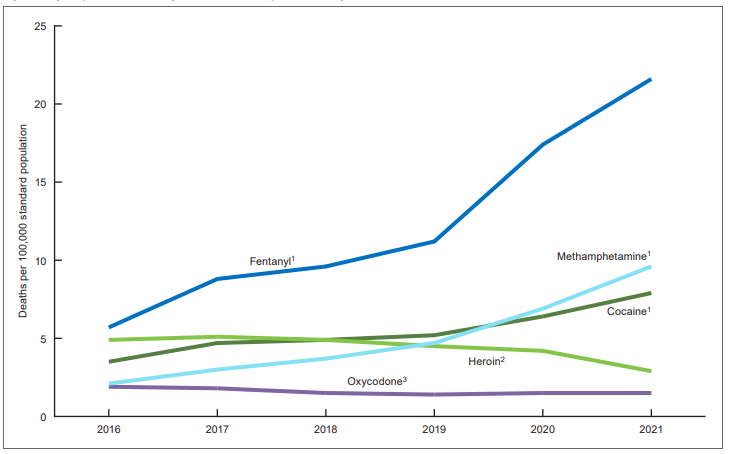
The study, released this week by the CDC’s National Center for Health Statistics, looked at overdose death rates from 2016 to 2021. Deaths involving fentanyl more than tripled during that period, rising from 5.7 deaths per 100,000 people in 2016 to 21.6 deaths per 100,000 in 2021. Drug deaths involving methamphetamine and cocaine also rose sharply, while fatal overdoses involving heroin declined.

And what about oxycodone, the most commonly prescribed opioid pain medication? It turns out oxycodone has always played a relatively minor role in the overdose crisis, although regulators and public health officials said otherwise in a concerted campaign against all prescription opioids.

“Overprescribing opioids – largely for chronic pain – is a key driver of America’s drug overdose epidemic,” then-CDC director Dr. Thomas Frieden said in a 2016 news release.

But the facts don’t support Frieden’s claim. In 2016, the year the CDC released its controversial opioid prescribing guideline, there were only 1.9 deaths per 100,000 people that involved oxycodone. By 2021, the rate had fallen 21% to 1.5 deaths -- well below the death rates of fentanyl, methamphetamine, cocaine and heroin.   

Drug Overdose Deaths in U.S. (2016-2021)

SOURCE: CDC

CDC researchers used an unusual method to conduct this study. Instead of relying on medical ICD-10 codes in death certificates, which lump drugs together into broad categories, the CDC used a “literal text” analysis.

“To address the limitations of ICD–10- coded mortality data, the National Center for Health Statistics has developed a method that searches the literal text of death certificates to identify mentions of specific drugs and other substances involved in the death. Death certificate literal text is the written information provided by the medical certifier, usually a medical examiner or coroner for drug overdose deaths, that describes the causes, manner, and circumstances contributing to the death,” the researchers explained.

Flawed Data

The literal text method is not foolproof, but it’s an improvement over the ICD-10 codes, which the CDC admitted in 2018 “significantly inflate” the number of deaths involving prescription opioids — flawed data that Frieden used to make his “key driver” of the epidemic claim in 2016.

How inflated were the overdose numbers back then?  Using the old ICD-10 method, which counted illicit fentanyl as a prescription opioid, Frieden’s CDC estimated that nearly 32,500 Americans died from overdoses of opioid medication in 2016. The death toll was later revised downward to about 17,000 overdoses after the CDC came clean about its flawed methodology.

Patient advocate Richard “Red” Lawhern has long been suspicious of CDC data, including studies that use literal text analysis.  

“CDC suggests an incidence of drug overdose deaths ‘involving’ oxycodone at only 1.5 per 100,000.  But they neatly avoid telling us that such a rate is so low that it confounds the non-uniformity of reporting from county to county, creating such statistical noise that the contribution of this agent (oxycodone) to overdose mortality is too small to accurately measure or report,” Lawhern said.  

Another problem is the qualifications of county coroners and medical examiners varies. Some are elected to their positions without any medical training or experience. The death certificates they fill out usually don’t say if a prescription drug was obtained legally or illicitly, or what specific drug or combination of substances caused the death. That is determined later by a toxicology test. As a result, a drug may be “involved” in a death and be listed on the death certificate, but have little or nothing to do with someone’s demise.

“It is startling that CDC has so consistently and deliberately conspired to disguise the fact that oxycodone really isn't significant in drug overdose mortality, and probably never has been,” Lawhern told PNN. 

Of course, every death is a tragedy in some way, regardless of the cause or substance involved. The graphic below helps bring oxycodone’s role into more context – comparing the five leading causes of death in 2021 to those involving fentanyl, oxycodone and the other drugs.

SOURCE: CDC

Despite the minor role played by oxycodone in 2021 deaths, efforts continue to restrict its availability. This year the Drug Enforcement Administration reduced the supply of oxycodone for the seventh consecutive year. Since their peak in 2013, DEA production quotas for oxycodone have fallen by 65 percent. The tightened supply has resulted in recent reports of oxycodone shortages and patients unable to get their prescriptions filled.

The DEA justifies the cuts by saying it is concerned about diversion and abuse, but the agency’s own data shows that less than one percent of legally prescribed oxycodone (0.3%) is diverted to someone it was not intended for.

U.S. Prescription Opioid Use Fell 7.4% in 2022  

By Pat Anson, PNN Editor

The amount of prescription opioids sold in the United States fell another 7.4% last year, according to a new report by the IQVIA Institute, a healthcare data tracking firm.

Since their peak in 2011, per capita use of prescription opioids by Americans has declined 64 percent, falling to levels last seen in the year 2000. Despite that historic decline, fatal overdoses in the U.S. have climbed to record levels, fueled primarily by illicit fentanyl and other street drugs.

“The greatest reductions in prescription opioid volume — measured in morphine milligram equivalents (MME) — have been in higher-risk segments receiving greater than 90 MMEs per day,” the IQVIA report found. “Despite significant progress in reducing opioid prescriptions to combat the opioid overdose epidemic, overdose deaths have been rising, primarily due to illicit synthetic opioids.”

The CDC estimates there were 108,712 overdose deaths in the 12-month period ending in November, 2022. About 72,000 of those deaths involved heroin or synthetic opioids such as fentanyl.

By comparison, drug deaths involving legal prescription opioids have remained relatively flat, averaging about 16,000 a year since 2017. They ticked upwards in 2020 and 2021, but appear have trended downward again in 2022, according to the IQVIA.

Prescription Opioid Use and Opioid Overdose Deaths

It appears likely that prescription opioid use will fall again in 2023, due in part to further cuts in opioid production quotas imposed on drug makers by the Drug Enforcement Administration. The DEA says the opioid supply will still be “sufficient to meet all legitimate needs,” but as PNN has reported, some manufacturers are currently reporting shortages of oxycodone and hydrocodone.      

Pain patients have complained for years about chain pharmacies being unable or unwilling to fill their opioid prescriptions, but the problem seems to have grown worse in recent months, particularly at CVS.

“Every month I have to spend hours on the phone trying to find a location that has them in stock,” a CVS customer in Indiana told us. “We should not have to be subjected to this every month!” 

“Some pharmacists are anti opiate. No matter what. She was rude and she is the manager. While it’s hard every month to fill, this time her rude attitude was over the top,” said another CVS customer in Colorado.

Medication Costs Declining 

There is some good news in the IQVIA report: medications are getting cheaper. The average amount paid out-of-pocket for a retail prescription fell from $10.15 in 2017 to $9.38 in 2022. Uninsured patients who pay the full amount in cash have also seen their drug costs decline slightly.

The use of manufacturer copay assistance programs and coupons is growing, collectively saving patients about $19 billion in 2022.

Over the next five years, growth in the use of biosimilar drugs to treat autoimmune conditions, diabetes and cancer is expected to save consumers over $180 billion. Like generic drugs, biosimilars are medications that can replace more expensive biologics such as Humira, which are losing patient protection.

Altogether, spending on medicines for the next five years is expected to be flat, according to the IQVIA, with rising costs in some drug classes offset by declines in others.

Study Links Rx Opioids to Higher Suicide Risk

By Pat Anson, PNN Editor

Suicide is an all-too-common experience in the pain community. About one in every ten suicides in the U.S. involves chronic pain, and in a PNN survey of nearly 6,000 pain sufferers, an astounding 49% told us they thought about suicide because their pain was so poorly treated.

Many of those patients lost access to opioid pain medication after the CDC released its opioid guideline in 2016. The resulting backlash against opioids by regulators and law enforcement had predictable results on people in pain, resulting in an untold number of suicides by mothers, husbands, veterans, advocates and others – that the CDC didn’t even bother to track.

Just a few months ago, a Georgia man and his wife died by suicide after the doctor who was treating the husband had his license to prescribe opioids suspended by the DEA.

A new study is now casting doubt on the association between suicide and cutbacks in opioid prescribing. Researchers at Columbia University Mailman School of Public Health looked at U.S. prescription data from 2009 to 2017 and found the suicide rate was significantly higher in census regions where there was more high-dose, long-term opioid prescribing.

“The relationship between opioid prescribing and suicide risk is a complex one. This is particularly the case when people have their opioids tapered,” said Mark Olfson, MD, professor of epidemiology at Columbia School of Public Health.

“People can become desperate if their pain is not well controlled. Yet opioids also pose a greater risk of overdose than any other drug class and approximately 40 percent of overdose suicide deaths in the U.S. involve opioids. At a population-level, the national decline in opioid prescribing over last several years appears to have reduced the number of people who died of suicide.”

The study findings, published in the American Journal of Psychiatry, are surprising because they cover a period when the U.S. suicide rate was steadily rising, fueled by factors such as mental illness, substance abuse, economic hardship and social isolation. The study ignores those societal issues and focuses solely on opioid medication as the driving force behind suicides.   

Olfson and his colleagues found that geographic regions with the biggest declines in opioid prescriptions tended to have the largest declines in suicide deaths, including suicide overdoses that involved opioids. If the national decline in opioid prescribing had not occurred, they estimate there would have been 3% more suicide deaths overall, and 10.5% more suicide deaths involving opioids.

“It is not surprising that regional declines in opioid prescribing were found to ameliorate local trends in suicide deaths. These findings reinforce the importance of safe opioid prescribing practices and proper disposal of unused opioids,” they reported. “While some patients with pain need and benefit from opioids without risk, those for whom opioids are prescribed should be evaluated and, if necessary, treated for co-occurring mental health disorders that might otherwise increase their risk of suicide.”

‘Confusing and Contradictory’ Findings

The new study is at odds with recent research in British Columbia, which found that tapering or stopping opioid therapy significantly raises the risk of a patient dying from an accidental or intentional overdose. A large 2021 study of U.S. patients on long-term opioid therapy also found that tapering raises the risk of a non-fatal overdose and attempted suicide.

There are “serious methodological problems” with the Columbia study, according to Stefan Kertesz, MD, an associate professor at the University of Alabama at Birmingham, who is leading a federally funded study of pain patient suicides. Kertesz says the study’s reliance on prescription data overlooks all the other issues in a community that may contribute to suicide.

“Let’s use common sense: If communities can change their level of opioid prescriptions, then surely they can change in countless other ways that might bear on community-level suicide risk. Some communities might have a decline in economic well-being. Others might invest in crisis centers,” Kertesz told PNN by email. “However, this paper’s statistical choices require us to assume that none of the 886 regions changed in any respect that would affect suicide, other than the number of opioid prescriptions.”

Kertesz is concerned the study findings could be used to justify further cuts in opioid prescribing.

“Unfortunately the paper offers a confusing, unnecessary and internally contradictory message about the application of its findings to individual patients, one that distracts from the work of the authors and is likely to be misapplied in ways that put patient safety at risk,” he said.

The study was funded by the National Institute on Drug Abuse.

Studying suicides is difficult for researchers because many suicide deaths are misreported as accidental or of undetermined cause, making much of the data unreliable. Drug experts say up to 30% of opioid overdose deaths listed as accidental may have been intentional.

Limiting Supply of Rx Opioids Fails to Achieve Goals

By Pat Anson, PNN Editor

Limiting initial prescriptions for opioid pain medication to 5-days’ supply did not reduce the rate at which patients in New Jersey transitioned to long-term opioid use, according to a new study at Rutgers University.

In 2017, New Jersey became one of the first states in the country to impose a mandatory 5-day limit on initial opioid prescriptions for acute pain. If a patient needed more, their doctor would have to write a new prescription, enroll them in a pain management program, and counsel them on the risks of opioid addiction.

At least 38 other states adopted similar laws, with the goal of reducing opioid diversion, misuse and overdose. Six years later, there is little evidence that New Jersey’s 5-day limit saved lives or accomplished any of its goals.

“This policy’s apparent failure to achieve its goals illustrates the extreme difficulty of solving healthcare problems by dictating physician behavior,” said senior author Stephen Crystal, PhD, director of the Rutgers Center for Health Services Research.

Crystal and his colleagues analyzed pharmacy data for over 130,000 New Jersey Medicaid patients who were prescribed opioids for the first time between 2014 to 2019. Their findings, recently published in the Journal of General Internal Medicine, show that new opioid prescriptions fell at a monthly rate of less than one percent (0.76%) after the 5-day limit was imposed, a decline that was about half the monthly rate (1.62%) prescriptions were falling before the limit took effect.

Doctors were writing fewer prescriptions for opioids in New Jersey and other states long before limits on the supply were even passed. Opioid prescriptions nationally are now at their lowest level in over 20 years.

“Opioid prescribing was already decreasing before this policy went into effect,” said lead author Peter Treitler, a research project manager at the Rutgers Institute for Health, Health Care Policy and Aging Research. “And so, by the time this New Jersey policy went into effect, it really didn’t change prescribing practices very much, at least in the New Jersey Medicaid population.”

An earlier study by the Rutgers research team found that medically treated overdoses in the Medicaid population tripled in New Jersey after the 5-day limit was imposed. Most of the overdoses involved illicit fentanyl and other street drugs, not prescription opioids.

Less than a third of New Jersey’s overdose survivors were even diagnosed with a chronic pain condition, suggesting the state’s focus on limiting pain medication was misdirected. Most people who overdose suffer from substance abuse disorder, depression or other mental health issues. And most overdoses involve illicit fentanyl and other street drugs, not prescribed medication.

In 2022, there were nearly 2,900 drug deaths in New Jersey – about 30% more than the number that overdosed in 2016, the year before the state’s 5-day limit became law.  

DEA Warns About Fentanyl As It Draws Criticism for Crackdown on Doctors

By Pat Anson, PNN Editor

The Drug Enforcement Administration has issued another public warning about the growing risk of counterfeit opioids and other medications made with illicit fentanyl. Over two-thirds of the drug deaths in the U.S. involve synthetic opioids like fentanyl, which is 50 to 100 times more potent that morphine.

Last year the DEA seized over 50 million counterfeit pills laced with fentanyl and more than 10,000 pounds of fentanyl powder. The seizures represent more than 379 million potentially deadly doses of fentanyl, according to the DEA, enough to kill every man, woman and child in the United States.

Over 56,000 American deaths last year involved fentanyl, nearly the number that died in the Vietnam War, and the crisis appears to be escalating. In 2021, a DEA laboratory analysis estimated that 4 out of 10 counterfeit pills laced with fentanyl contained a potentially lethal dose. The DEA now estimates that six out of ten fake pills contain a deadly dose of fentanyl. Just two milligrams of fentanyl, enough to fit on the tip of a pencil, is considered a potentially lethal dose.

“More than half of the fentanyl-laced fake prescription pills being trafficked in communities across the country now contain a potentially deadly dose of fentanyl. This marks a dramatic increase – from four out of ten to six out of ten – in the number of pills that can kill,” DEA Administrator Anne Milgram said in a public safety alert. “Never take a pill that wasn’t prescribed directly to you. Never take a pill from a friend. Never take a pill bought on social media. Just one pill is dangerous and one pill can kill.”

In an effort to bring more public attention to the fentanyl crisis, the DEA launched its One Pill Can Kill campaign, which highlights the similarities between real medications like oxycodone and alprazolam and their fake counterparts. The counterfeit pills are mass produced by drug traffickers in the U.S. and Mexico, using chemicals largely sourced from China.

Backlash Against DEA

As the DEA grapples with the fentanyl crisis, it’s coming under growing criticism about its efforts to reduce the supply of legal prescription opioids. Recent articles in USA Today, The New York Times, Los Angeles Times and VICE Newsmany based on stories that first appeared on PNNsuggest that the mainstream media is slowly coming to recognize the harm caused to pain patients by the DEA’s enforcement actions against doctors who prescribe opioids.

“Law enforcement agencies, especially the Drug Enforcement Administration, are out of control, with the DEA routinely caught releasing ‘safety plans’ for the patients of arrested physicians that simply direct pain patients to the nearest emergency room,” wrote Peter Pischke, a disabled freelance journalist, in a USA Today op/ed.

“American medicine and law enforcement continue to fight the last war. Policymakers still operate under the assumption that too many opioids are being prescribed. Overdose deaths — including those among adolescents — are now overwhelmingly caused by street fentanyl, not prescription medications,” Maia Szalavitz wrote in The New York Times.

The backlash against the DEA produced a backlash of its own in Newsweek, in an op/ed by a former deputy chief of staff at the DEA. Rather than doing fewer enforcement actions against doctors, Jim Crotty believes there should be more.

“With the U.S. drug crisis reaching unprecedented levels, and many opioid use disorders starting with prescription drugs, now is not the time to increase their availability,” wrote Crotty, who said the recent deaths of patients who lost access to opioids when their doctor’s license was suspended do not justify a change in DEA policy.

“These isolated incidents, however tragic, should not be used to upend otherwise sound drug policies designed to protect the American public from drug addiction and abuse,” said Crotty. “The U.S. is making slow but steady progress in rolling back the opioid crisis, but there is much work to be done. The threat of prescription opioids still looms large and requires continued vigilance from DEA and its partners to protect Americans' health and safety. We should be asking them to do more, not less.”

Crotty said over 13,000 Americans have died from overdoses involving prescription opioids in the last 12 months – a fraction of the number dying from fentanyl -- and repeated the old saw about the U.S. being “the world's largest consumer of prescription opioids.” That may have been true a decade ago, but no longer is. The U.S. now ranks 8th in per capita opioid consumption, behind Canada, Australia and several European countries