
U.S. Overdose Deaths Down Significantly
/By Pat Anson
The number of fatal drug overdoses fell sharply in the U.S. in 2024, led by a significant decline in deaths involving illicit fentanyl, according to a new analysis.
Over 79,000 Americans lost their lives to a drug overdose in 2024, compared to 105,000 in 2023, a 24.5% decline in one year. Over 54,000 of the deaths in 2024 involved an opioid of some kind.
The analysis by KFF further demonstrates the declining role of prescription opioids in the nation’s drug crisis. Prescribed opioids are now involved in about one in seven (13.6%) drug overdoses.
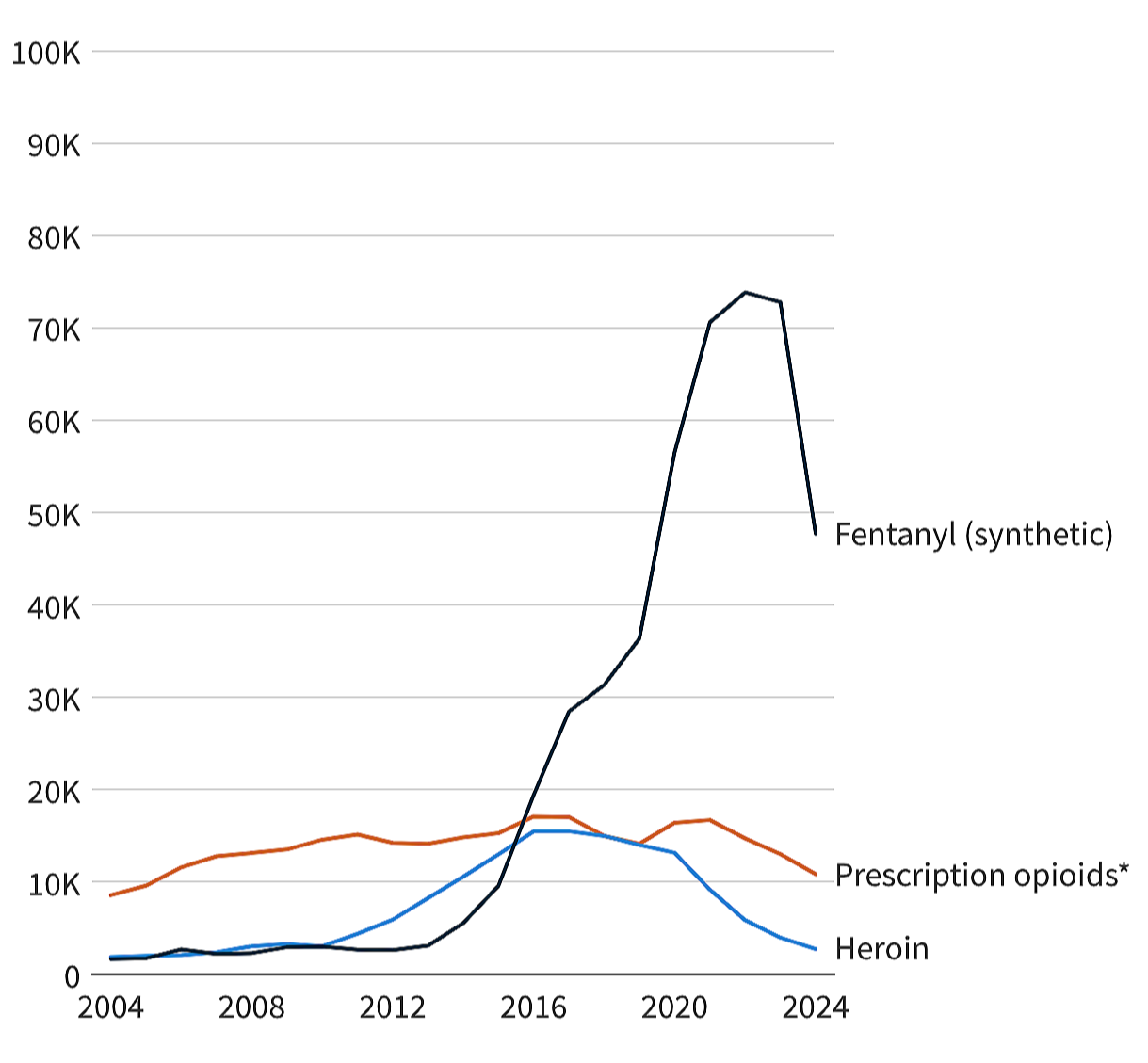
In 2024, 10,851 Americans died from an overdose involving a natural or semi-synthethic prescription opioid, compared to 47,735 deaths involving synthetic opioids, mostly illicit fentanyl.
Deaths from prescription opioids peaked at 17,029 in 2017 and have steadily declined.
U.S. Opioid Overdose Deaths 2004-2024
SOURCE: KFF
“Since the opioid epidemic was declared a public health emergency in 2017, it has claimed more than half a million lives. While the epidemic was initially driven by prescription opioids and heroin, it has evolved in recent years, to be dominated by illicit synthetic fentanyl — a substance significantly more potent than morphine,” KFF said. “Provisional CDC data suggest opioid deaths have continued to decline through 2025.”
The KFF analysis also looked at deaths involving alcohol, suicide and firearms.
In 2024, 48,824 American lives were lost to suicide, down slightly from the previous year. Firearms accounted for 57% of those deaths. There were 46,714 “alcohol-induced” deaths in 2024 caused by health conditions attributed to excessive alcohol use, about the same number of fentanyl overdoses.
Those deaths greatly outnumber fatal overdoses involving prescription opioids.
U.S. Deaths in 2024
As PNN has reported, a recent study ranked alcohol as the 5th most harmful drug In the United States, behind illicit fentanyl, methamphetamine, crack and heroin. Prescription opioids ranked as the 7th most harmful drug in the U.S.
The analysis not only looked at the direct harm to drug users, but the indirect harm to families, communities and society at large caused by excessive drug use.
A panel of experts said the analysis shows how misdirected U.S. drug policy is, which is focused on crime and punitive measures to stop drug use, rather than public health measures to address substance use disorders. Criminalizing drug use may also be making the drug crisis worse, by taking legal drugs away from people who benefit from them.
“All drugs have benefits to people who use them at least initially, and some may have ongoing benefits. For legal drugs, there may be social benefits like employment in related industries and taxation to fund public services,” wrote lead author Michael Broman, PhD, an Assistant Professor at The Ohio State University College of Social Work.
“Redirecting resources towards harm reduction may reduce social harms by reducing the economic cost of policing and surveilling people who use drugs. Concurrently, PWUD (people who use drugs) could remain contributing members of their families and communities.”