
Tiny Injectable Implant Could Revolutionize Neuromodulation
/By Pat Anson
Scientists in Abu Dhabi have developed a tiny neuromodulation device that can treat chronic nerve pain without the need for invasive surgery.
The experimental device is so small – about the size of a small seed – that it can be injected into the body with a standard needle. It is powered wirelessly from outside the body, allowing doctors or patients to adjust its neuromodulation levels in real time.
“This work represents a shift in how we think about treating nerve-related conditions,” said Khalil Ramadi, PhD, an Assistant Professor of Bioengineering at NYU Abu Dhabi and senior author of a research paper published in Science Advances.
“By creating a device that can be injected rather than surgically implanted, we are making these therapies simpler, safer, and more accessible, while still maintaining precise control over nerve activity.”
Current neuromodulation methods, such as spinal cord stimulation and transcutaneous electrical nerve stimulation (TENS), have their limits.
TENS units are not invasive and easy to operate, but can cause uncomfortable tingling sensations for patients. They also stimulate a wide area, activating nerves and muscles that don’t need treatment.
Spinal cord stimulators require invasive surgeries near the spine, and come with implanted wires and batteries that can malfunction, need replacement, and cause infections.
Because the SEED (Stimulating Electrode for Electroceutical Delivery) implant is injected, it can be placed and tracked with standard medical imaging, such as ultrasound and CT scans, allowing it to target a specific nerve.
Once implanted, it delivers mild electric signals that can be programmed and tailored for each individual patient. Power for the device is delivered wirelessly from an external battery that can be worn on the wrist.
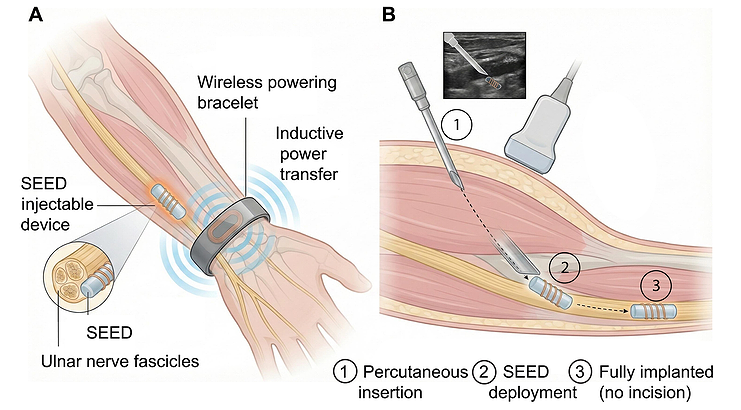
SCIENCE ADVANCES
The SEED device is in the preclinical stage and has only been tested on the peripheral nerves of laboratory rats. Researchers say the device demonstrated precise control over nerve stimulation and performed consistently.
“This technology has the potential to bridge the gap between non-invasive therapies and traditional implants,” said first author Mohamed Elsherif, PhD, Research Associate at NYU Abu Dhabi. “It opens the door to treatments that are both effective and easy to deliver, which could significantly improve patient care.”
The SEED implant will likely need to be tested on larger animals, such as pigs or sheep, before human trials can begin. Clinical use of the device will require FDA approval and is at least 5 to 10 years away.
Researchers at Rice University are developing a similar device – about the size of a grain of rice – to treat neuropathic pain. Like the SEED implant, the device has not been fully tested on humans.


