
DEA Missed Deadline for Opioid Production Quotas. Will It Worsen Shortages?
/By Pat Anson
In recent years, hundreds of physicians have been prosecuted by the U.S. Justice Department for violations of the Controlled Substances Act (CSA).
In many cases, the doctors were accused of prescribing opioid pain medication without “a legitimate medical purpose” – a vague term in the CSA that was meant to prevent drug abuse, but in practice put the DOJ in charge of deciding whether healthcare decisions involving controlled substances are legal.
The CSA is rigidly enforced when federal prosecutors believe opioids are prescribed excessively. But when it comes to enforcing another provision in the CSA, the DOJ and Drug Enforcement Administration have routinely ignored deadlines for setting aggregate production quotas (APQs) for opioids and other Schedule I and II controlled substances:
“On or before December 1 of each year, upon application therefor by a registered manufacturer, the Attorney General shall fix a manufacturing quota for the basic classes of controlled substances in schedules I and II.”
The December 1 deadline is important because it gives the pharmaceutical industry a small window to prepare for the coming year by acquiring raw materials for drugs, setting manufacturing schedules, and distributing medications to hospitals and pharmacies – a process that can take as long as six months. .
But Attorney General Pam Bondi and acting DEA Administrator Terry Cole didn't publish their proposed quotas for 2026 in the Federal Register until November 28, which call for a 6% cut in the supply of oxycodone.
Allowing for a shortened public comment period that ends December 15, and time to review thousands of comments and make changes in the quota allotments, that means the final APQs for next year will likely not be ready until after January 1.
The last time production quotas were that late was in 2024, when the final APQs were not published until January 3. Drug shortages spiked to record levels in the first few months of that year, including many medications that are covered under the quota system.
Missing the deadline again this year threatens to worsen chronic shortages of oxycodone, hydrocodone, fentanyl, hydromorphone, morphine and amphetamine-based stimulants that are vital to millions of patients who live with pain or attention deficit disorder (ADHD).
The DOJ and DEA did not respond to multiple requests from PNN to explain why the CSA deadline was missed again.
This is not a new problem. Late quotas and drug shortages have persisted for years, as the DOJ and DEA have focused on going after doctors who prescribe opioids – at times using “flimsy evidence” – rather than ensuring that essential medications are available on time.
That mindset of being a law enforcement agency first – with maintaining the drug supply an afterthought – may have cost some patients their lives.
“We talk a lot about opioid misuse, but almost never about the quiet suffering caused when essential pain medicines simply aren't available,” says Lynn Webster, MD, a pain management expert and former president of the American Academy of Pain Medicine. “Chronic delay and rigidity in quota decisions make patients with serious illness feel like collateral damage in a war on drugs that has lost sight of its humanitarian obligations.
“Quotas were meant to curb diversion, not to create a permanent state of scarcity for people in pain. By keeping quotas tight and decisions late, the DEA has turned an already fragile supply chain into a game of musical chairs where patients lose their seats.”
Late Quotas Worsened Drug Shortages
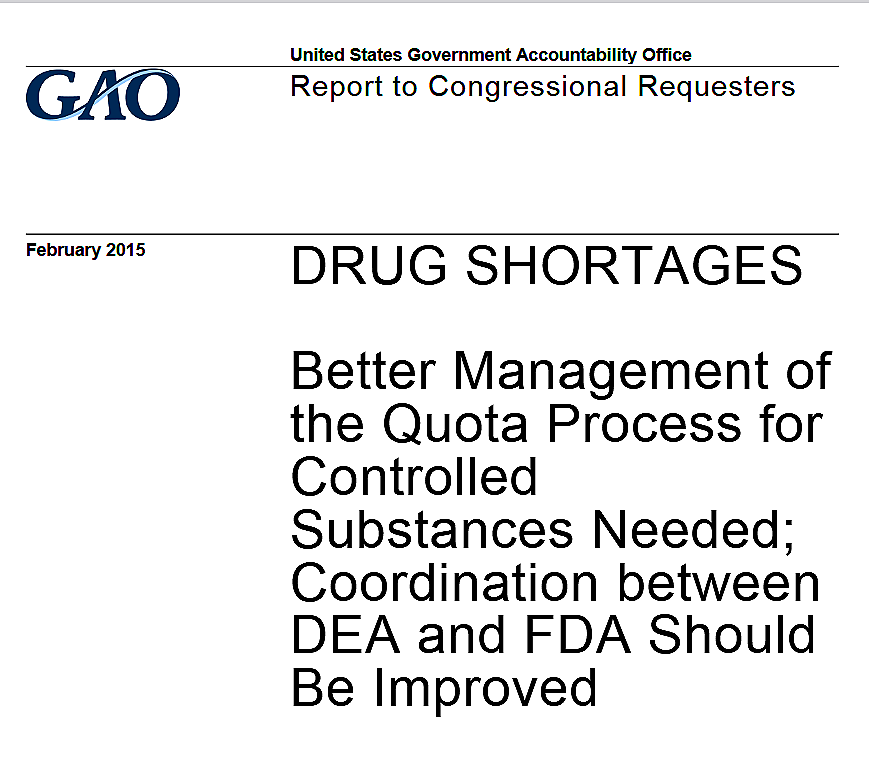
As far back as 2015, the General Accountability Office (GAO) warned in an audit report that the DEA “has not effectively administered the quota process.” Although a decade old, many of the problems cited by the GAO still exist today.
“Each year, manufacturers apply to DEA for quota needed to make their drugs. DEA, however, has not responded to them within the time frames required by its regulations for any year from 2001 through 2014,” the GAO said.
“Manufacturers who reported quota-related shortages cited late quota decisions as causing or exacerbating shortages of their drugs.”
The report found that drugs containing Schedule II controlled substances accounted for over half the shortages between 2001 and 2013. Several manufacturers complained to the FDA the shortages were caused by the DEA’s mishandling of the quota system.
But the DEA denied any responsibility for the shortages, while blaming the missed deadlines on “inadequate staffing” and an “increasing workload” in its Quota Unit.
“DEA is confident that its administration of the quota process did not affect a shortage during the period of review because drug product shortages are not limited to products that contain Schedule II controlled. substances,” Joseph Rannazzisi, then-DEA Deputy Assistant Administrator, wrote in the agency’s response to the GAO report.
Rannazzisi would later emerge as a “whistleblower” on 60 Minutes, who blamed the opioid crisis on lax policies at the FDA that favored that drug industry.
The relationship between DEA and FDA, at least in 2015, was not one of trust. The FDA advised the DEA about medical demand for Schedule II drugs and any shortages that may exist, but the DEA didn’t always listen.
“DEA and FDA are not able to effectively collaborate due to fundamental disagreement over whether any given shortage exists. DEA has made it clear it does not trust FDA’s information, as it does not consider many of the shortages that FDA verifies to be legitimate,” the GAO said. “They do not believe FDA appropriately validates or investigates the shortages.”
The GAO concluded that problems in DEA’s Quota Unit run deeper than any petty rivalries with the FDA.
“Our work shows that DEA’s lack of internal controls, such as controls to ensure data reliability, performance measures, and monitoring of performance, may hinder the agency’s ability to ensure an adequate and uninterrupted supply of controlled substances,” the 2015 report found. “This approach to the management of an important process is untenable and poses a risk to public health.”
New Deadline
The GAO’s critique came at a time when the DEA’s deadline for final APQs was October 1 – a deadline the agency consistently failed to meet.
To buy itself more time to work on quotas, the DEA lobbied Congress to change the annual deadline to December 1 in the 2018 Support Act, a bill intended to reduce opioid diversion. The DEA also reduced the amount of inventory drug manufacturers are allowed to keep of controlled substances, and agreed to base its quotas on dosages, not the raw supply of drugs.
How has that worked out? Poorly.
The DEA has not only been unable to meet the December 1 deadline, but the smaller inventories have worsened the ability of drug manufacturers to respond to late quotas and emerging drug shortages.
The pharmaceutical industry warned the DEA that reducing inventories would only worsen shortages and do little to prevent diversion.
“We believe that risks associated with this proposal, including the increased likelihood for drug shortages and market outages, greatly outweigh the negligible benefit this provision will provide,” Larry Cote, an attorney representing a drug manufacturer, wrote to the agency in 2019.
“Given the timing of procurement quota issuance, it will become more imperative to carry increased levels of inventory at year end in order to ensure continued drug supply, as opposed to decreased levels.”
The DEA ignored those warnings and reduced inventories anyway. As a result, analgesic medications needed for surgery and post-op care, such as injectable fentanyl and hydromorphone, have been on the FDA shortage list for years, in part due to low inventories. The two drugs are rarely diverted.
‘Vulnerable to Supply Shocks’
Two pharmacists recently criticized the DEA for its “outdated system” for APQs.
“The current one-size-fits-all system for setting APQs is ineffective and Congress recognized this back in 2018, passing the SUPPORT Act to modernize the APQ setting process and require quota allocations based on dosage form. Yet seven years later, the DEA has failed to implement this law, leaving manufacturers constrained, patients underserved, and the nation vulnerable to supply shocks,” Soumi Saha, PharmD, and Justin Schneider, PharmD, wrote in a recent op/ed published in the Pharmacy Times.
Saha and Schneider believe many of the quota problems could be addressed if the DEA were to hire a Chief Pharmacy Officer who is familiar with the drug supply system and is put in charge of the quota system.
“It is time to elevate the agency’s clinical responsibility by establishing a Chief Pharmacy Officer (CPO) within the DEA - a role dedicated to ensuring that patient access is not an afterthought, but a core priority,” they said. “A strong CPO would not only modernize quota systems but also bring agility, accountability and patient advocacy to the heart of DEA decision-making.”
To be clear, the DEA is not solely at fault for persistent shortages of opioids and other controlled substances. A 2021 opioid litigation settlement with three drug distributors essentially rationed the supply of opioids at many pharmacies and made pharmacists even more wary of filling new prescriptions.
In a 2023 PNN survey of over 2,800 patients, 90% said they experienced delays or problems getting their opioid prescriptions filled, mostly because their pharmacy was out of stock. Nearly one in five were unable to get their pain medication, even after contacting multiple pharmacies.
Some generic drug manufacturers have stopped making opioids because of low profit margins and because of concerns they could be targeted by plaintiff law firms in opioid lawsuits that could cost them billions of dollars.
Bad weather and a heavy reliance on foreign drug manufacturers have also made the supply chain less reliable and contributed to shortages.
But the DEA’s chronic failure to meet quota deadlines – a problem dating back decades – and its slow-walking of efforts at reforming the quota system, have made a fragile drug supply chain even more vulnerable to disruptions. And it is patients who pay the ultimate price for the DEA’s negligence.
“When DEA repeatedly misses its own deadlines for setting opioid production quotas, that uncertainty reverberates all the way to the bedside,” says Dr. Webster. “Manufacturers pull back, pharmacies ration, and it's the patients – people with cancer, sickle cell disease, or severe chronic pain – who are left wondering if their next prescription will even be filled.”
Should the DEA hire a Chief Pharmacy Officer? Should deciding what is or isn’t “a legitimate medical purpose” be left to the DEA and DOJ? Only a few days are left to comment on the DEA’s proposed APQs for 2026. You can leave a public comment by clicking here.