
Many Rx Opioids – Not Just Suboxone – Raise Risk of Dental Disease 

By Pat Anson

Suboxone isn’t the only opioid medication linked with dental decay and disease.

A large study led by VA Connecticut researchers found that patients on long-term opioid therapy with pain medications such as morphine and oxycodone have a significantly higher risk of infection-related dental disease.

The observational study included data from over 2 million U.S. veterans, 36% of whom were on long-term opioid therapy (LTOT). Those taking opioid pain medication for at least 90 days had a 24% higher chance of tooth decay, infections or tooth loss. 

Suboxone, which contains the partial opioid agonist buprenorphine, was excluded from the study, along with the opioid methadone. Both medications are used to treat opioid use disorder (OUD). 

The FDA warned in 2002 that buprenorphine tablets and film, when dissolved in the mouth, were linked to serious dental problems, including tooth decay, cavities, oral infections, and loss of teeth. Methadone has also been associated with dental problems because it induces dry mouth (xerostomia), which reduces saliva needed to wash away bacteria and plaque.  

The new study is believed to be the first linking dental disease to opioids taken long-term for pain relief.

“To our knowledge, this is the first study to demonstrate the association between LTOT exposure and dental disease. This finding is important in light of recent warnings of buprenorphine risks that may influence decision-making in the context of chronic pain and/or OUD,” researchers reported in the journal PLOS One.

In their analysis, VA researchers compared veterans who took 12 opioids (hydrocodone, oxycodone, morphine, fentanyl, hydromorphone, dihydrocodeine, meperidine, pentazocine, propoxyphene, levorphanol, tramadol, or tapentadol) to veterans who had no exposure to LTOT in the prior year.

Researchers think the higher rate of dental disease for those on LTOT stems from immune suppression and reduced saliva flow, which raises the risk of bacterial infections that lead to dental disease and cavities. 

The findings suggest that all patients on LTOT – whether for pain relief or OUD treatment – should be cautioned about the risks of dental problems.

“Concern over these risks may present a barrier to buprenorphine initiation in patients prescribed LTOT for whom such treatment is indicated. However, full opioid agonists themselves may pose oral health risks due to immunosuppression and well-documented effects on saliva flow causing xerostomia; both create opportunity for oral disease development,” researchers concluded.

Doctors who have patients on LTOT are advised to monitor their oral health and to have discussions with patients about dental risks before starting them on opioids.

There are simple steps patients on long-term opioids can take to reduce their risk of dental disease. Patients on buprenorphine or methadone are often advised to drink more water to combat dry mouth, and to brush and floss regularly to help prevent dental infections. 
Safer Opioid Supply Helps Reduce Overdoses

By Pat Anson

Should people at high risk of an overdose be prescribed opioids like hydromorphone or should they get methadone to help them cope with opioid addiction?

It’s a controversial question in Canada, where harm reduction programs are being used to give high-risk drug users a “safer supply” of legal pain medications as an alternative to increasingly more toxic and deadly street drugs. Critics say safer opioid supply (SOS) programs don’t reduce overdoses and are a risky alternative to more traditional addiction treatment drugs like methadone.

A new study, however, found that SOS programs are just as effective as methadone and may even be safer in the long run. Researchers in Ontario followed the health outcomes of over 900 people newly enrolled in SOS programs, comparing them with a similar number of drug users who started methadone treatment.  

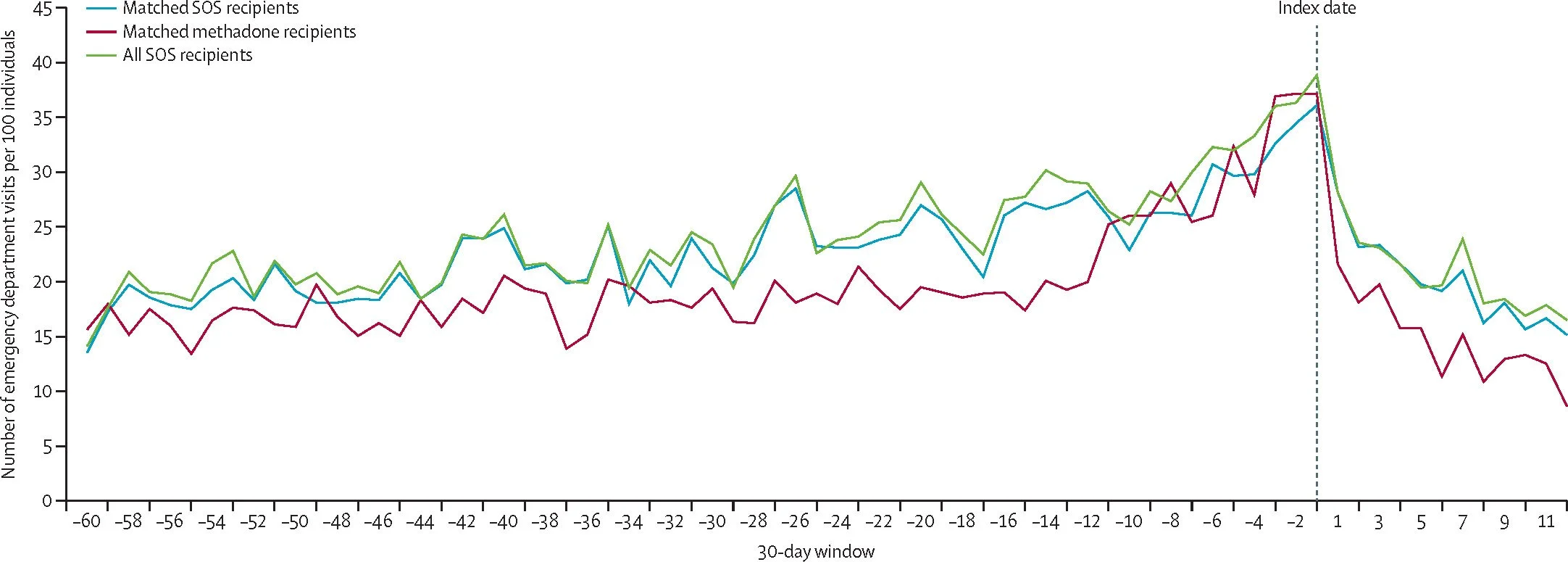
Their findings, published in The Lancet Public Health, show that people in both the SOS and methadone groups had significant declines in overdoses, emergency department (ED) visits, hospitalizations, severe infections, and health care costs in the year after they started treatment. In both groups, deaths related to opioids or any other cause were uncommon.

ED Visits Fell After High-Risk Drug Users Enrolled in SOS or Methadone Programs

THE LANCET PUBLIC HEALTH

"This is the first population-based study to compare SOS programs with opioid agonist treatment, and to explore how people's outcomes change in the year after initiation," said lead author Tara Gomes, PhD, an epidemiologist and Principal Investigator at the Ontario Drug Policy Research Network (ODPRN).

Gomes and her colleagues found that people on methadone had a slightly lower risk of an overdose or being admitted to hospital, but they were also more likely to discontinue treatment and be at risk of a relapse. The higher dropout rate outweighed most of the benefits of methadone over SOS.

"Neither methadone nor safer supply programs are a one-size-fits-all solution, but our findings show that both are effective at reducing overdose and improving health outcomes," said Gomes. "They are complementary to each other, and for many people who haven't found success with traditional treatments like methadone, safer supply programs offer a lifeline. Our findings show that when safer supply programs are implemented, we see fewer hospital visits, fewer infections, and fewer overdoses."

SOS programs were launched in Ontario and British Columbia to combat a rising tide of overdoses linked to illicit fentanyl. A decade ago, Vancouver was the first major North American city to be hit by a wave of fentanyl overdoses, which led Vancouver to become a laboratory for harm reduction and safe injection sites that provided heroin or prescription opioids to drug users.  

The results have been somewhat mixed. An investigation by the National Post found that hydromorphone pills given to drug users in Vancouver were being sold on the black market, with the sellers then using the money to buy street drugs. Complaints about people selling their safe supply drugs led to British Columbia’s Health Minister recently changing the rules so that the SOS drugs are consumed while under the supervision of a pharmacists or healthcare provider.

A 2024 study in JAMA Internal Medicine found that opioid-related hospitalizations rose sharply in British Columbia after harm reduction programs were launched there, although there was no significant change in overdose deaths. The spike in hospitalizations may have been due to more toxic street drugs and counterfeit pills on the black market.

Being Taken Off Methadone Is Inhumane

By Wendy Cooper, Guest Columnist

I am a pain patient and diabetic entering my second week of detox.  My doctor will no longer prescribe methadone because he’s afraid of being targeted by the DEA for not following the “voluntary” CDC guideline.  He said they are putting doctors in prison by the hundreds and it’s just no longer worth the risk. 

I was on methadone for years.  I am also a gastric bypass patient, so I will not be able to take any type of NSAID (non-steroidal anti-inflammatory drug) for pain. 

When my doctor first suggested methadone I was totally confused.  I told him, “But wait, that’s for drug addicts.”  Well it is, but it’s also very effective for pain control.  After taking it for a month I was so happy.  It totally handled my pain and I didn’t have all of the other side effects, like making me sleepy and lethargic.  My mind was clear. I had my life back.  Yes, for many methadone works.  Sadly, it used to work for me, too.  

I am now back on insulin every day due to the pain, after having been off of insulin for years. Methadone did that.  It started the ball rolling in a positive direction. I was able to exercise more and take care of my family, because the pain relief helped get my diabetes under control. Not anymore. 

Supposedly the danger is because methadone, which has been around for over 50 years, has an effect on the respiratory system.  Well, this is true of many medications if they are not taken correctly.  If I take too much of my insulin, it will have an effect on my respiratory system too — as in me not breathing at all because I will be dead. 

Tons of medications have dangerous side effects if not taken properly.  What used to happen is you would weigh the benefits and the risks with your physician and then the patient would make an informed decision. 

WENDY COOPER

Why does the government have the right to take away medication that has changed my life for the better?  Why am I being treated like a child by assuming I will not take my medication correctly?  I can’t think of any valid reason for this except MONEY.  Methadone is $35 per month, while buprenorphine (Suboxone) is close to $300. 

Buprenorphine is not a good fit for pain patients.  We are much more likely to go to the emergency room for an acute event than non-pain patients.  What will they give us for pain? 

It’s my understanding that pain medications are complicated when you are facing surgeries while on buprenorphine.  I have four surgeries scheduled this year.  Am I supposed to wean myself every time I get ready for one of my surgeries? 

I always felt safer from any type of addiction issue because methadone took away the “feel good” effects of Percocet.  If I hurt myself, I could take a Percocet and it would help with the additional pain. 

I don’t have an addiction problem, but like most pain patients I am concerned about developing one. I’ve always felt it is my responsibility to take precautions and govern myself with my own guidelines.  Well, that benefit is gone.  I don’t want to live anymore. This is inhumane. 

Wendy Cooper lives in Florida.

Pain News Network invites other readers to share their stories with us. Send them to:  editor@PainNewsNetwork.org