Pfizer Loses Lyrica Patent Case

By Pat Anson, Editor

A British judge has strongly rebuked Pfizer for making "groundless threats" against doctors and pharmacies in the UK to prevent them from prescribing or selling cheaper generic versions of  Lyrica for pain relief.

Judge Richard Arnold ruled against Pfizer in a patent protection case, saying emails and letters the U.S. drug maker sent to British healthcare providers were “calculated to have a chilling effect on the willingness of pharmacies to stock and dispense generic pregabalin.”

Pregabalin is the generic version of Lyrica, a blockbuster drug that generates over $5 billion in sales annually for Pfizer.

The company's patent on Lyrica for the treatment of epilepsy and anxiety expired last year, but a secondary patent for pain is good until 2017.  However, that didn't stop British doctors from prescribing pregabalin "off-label" for pain. According to Pharmalot, about 80% of UK patients on pregabalin are using it to treat pain -- amounting to about $386 million in lost Lyrica sales for Pfizer.

Arnold's ruling that doctors and pharmacists were not infringing on the patent does not impact Pfizer's patent rights outside of the UK. The company said it would appeal the decision.

“Our intention was only ever to communicate the existence and importance of our second medical use patent for the use of Lyrica in pain," Pfizer said in a statement. “With the benefit of hindsight and having navigated particularly challenging and complex legal issues, we wish we had been able to explain this better and sooner."

Ironically, Pfizer paid $2.3 billion dollars in 2009 to settle criminal and civil charges in the U.S. for the off-label marketing of Lyrica and other medications – the very sort of off-label use it was trying to stop in the U.K.

Lyrica is one of only three drugs approved by the U.S. Food and Drug Administration to treat fibromylagia. Although it is the most widely prescribed medication for fibromyalgia, many patients have written to Pain News Network warning about its side effects.

"I have memory loss and bad vision from Lyrica. Some of my memory will never be restored," said Dana.

"Lyrica made me fat, extremely fat, I was depressed on this drug too. No thanks," said Freda.

"I have tried Lyrica. I was falling on the floor. Could not walk without holding onto a cane," said Nancy. "It's time for researchers to find medications that are meant to treat Fibromyalgia, and not second or third off label uses of other meds that were never intended for FM. After 25 years, I'm really tired of waiting!"

A Pained Life: Waiting Can Be a Good Thing

By Carol Levy, Columnist

I am on an online "chat" with the cable company. I know this will be difficult -- my eye pain is made worse by having to read and type -- but it is just so darn difficult getting them on the phone.

The chat was going well, but it took what seemed like forever between responses from the representative. I was getting more and more frustrated and annoyed. 

When is she going to come back online so I can be done with this already? 

My reasoning was simple. The faster we can finish this, the sooner I am to no longer doing something that is causing me pain.

I was fuming. C'mon, C'mon!

And then it suddenly dawned on me -- the waiting is a good thing. Every minute or two between replies means I am not using my eye. It is free downtime, my eye getting a few minutes of reprieve.

How many times have you gone out with someone, maybe to shop for clothes or to buy groceries, and the other person stands there looking at items, wrestling with a decision:  "This one or that one? That one or this one?"

And how often do you get mad or upset? My body is hurting and the pain is growing. Please, enough already! Or maybe you even say it. 

What if, instead of letting the frustration or even the pain get to you, you take the opportunity to find a chair or lean against a counter? Or even say, "I need to leave the store. I'll go back and wait in the car." 

So often it feels like we have no options. It is an either/or situation -- either leave or let the pain take over.  Or feel like you are antagonizing the person you are with. 

But maybe there is a third choice. 

Instead of ending up upset because you could not get done what you came to do, or the person you came with is annoyed because your mood has turned foul and they "don't want to hear about your pain" anymore; maybe it is time to change our thinking.  

I am not one to dole out platitudes. I don't think we can make lemonade out of our pain-filled lemons. But just for this instance -- turn that frown upside down, as it were.

Take the frustration of waiting and give it a reason. 

Take the time to find a safe area, couch, counter, or a quiet fitting room and turn the negative of frustration into a positive time for yourself.  And a time-out for your body. 

Carol Jay Levy has lived with trigeminal neuralgia, a chronic facial pain disorder, for over 30 years. She is the author of “A Pained Life, A Chronic Pain Journey.”  Carol is the moderator of the Facebook support group “Women in Pain Awareness.” Her blog “The Pained Life” can be found here.

The information in this column should not be considered as professional medical advice, diagnosis or treatment. It is for informational purposes only and represent the author’s opinions alone. It does not inherently express or reflect the views, opinions and/or positions of Pain News Network.

Blood Test Identifies Women Prone to Migraine

By Pat Anson, Editor

Researchers may have discovered a new marker for episodic migraine – lipids in the blood that regulate inflammation in the brain.

In a small study involving 88 women, researchers found that total levels of the lipids -- called ceramides or sphingolipids -- were significantly decreased in women with episodic migraine when compared to women without migraine. Episodic migraine is defined as less than 15 headaches per month. The women in this study had an average of 5.6 headache days a month.

"While more research is needed to confirm these initial findings, the possibility of discovering a new biomarker for migraine is exciting," said study author B. Lee Peterlin, DO, with the Johns Hopkins University School of Medicine. The study is published in Neurology,  the medical journal of the American Academy of Neurology.

Ceremides are bioactive lipids that may be involved in other neurological disorders, such as dementia and multiple sclerosis.

Women with migraine had approximately 6,000 nanograms per milliliter of ceramides in their blood; while women without headache had about 10,500 nanograms. Every standard deviation increase in total ceramide levels was associated with over a 92% lower risk of having migraine. Two other types of lipids, called sphingomyelin, were associated with a 2.5 times greater risk of migraine.

The researchers tested their theory by analyzing the blood of a random sample of 14 of the women. They were able to correctly identify those who had migraine and those who did not based on their lipid levels.

"This study is a very important contribution to our understanding of the underpinnings of migraine and may have wide-ranging effects in diagnosing and treating migraine if the results are replicated in further studies," said Karl Ekbom, MD, with the Karolinska Institute in Stockholm, Sweden, who wrote an accompanying editorial.

Ekbom noted there were limitations in the study. Only women were included, chronic migraine was not studiedm and an unusually high number of participants had migraine with aura

Migraine is thought to affect a billion people worldwide and about 36 million adults in the United States, according to the American Migraine Foundation. It affects three times as many women as men. In addition to headache pain and nausea, migraine can also cause vomiting, blurriness or visual disturbances, and sensitivity to light and sound.

Miss Understood: A Taste of Remission

By: Arlene Grau, Columnist

If you ask me to plan something, almost anything that requires me being somewhere on a certain day for any amount of time, I would have to decline because I never know how I'll be feeling on any given day.

Now ask me to plan a family vacation that would take me to Hawaii, where I would be 5 hours away from my doctor by plane – well, that would be insane.

However, I did just that and the results were better than expected.

I had my Rituxan infusion a month prior to leaving in hopes that it would kick in just before I left. My body, however, had a different agenda. I began feeling ill the week after my treatment. On top of that, I suffered a bad fall at home. I sprained my ankle, bruised my hip, and hurt my knee.

Instead of making progress, I was taking several steps backwards. I had tried to prepare my body for months and it was beginning to feel like it was all in vain.

But my husband and doctor didn't allow me to give up. My doctor prepared an emergency plan for me before I left. He prescribed backup antibiotics in case I became ill, started me on a temporary prednisone dosage, printed up my most recent patient summary (since I was taking so many medications with me), and gave me contact information for a rheumatologist in Hawaii in the event that I needed to be seen. He even called the other doctor ahead of time and told me to email him for anything.

20150829_182849.jpg

Although my body wasn't completely ready, I felt like I had the tools necessary to handle any medical emergency I may have.

Now, I don't know if it was the simple fact that I removed myself from all the stressors in my life, but I felt so much better while I was in Hawaii during that one week than I have since I was first diagnosed with rheumatoid arthritis eight years ago.

My theory is that the change in climate helped with the inflammation I was suffering from. I know that when it's very cold and dry, I tend to flare up and feel very ill. And when it's really hot and the sun is pounding down on me, I feel my weakest and just as sick.

But out there I was met with humidity and sunlight that didn't feel like it was stripping away every ounce of energy I had.

I had one or two trying days; granted I was doing a lot more than I've ever done at home as far as activities and walking go. But I was extremely proud of everything I was participating in. I even got to enjoy my 30th birthday in Hawaii, one I never thought I would live to see.

I knew as soon as we got home that something was different because I woke up feeling like I had been hit by a truck. As quickly as the swelling and inflammation left, it returned. My insomnia is back and my migraines are more intense.

But I got taste of what remission might be like.

It was a great vacation with a bittersweet ending because, instead of dreaming about the visual paradise I was in, I'm left day dreaming about the physical paradise I felt -- the one that had less limitations and more of my old self.

Arlene Grau lives in southern California. She suffers from rheumatoid arthritis, fibromyalgia, lupus, migraine, vasculitis, and Sjogren’s disease.

The information in this column should not be considered as professional medical advice, diagnosis or treatment. It is for informational purposes only and represent the author’s opinions alone. It does not inherently express or reflect the views, opinions and/or positions of Pain News Network.

Smoking Accelerates Multiple Sclerosis

By Pat Anson, Editor

Smoking is never a good idea for anyone – especially people in chronic pain -- but according to a new study it is particularly bad for multiple sclerosis patients, both before and after diagnosis.

Cigarette smoking is already a known risk factor for developing multiple sclerosis (MS), but in a first of its kind study published in JAMA Neurology, Swedish researchers found that continuing to smoke after diagnosis significantly accelerates progression of the disease.

MS is a chronic and incurable disease which attacks the body’s central nervous system, causing numbness in the limbs, difficulty walking, paralysis, loss of vision, fatigue and pain. Symptoms begin with a series of irregular relapses, and after about 20 years MS worsens into a secondary progressive (SP) stage of the disease.

In a study of over 700 MS patients who continued to smoke after their diagnosis, researchers found that each additional year of smoking accelerated the time to SP conversion by 4.7 percent.  

Looking at it another way, the study found that patients who continued to smoke converted to SP faster (at an average age of 48) than those who quit smoking (at age 56).

“This study demonstrates that smoking after MS diagnosis has a negative impact on the progression of the disease, whereas reduced smoking may improve patient quality of life, with more years before the development of SP disease,” said lead author Jan Hillert, MD, Department of Clinical Neuroscience, Karolinska University Hospital Solna in Stockholm.

“Evidence clearly supports advising patients with MS who smoke to quit. Health care services for patients with MS should be organized to support such a lifestyle change.”

Getting MS patients to quit is important not only for patients, but for society as a whole because of the high cost of treating MS. Disease modifying drugs such as fingolimod and natalizumab, cost about $30,000 per year and are not always effective.

“This study adds to the important research demonstrating that smoking is an important modifiable risk factor in MS. Most importantly, it provides the first evidence, to our knowledge, that quitting smoking appears to delay onset of secondary progressive MS and provide protective benefit,”  said Myla Goldman, MD, of the University of Virginia, and Olaf Stüve, MD, of the University of Texas Southwestern Medical Center in an accompanying editorial in JAMA Neurology.

Previous studies have found that smoking increases your chances of having several types of chronic pain conditions.

A study of over 6,000 Kentucky women found that those who smoked had a greater chance of having fibromyalgia, sciatica, chronic neck pain, chronic back pain and joint pain than non-smokers. Women in the study who smoked daily more than doubled their odds of having chronic pain.

A large study in Norway found that smokers and former smokers were more sensitive to pain than non-smokers. Smokers had the lowest tolerance to pain, while men and women who had never smoked had the highest pain tolerance.

Visiting a Medical Marijuana Dispensary

By Ellen Lenox Smith, Columnist

Many people who are considering medical marijuana for pain relief are reluctant to visit a marijuana dispensary, fearing it might be in a bad part of town or that they may encounter some unsavory characters.

Since I am a home grower of marijuana, I felt it was best to visit a dispensary in my home state of Rhode Island to get a fresh, first hand view of what the experience is like. Through the kindness of Barbara Pescowolido at the Thomas C. Slater Compassion Center in Providence, this visit was made possible.

The first thing that I noticed was the professional layout that included informed, pleasant and knowledgeable employees who were there to greet me. There is 24 hour surveillance of the premises, a well-lit parking area, and a professionally trained security team.

I had to show to identification, which requires a Rhode Island medical marijuana patient or caregiver card,  and another form of ID, like a driver's license. After my information was put into the computer and confirmed, I was buzzed into the center. If a patient is not able to walk without assistance, he or she can be accompanied by a licensed caregiver, who would also be required to present credentials.

Every new patient is given an orientation session that includes a one-to-one educational conversation, and a folder of information to take home and review for future visits.The folder includes the different methods of ingesting marijuana, the concentrated forms available, their laboratory testing procedures, how to use your medicine sensibly, and a form that explains cannabis and the difference between sativa and indica plants.

There’s also a patient journal so you can record the type of marijuana you tried, how you ingested it, the date/time of taking, and the duration/effect. This is to help both the patient and staff make educated decisions on your next purchase.

Also included is a “Good Neighbor Agreement” the patient is to read and sign. You are expected to follow the guidelines to be able to continue using their services. They include:

  • Not to smoke or consume marijuana on site or in the parking lot
  • Refrain from using cellphones or cameras while in the building
  • No minors allowed unless they are a patient and accompanied by a parent or legal guardian
  • No minors left in your vehicle unattended while visiting the center
  • No animals except guide/service animals are allowed inside
  • Keep all medicine and money our of plain sight
  • No weapons allowed.
  • Do not invite individuals who are not patients or caregivers, unless special arrangements are made with management
  • Do not throw litter in the parking lot or surrounding area
  • Marijuana purchased in the center is not for resale. Any member found reselling will have their membership revoked
  • Keep all conversations respectful and appropriate

New patients also learn about a wide range of free ancillary services, such as massage, reiki, hydrotherapy bed, cultivation, and classes on cooking and methods of consumption. There are also product showcases and live demo’s that include weekly open house tours, 1:1 consultations, loyalty rewards program, a community newsletter and a cannabis library/DVD section.

The next step for me was to take a number while relaxing in a tastefully designed waiting area. When you are called up to the counter, you get to work 1:1 with a knowledgeable patient advisor/employee.

A menu hangs over the counter sharing what medications are available. A variety of edibles, capsules, concentrates in syringes, flowers, exilers, and topicals are for sale.

This center has come up with a novel idea. For just $20, you can purchase a sampler packet that includes small samples of medicine that includes THC capsules, CBD capsules, elixir, a cookie, hard candy and gummy bears. This allows the patient to return home and try these different methods to decide what fits best for their needs.

The center is still not able to grow all that is needed to accommodate patients, so there are times customers return for a specific product to find it is not available. It is difficult for the center to have to rely on others growing for them, so their goal is to one day be totally self sufficient.

P1010877.JPG

Patients are allowed to purchase 2 ½ ounces every fifteen days. Records are kept in a computer so that no one ever goes over that amount unintentionally or intentionally. You are able to check the center’s website for a "menu" of the current product being sold, but you are not allowed to purchase online.  

Prices presently range from $25 to $50 for an eighth of an ounce of product. Prices can fluctuate if the marijuana tests out to be stronger. All marijuana, either grown on site or purchased from growers, is tested and cleaned.

My experience there was pleasant and educational. For a closer look at the Thomas C. Slater Compassion Center, you can watch this short video the center has on YouTube:

Uploaded by Slater Center on 2015-06-09.

If you live in a state that allows medical marijuana, but does not permit you to grow your own or have a caregiver grow for you, then a dispensary like the one I visited can probably meet your needs. But each state has different laws and regulations for both patients and dispensaries, so your experience may differ from mine.

Visiting a dispensary and trying medical marijuana for pain relief could result in a significant improvement in your quality of life.

Ellen Lenox Smith suffers from Ehlers Danlos syndrome and sarcoidosis.

Ellen and her husband Stuart live in Rhode Island. They are co-directors for medical marijuana advocacy for the U.S. Pain Foundation and serve as board members for the Rhode Island Patient Advocacy Coalition.

For more information about medical marijuana, visit their website.

The information in this column should not be considered as professional medical advice, diagnosis or treatment. It is for informational purposes only and represents the author’s opinions alone. It does not inherently express or reflect the views, opinions and/or positions of Pain News Network.

Medical marijuana is legal in 23 U.S. states and the District of Columbia, but is still technically illegal under federal law. Even in states where it is legal, doctors may frown upon marijuana and drop patients from their practice for using it.

Your Friendly Neighborhood DEA Snitch

By Steve Meister, Guest Columnist

A recent story out of the Southeast caught my eye. A local pain management doctor has been cut off by local pharmacies, or more precisely, the patients of that doctor have been cut off because local pharmacies are refusing to fill pain scrips written by that doctor.

In these instances, which I’ve seen some of my own doctor-clients’ experience, the pharmacies’ actions range from altruistic and concerned, to cowardly and hasty disassociation from a provider who may or may not have done anything wrong.

The doctor who was the subject of the news story does, admittedly, write many, many pain prescriptions, and perhaps he does deserve a close second look by pharmacists. Pharmacists, after all, have a very important job, not only to fill a prescription correctly and consider drug interactions, appropriate dosage, and medical necessity, but they also have a responsibility under federal law to double-check the legitimacy of the prescription to begin with.

This is especially true when it comes to pain prescriptions, and so says the DEA. Loudly, in fact. So loudly does the DEA make this pronouncement to pharmacists, that many times I have seen pharmacists inform on doctors just to get the DEA off the pharmacy’s back.

While a pharmacist can always say, perhaps legitimately, that he or she was righteously concerned about the sheer volume of pain scrips coming out of a certain doctor’s office, that same pharmacist might be getting visits from DEA agents.

The pharmacist knows from the get-go that “naming names” is often a good way to get the DEA to redirect its focus. So pharmacists name names. And then other pharmacists in the area get word, and cut off the same doctor or the doctor’s patients. A type of local hysteria takes over, and pretty soon, there are a lot of pain patients finding pharmacy counters off limits to them.

What happens to these patients? An excerpt from the recent news story gives you an idea:

“I didn’t have a real good feeling about cutting people off cold turkey, but in some cases it was warranted,” a local pharmacist said.

The pharmacist interviewed is admitting that an abrupt cut-off of one’s prescription drug dosage can force people to go “cold turkey,” without tapering off of powerful medication on which the patient may have become physically dependent or developed a tolerance. What does it mean when there’s no tapering off? It means a patient risks going into withdrawal, which can be very dangerous and which subjects innocent people to great physical and psychological agony.

According to prescribing and pharmacy practice guidelines, doctors and pharmacists SHOULD NOT subject patients to abrupt, 100% cut-off from opioid dosage, even if a patient is exhibiting signs of misuse. Medication is to be titrated down, patients provided with enough medication for a reasonable time to allow them to find another provider, or be referred to substance abuse treatment programs if necessary, and patients are NOT to be placed at unnecessary risk of going into withdrawal.

And when the DEA is breathing down your neck, Mr. Pharmacist? It’s OK to kick patients to the curb then? No, it’s not. The pharmacist interviewed in the story is actually violating prescribing guidelines and probably running afoul of rules of professional conduct. He is certainly not placing patient safety ahead of his own survival. And without doubt, he is not alone in his self-serving behavior.

Unfortunately, as is often the case, people who otherwise act with dignity and compassion in their professional lives fail to show courage in the face of government intimidation. It’s easier to name names.

Steve Meister is a criminal defense attorney and former prosecutor in Los Angeles.  He advises prescribers on how to comply with prescription criminal laws, and defends people accused of overprescribing narcotics.  

This column is republished with permission from Steve’s blog, Painkiller Law.

The information in this column should not be considered as professional medical advice, diagnosis or treatment. It is for informational purposes only and represents the author’s opinions alone. It does not inherently express or reflect the views, opinions and/or positions of Pain News Network.

Discovery Could Lead to Earlier RA Treatment

By Pat Anson, Editor

Scientists have discovered a new protein that regulates the severity of tissue damage caused by rheumatoid arthritis, a finding that could help identify RA patients earlier for more aggressive treatment.

The protein – known as C5orf30 – was found in DNA and biopsy samples from the joints of over 1,000 RA patients in the UK and Ireland.

"Our findings provide a genetic marker that could be used to identify those RA patients who require more aggressive treatments or personalized medicine," said Professor Gerry Wilson from the School of Medicine and Medical Science, University College Dublin, who led the research.

"They also point to the possibility that increasing the levels of C5orf30 in the joints might be a novel method of reducing tissue damage caused by RA".

Rheumatoid arthritis is a chronic autoimmune disease in which the body’s own defenses attack joint tissues, causing joint pain, inflammation and bone erosion. About 1.5 million Americans and 1% of adults worldwide suffer from RA.

"These exciting findings will prompt us to further explore the role of this highly conserved protein that we know so little about, and its significance in human health and disease,” said co-author Dr. Munitta Muthana from the Medical School at the University of Sheffield.

The study, funded by Arthritis Ireland and the University of Sheffield, is published in the journal PNAS.

It is estimated that 30% of patients with rheumatoid arthritis are unable to work within 10 years of onset of the disease. It affects more women than men, and often more severely. RA is most common between the ages of 40 and 70, but it can affect people of all ages, including children.

Although there is no cure for RA, new drugs are available to treat the disease and slow joint damage. Self-management of the condition by patients, including exercise, is also known to reduce pain and disability.

One of the biggest problems in treating RA is early diagnosis and treatment, which can reduce the amount of joint damage.  

"Treatments for arthritis have improved enormously over the last number of years. Thirty years ago, rheumatologists' waiting rooms were filled with people in wheelchairs. Today, that is no longer the case. The outlook for a person diagnosed with arthritis in 2015 is much brighter than it used to be,” said John Church, CEO of Arthritis Ireland.

British researchers recently said they were close to developing a blood test that could detect both RA and osteoarthritis in its earliest stages.

Osteoarthritis (OA) is a progressive joint disorder caused by painful inflammation of soft tissue, which leads to thinning of cartilage and joint damage in the knees, hips, fingers and spine.

Researchers at the University of Warwick’s Medical School identified a biomarker linked to both forms of arthritis. Diagnostic blood tests already exist for RA, but the newly identified biomarker could lead to one which can diagnose both RA and osteoarthritis.

“This discovery raises the potential of a blood test that can help diagnose both RA and OA several years before the onset of physical symptoms," said lead researcher Naila Rabbani, PhD.

Rabbani’s research focused on citrullinated proteins (CPs), a biomarker present in the blood of people with early stage rheumatoid arthritis. Patients with RA have antibodies to CPs and the Warwick researchers established for the first time that CPs levels also increase in early-stage OA.

That research is published online in Nature Scientific Reports.

Using Meditation for Chronic Pain Relief

By Pat Anson, Editor

“Imagine standing by a fountain in a beautiful garden on a warm summer day.”

The female voice is both soothing and alluring, as she invites you into a garden and guides you toward a hammock.

"It is peaceful and safe. And no one expects anything from you here,” she says. “Here you can escape from the troubles of daily life.”

The birds are chirping. The fountain is gurgling. You close your eyes and relax.

And your pain disappears.

That’s the goal of a meditation program created by Wellmind Media, a UK company that specializes in online courses for managing pain, stress, anxiety and depression.

The 21-minute pain management course hosted at Meditainment.com (click here to see it) takes you into a “secret garden” of your own imagination, designed to help your pain seem less important. Tens of thousands of people have visited the site for pain relief.

““I was able to drift away and place myself somewhere else besides in my chair. I didn't think about the pain,” said Taber Fellows in an online post.

“Amazing! Way better than painkillers,” wrote Holly Maslen.

“Been fighting a migraine all day, and this helped tone it down to a more bearable level. Will check out the other meditations as well, thank you,” said Kristi Morningstar.

In all, Meditainment offers 18 different online courses (including one to help you sleep) that can take you anywhere from an island paradise to a mountain refuge to an arctic igloo – all without getting out of your chair. The first two courses you watch are free, but gaining access to the other 16 will cost you $15.

“When meditation is used as a form of relaxation when in pain, it can be of great benefit, reducing the fear aspect and emotional responses of experiencing pain as well as changing the contextual evaluation of stimuli, and sensory events,” said Rebecca Millard, Project Manager at Wellmind Media.

“Although we haven’t conducted any scientific research into this ourselves, there is increasing evidence to support meditation for the relief of pain. For us, the testimonials and comments on the pain management meditation speak for themselves.”

Online meditation and “mindfulness” cognitive therapy have been available for several years, and there is increasing evidence showing that they are effective in treating a broad range of mental health issues, including anxiety, depression and stress.

“Mindfulness is about paying attention to the present moment, non-judgmentally, with a gentle curiosity. It’s an awareness that emerges from paying attention on purpose to the present moment. It’s a mind-body approach, which involves paying attention to thoughts, feelings and body sensations,” said Millard in an email to Pain News Network.

“If we have more awareness and understanding of ourselves we can use this as a tool for pain management. Stress is linked to pain and too often pain is seen as something that the body experiences rather than linked to the mind.”

One study, published in the British Medical Journal, found that online mindfulness courses were often just as effective as face-to-face meetings with a therapist.

“The people choosing to use the course in this mode of delivery appear to be finding it helpful,” the study concluded. “That the levels of negative emotion reduced significantly on completion of the online mindfulness course and further decreased at 1 month follow-up is suggestive of significant improvements.”

You can try an online mindfulness course by visiting Be Mindful Online. The mindful and meditation programs mentioned in this story are offered by the UK National Health Service, but are available to anyone around the world.    

The Dangerous Game of Forced Opioid Reduction

By Forest Tennant, MD, Guest Columnist

A colleague who I highly respect just informed me of a woman with intractable angina who had multiple, inserted coronary splints and required a high daily dose of morphine. Without warning, her insurance company arbitrarily decided she did not need opioids. As one might expect, the forced cessation of opioids led to her death.

The forced reduction and/or cessation of daily opioids in stabilized patients have, in some corners of our country, reached the point of unscientific and inhumane hysteria. The craze to fight opioid abuse and force opioid dosages below 100 to 120 mg of morphine equivalents a day (MEQ) is now harming some patients who have been doing quite well on stable, daily opioid dosages. Some of the rhetoric and tac­tics being used to force opioid reduction are farcical if they weren’t so tragic in their consequences.

First, who is doing the forcing? There are multiple culprits: insurance companies, state legislators, regulators, and suppli­ers. Some of the tactics to force opioid reduction are indirect, such as limiting the amount of opioids a pharmacy can stock. Others are blatant, such as states that require physicians to seek a pain consultation if they continue to prescribe over a threshold MEQ level, even to patients who have been well maintained for a considerable time period. For example, in Washington State, a 120 mg/d MEQ threshold will trigger the prescribing physician to conduct, or refer the patient for, a pain consultation (exceptions and exemptions do exist). As noted by Stephen J. Ziegler, PhD, JD, “in some states, these thresholds appear in regulations, making the actions required actions, while in other states the thresholds appear in guidelines, making the actions merely recommended.”

Insurance companies are currently the most dangerous “forcers.” Neither patient, pharmacist, nor physician is pre­pared when a stable, opioid-maintained patient goes to fill a long-standing opioid prescription only to be told their insurance company has suddenly decided the patient should immediately cut their opioid daily dose by 30% to 70%, or even stop it altogether. The saddest aspect of this dan­gerous practice is that the motive is clearly greed, although the reduction may be accompanied by an “out-of-the-blue” statement that the forced reduction is for the patient’s safety. For example, insurance companies have recently informed long-standing, opioid-maintained patients that they have suddenly and capriciously decided they will no longer cover brand name opioids, injections, patches, compounded for­mulations, or a daily dosage above a specific level.

Insurance companies and some state guidelines are spitting out two illogical excuses for the forced reduction of opioids. One is that opioids dosages above 120 mg or so of MEQ are unsafe. Show me a study that indicates tissue toxicity of opioids at dosages over 120 mg in patients who have been maintained at a stable dosage for over 1 year. Patients who have been titrated up to dosages above 120 mg of morphine and periodically monitored by competent physicians almost always experience improved health and function, not the reverse. I have several patients who have been safely main­tained on high opioid dosages and led quality lives for over 20 years!! Why force these folks into sickness, suffering, and possibly death by suddenly and capriciously claiming their life-saving medication is dangerous?

The other straw-dog is “hyperalgesia.” Would someone please tell me how I’m to define and diagnose hyperalge­sia in a patient who has been well maintained on a stable opioid dosage—high or low—for over a year? Hyperalgesia has become a label and excuse to force down opioid dos­ages. Reputable and credible pain practitioners are not even sure it exists in a human who is well maintained on opioids. Whenever I see a patient who is on opioids and claims their opioids aren’t working as well as they used to, I take a hor­mone profile. Once I replace any deficient hormones, the patients’ opioids resume working.

My demand is for someone to send me the consensus doc­ument that tells me how to objectively diagnose hyperalge­sia in patients who have been well maintained on opioids over 90 days. What’s more, if hyperalgesia exists, what harm does it do? If we really believe that hyperalgesia is a problem with high-dose opioids, we must remove all intrathecal opi­oid pumps because these devices deliver a MEQ directly to the CNS receptors that is far in excess of any dosage we can achieve by peripheral administration!!

Readers of Practical Pain Management well know that severe, constant pain has far more risks than any stable, daily opioid dosage. Severe pain adversely affects the cardiovas­cular, endocrine, immune, and neurologic systems. It sends patients to bed in agony to lead a short, suffering life. There is no need to take these risks in a caring, concerned soci­ety, as a minute extract from the opium plant can prevent these complications and the pathetic, miserable death that a forced opioid reduction can bring.

So what do we do at this point? First, physician’s need to correct any false comments about the imagined dan­gers of stable, on-going opioid dosages. Whenever possible, pain practitioners should attempt to prescribe non-opioid pharmaceuticals that have come forward in recent years. In the latter category, I place ketamine, anti-epileptic agents (gabapentin, pregabalin, etc), and neurohormones (oxyto­cin, human chorionic gonadotropin, and progesterone). I’ve cut my patients’ opioid use by about 50% over the past 5 years by use of these new agents. I also recommend obtain­ing an opioid serum level in patients who take over 100 mg of MEQ. The presence of a reasonable opioid serum level indicates that the patient is ingesting opioids and is func­tioning well with a high opioid dosage.

Lastly, and most important, families of patients who must take a high daily opioid dosage need to become publicly active as advocates for their loved one. Unfortunately, but realistically, patients who must take a high opioid dosage always have a debilitating condition such as arachnoiditis, CRPS, traumatic brain injury, post-encephalitis headache, or facial neuropathy, and are too ill to fend for themselves. But their family can. Its time families demand the right of their suffering loved ones to obtain opioids, and their direct and blunt communication should go to State Medical Boards, insurance companies, wholesale suppliers, and their elected representatives.

Also, pain patients and family members should start joining the emerging nationwide organizations that are now forming to fight back. While we physicians have little public voice left, families of pain patients can, should, and will be heard.

Dr. Forest Tennant is pain management specialist in West Covina, California who has treated chronic pain patients for over 40 years. He has authored over 300 scientific articles and books, and is Editor Emeritus of Practical Pain Management.

This column is republished with permission from Practical Pain Management.

The information in this column should not be considered as professional medical advice, diagnosis or treatment. It is for informational purposes only and represents the author’s opinions alone. It does not inherently express or reflect the views, opinions and/or positions of Pain News Network.

Controversial Montana Doctor Suspends Practice

By Pat Anson, Editor

A Montana doctor who has been at the forefront of the debate over opioid prescribing is closing his urgent care clinic and will no longer prescribe medication to pain patients. Dr. Mark Ibsen said he didn't do anything wrong, but was tired of facing regulatory scrutiny over his opioid prescribing practices.

“The clinic is closing today. I’m going to disappear for awhile,” said Ibsen, who owns and operates the Urgent Care Plus clinic in Helena.

Ibsen said he would stop practicing medicine “in solidarity” with Dr. Chris Christensen, another Montana doctor who was arrested last week and charged with 400 felony counts, including two negligent homicide charges, in connection with the overprescribing of opioids.

Ibsen himself was the target of a lengthy investigation by the Montana Board of Medical Examiners after he started treating many of Dr. Christensen’s former patients after Christensen’s Ravalli county clinic was shutdown. Many of the patients were in opioid withdrawal and went to Ibsen because he was one of the few doctors in the state still willing to prescribe pain medication.

“I’m the last man standing in Montana, I think. I don’t know if there is anyone else who will do it. I think not. Because they were all coming to me because they were abandoned by their doctors,” said Ibsen.

Although a state hearing examiner ruled this summer the medical board “did not meet its burden of proof” in the overprescribing case against Ibsen, he has not yet been formally cleared of charges.  The examiner recommended that Ibsen be put on probation for 180 days for poor record keeping.

Ibsen told Pain News Network he was under a lot of stress and was deeply in debt from the legal cost of defending himself and treating Medicaid patients at low reimbursement rates.

“This is not a protest. This is me saying I can’t do this. I’m working in a hostile regulatory environment. And I’m stopping,” Ibsen said.

dr. mark ibsen

dr. mark ibsen

“I’m frightened. They’ve got me scared. The DEA said to me two years ago, ‘Dr. Ibsen you are not only risking your license, you’re risking your freedom by prescribing to patients like these.’ And I said patients like what? And they said patients who might divert their pills. And I said might? And they said yes. I said that’s a law enforcement job. My job is to treat the patient in front of me and do what I think is best for them based on what they tell me and what my testing shows.”

Ibsen said his urgent care clinic treated about 30 to 60 patients a day for a variety of conditions and he regularly prescribed opioids to a “couple hundred” patients. He said he didn’t know where they would get their pain medication now.

“I have also deeply considered whether stopping prescribing opiates sends a message that I'm afraid I've done something wrong. Let me assure you I have done nothing wrong. I have upheld my oath as long as I can. The pressure is just too much and today in particular I cannot concentrate on these complex cases. Therefore my clinic is closed and I'm going home,” he said.

"Dr. Ibsen was unfairly targeted and helped Christensen's patients wean from high doses.  Who is going to wean Ibsen's patients now?" asked Terri Anderson, a chronic pain sufferer and patient advocate who lives in Hamilton, MT.

"Pain patients are ultimately the ones who suffer.  I try to look at it from all sides and if it were my brother who overdosed then I would be upset. However it is easy to judge and my first thought is that pain patients come with risk to the prescriber, because they often suffer many other health issues besides just pain, including anxiety, depression and PTSD (post traumatic stress disorder)."  

In the last month, Ibsen said three staff members had resigned from his clinic, which he likened to a “war zone” because of the stress of treating patients who had nowhere else to go.

“Maybe I will come back. But I’m rattled. I’m too rattled to think of the right blood pressure medication to give to a patient. I can’t concentrate. I don’t want any patient injured today because my concentration is so poor,” Ibsen said. “When I am well enough, and I feel safe to practice in the way I know how, I will return.”

Power of Pain: Changes in Family Dynamics

By Barby Ingle, Columnist

Chronic pain can be a lifelong situation that has a significant impact not only on the patient, but on family and friends as well. The condition may affect every aspect of the patient's life in varying degrees, including professional, social, and daily living activities. Everyone may have to make adjustments.

After health, patients are usually hit hardest by the financial aspects of the chronic disorder. Frequently, a leave of absence or early retirement from work is needed due to the inability to perform work-related tasks. Financial difficulties are acerbated by frequent visits to healthcare providers, medical-related expenses and unemployment.

To help reduce stress for everyone, it may be smart for the patient and their family to meet with a financial planner or insurance agent and devise a budget for future expenses.

With less money and mobility, there’s a tendency to give up favorite activities like hiking, sports, traveling, and participating in family events. Exercise becomes more difficult and everyday activities such as driving and shopping may need to be modified or given up.

Despite a wide range of treatment options available, a patient with chronic pain may not seek help and dismiss efforts by others.

Some reasons for this include fears of:

  • Addiction to medications
  • Lack of insurance coverage
  • Not understanding insurance coverage
  • Belief that nothing can help them
  • Recurring pain will be worse
  • Being seen as a "complainer"
  • Side effects from treatments
  • Tolerance to medications

It is important to discuss these concerns with family members, friends, physicians, or support service professionals (psychologist, social worker, etc.) in order to take advantage of options that are available and may actually lead to pain relief and improvement in the overall quality of life.

Planning is a key component to keeping stress levels down and a great way for family and friends to learn how they can help. Having the patient map out a plan of action for daily routines and responsibilities allows everyone to know when and where their help is needed and minimizes unexpected mishaps. Responsibilities that may need to be addressed include carpools, housework, cooking, holiday activities, laundry, leisure activities, jobs, pet care, planning meals, self-care, and shopping.

Pain patients should be encouraged to stay active, join a support group or seek psychological counseling if appropriate. Some patients find benefit in getting involved in volunteer work, which allows them to set their own hours and to feel they can contribute to others instead of just focusing on their own condition. Patients also be able counsel others with chronic pain.

Caregivers and friends can encourage the patient to do well and get treatments they are comfortable with. Find the balance between encouragement and pressure so the patient knows you love them and that no matter what they choose you will accept it.                                             

It can be difficult (or impossible) to imagine that someone can be in constant severe pain.  It's normal if you have not lived through it yourself. For a caregiver, it may be hard to stand by and accept that your loved one’s pain cannot be fixed or cured (although it may be eased). 

It may also be hard to accept that you cannot make it better. If you are in a close relationship with someone in chronic pain, you are likely to develop a variety of negative feelings like anger or resentment. This is a normal part of the process for both you and the loved one in pain. You are both victims of the pain problem.

Learn how to set the expectation as soon as you can as to what your needs are as a patient or caregiver, what progression the chronic illness is expected to take, what treatment options are available, and the best ways to communicate with each other what will make life easier for the patient, family and caregivers.

Turning to family and friends as caregivers and support outlets is important for everyone to have better daily living.

Barby Ingle suffers from Reflex Sympathetic Dystrophy (RSD) and endometriosis. She is a chronic pain educator, patient advocate, motivational speaker, best-selling author, and president of the Power of Pain Foundation.

More information about Barby can be found by clicking here.

The information in this column should not be considered as professional medical advice, diagnosis or treatment. It is for informational purposes only and represents the author’s opinions alone. It does not inherently express or reflect the views, opinions and/or positions of Pain News Network.

Reader Calls for Pain Patient 'Bill of Rights'

By Pat Anson, Editor

A North Carolina woman who suffers from Reflex Sympathetic Dystrophy and several other chronic pain issues wrote to us recently about a serious problem she had with a urine drug test (UDT) performed in her doctor’s office.

Her urine tested positive for oxycodone and hydrocodone, two opioid pain medications she did not have prescriptions for. So the doctor dropped Paulette Waters from his practice, informing her by registered letter that she would no longer be his patient after 12 years without any other issues.

“This is where my horror story starts and has as of yet to end. The letter stated that I had broken the pain agreement and my doctor would not be seeing me anymore. The letter being generic and not including any details or UDT results,” wrote Paulette, who asked that Pain News Network not use her real name because she’s afraid of being blackballed by more doctors.

We’ve written before about these “point of care” (POC) urine tests. The immunoassay tests are often used by doctors to screen pain patients for the misuse or abuse of drugs – but they’re wrong about half the time. One study, for example, found that POC tests give false positives 41% of the time for oxycodone. Sometimes even a simple over-the-counter medication like ibuprofen can trigger a false positive for marijuana.

A more complex laboratory test that uses chromatography-mass-spectrometry to identify individual molecules is far more accurate than POC tests, but they cost thousands of dollars -- something many insurers and patients are unwilling or unable to pay for.

Instead of conducting additional tests or giving a patient the benefit of the doubt, some doctors take the easy way out by dropping patients like Paulette.

The problem now has become that since this test, no pain clinic will see me, let alone let me tell my side of the story,” says Paulette, who has been struggling for the past year to clear her name and get the pain medication she needs.

“Knowing I have a legitimate chronic disease there is no cure for, why would I jeopardize myself by doing something that would put me in a position to not have the medicine I needed to help me live somewhat of a normal life?” she asks.

Paulette has called different lawyers and even the ACLU, but no one has taken her case. She’s also written to the state medical board, believing her doctor didn’t follow proper protocol before dismissing her.

“As of now a patient who legitimately suffers from chronic pain has no voice, recourse or method to keep them from being falsely accused of failing a urinary drug test,” she adds.

Patient Bill of Rights

Paulette thinks it’s long past time for a “Patient Bill of Rights” – one that spells out exactly what’s expected of doctors andpatients before, during and after a drug test, including:

  1. Make patients aware that UDT’s can have false positives and false negatives.
  2. Inform patients what kind of test they are taking.
  3. Make sure the patient and doctor have a list of all prescription drugs the patient is taking, including over-the-counter meds, vitamins and supplements that could affect the test results.
  4. Make patients aware what consequences they could face if a test result is abnormal.
  5. Make sure the patient has a signed copy of their pain contract or drug agreement.
  6. Allow the patient to observe the urine sample being sealed in front of them.
  7. Make patients aware that insurance companies do not always pay for drug tests.
  8. Make doctors follow guidelines if there is an abnormal test result. Have them tell the patient in person, instead of a generic letter dismissing them.
  9. Allow at least one more reliable drug screen to be sure false positives or negatives did not occur.

Paulette says pain patients have paid a price for too long in the “War on Drugs” – becoming casualties of misguided policies they have no voice in. 

“All of these battles are between the DEA, insurance companies and doctors,” she says. “The one person that is left out is the patient who is the one suffering. that only has the option of seeing a doctor for their chronic pain. This leads them to such things as buying street drugs, depression, committing suicide, and other health problems because their legitimate chronic pain is not under control.”

5 Real-Life Tips for Traveling with Chronic Pain

By Crystal Lindell

One of the best things about my job is that after I got sick I got to switch over to a work-from-home arrangement. Honestly, if it wasn’t for this, I probably wouldn’t have a job right now.

However, there is one caveat. I have to travel. A lot. And while normal people probably think of business trips as a glamorous affair involving lots of great Instagram shots, anyone with chronic pain will tell you that they’d pick a day on the couch watching Netflix over a two-day business trip to North Carolina any day of the week.

But all of us have to go places sometimes, whether it’s a vacation to Mexico or a flight to the Mayo Clinic, so dealing with airports and the TSA isn’t always something we can avoid.

There are a few things I’ve learned on all those business trips that help me cope with it all.

So here’s some tips for navigating swollen feet, the medications in your carry-on, and window seats.

1.  Check your bag

This is definitely the most important tip I can give you.

Yes, on most airlines it costs a little more, but that’s why God invented Southwest and it’s free checked-bag policy.

And yes, sometimes you get to your hotel only to discover that the mirror in your $32 Urban Decay Naked Flushed compact somehow broke in transit. But there are other mirrors.

And not having to deal with luggage can be the difference between arriving in Phoenix feeling like you’ve just been involved in a plane crash, and arriving in Phoenix feeling like you just got up from a really great nap.

From a practical standpoint, checking your bag means you don’t have to drag it to your terminal or deal with lifting it up into the overhead bin while desperately looking around for help from the other travelers, hoping one of them has the magical ability to see your invisible illness. 

And it also means that you’re free to be one of those carefree people boarding the plane holding just a purse and a cell phone. Trust me, it’s the only way to fly.

2.  Put all your medications in your carry on.

No, seriously, all of them. Even that one you only take right before bed that you don’t think you’ll possibly need before you arrive. And that other one that you definitely don’t think you’ll need because you only take it on Wednesdays and today is Thursday.  

While regular people with regular health may think it’s a no brainer to carry-on all your pills, that’s not the case for us. People who deal with chronic pain have a legit chance of needing  23 different prescription bottles daily, so downsizing a carry-on bag by putting a couple of them in the checked luggage doesn’t seem so crazy. Unfortunately, there are so many things that can go wrong.

They could lose your luggage. Or you could miss your connecting flight. Or zombies could attack. So it’s just better to have that hydrocodone in your purse just in case.

And if any of the TSA agents try to give you crap about all that morphine you carry around, just show them your name on the prescription bottle and say, “No, yeah, these are mine. Sorry about that. Thanks for asking though. And also you’re doing a really great job here.”

Because you don’t want to be rude to a TSA agent — those guys have power over the terrorist watch list.   

3.  Buy the huge Fiji water bottle and drink all of it

The thing is, if you have chronic pain, all those warnings about drinking water to stay hydrated in the sky are even more pertinent.

Sleeping pills, nerve medications and opioids all have the fun side effect of dehydrating you all by themselves, so when you add in recycled air and cabin pressure suddenly you’re so thirsty even a caffeine-free, diet, generic Coke sounds good.

And, here’s what nobody tells you about that — all that dehydration and sitting on a plane in seats too small to bend your ankles makes your feet swell up. It’s a real thing. And it sucks.

So yeah, water, it’s important — especially if you’re planning to wear flip-flops on your trip.

But, as anyone who’s ever had to go through security at the airport will tell you, it’s impossible to get a bottle of any kind of water through the X-ray machine. So if you want to stay hydrated you have to buy something after the checkpoint. And personally, I like to use it as an excuse to splurge on one of those completely impractical square bottles of Fiji.

Hey, if you have to buy a bottle of water, you may as well buy the one that tastes like it came from the Garden of Eden.

4.  Pack dry shampoo and skip the showers

When you do finally get to L.A., the Mayo Clinic, or your grandma’s house, the very best thing you can do is skip the shower and just spray a crap ton of dry shampoo on your bangs. Seriously, this has been the BIGGEST lifesaver for me when traveling.

Chronic pain has this way of turning simple showers into some sort of extreme marathon mud run through the Amazon. And while normal people might think they should be fresh and clean when they have a business meeting, people with chronic pain know that it’s more important to actually show up to said business meeting.

Skipping the shower can preserve precious energy that will help you endure the trip, or, you know, maybe even have some fun later on — assuming your sleeping pill hasn’t kicked in yet.

5.  Go for the window seat

Even with the pain and the pills and the swollen feet and the missed connections, travel is still travel, and getting to ride on a plane is still pretty cool.

Honestly, window seats aren’t actually practical at all. It’s just that much harder to get up and use the bathroom after downing all that Fiji water, and you have nowhere to run when the old dude sitting next to you starts hitting on you hard core 5,000 feet in the air.  

But, window seats are something more important than practical — they’re fun. All you have to do is glance out the window and you’ll get a view most people in human history have never had the chance to experience — whether it’s a blanket of pure white clouds, a bird’s eye look at the people who call this planet home, or just a great play-by-play of the machine you’re riding in gliding toward the heavens.

It’s pretty incredible when you think about it.  

And sometimes, every once in a while, something almost magical happens, and you end up in a window seat, in an exit row, AND nobody sits next to you. It’s not quite first class, but it’s close enough.

And when you finally get to wherever you’re going, you can toss that empty bottle of Fiji into the recycling bin, grab your checked-luggage off the carrousel, throw on some sunglasses, and tackle your trip like the chronic pain warrior you are.

Bon Voyage!

Crystal Lindell is a journalist who lives in Illinois. She loves Taco Bell, watching "Burn Notice" episodes on Netflix and Snicker's Bites. She has had intercostal neuralgia since February 2013.

Crystal writes about it on her blog, “The Only Certainty is Bad Grammar.”

The information in this column should not be considered as professional medical advice, diagnosis or treatment. It is for informational purposes only and represent the author’s opinions alone. It does not inherently express or reflect the views, opinions and/or positions of Pain News Network.

Wear, Tear & Care: Rating the Pain Creams

By Jennifer Kain Kilgore, Columnist

I am a connoisseur of pain creams. My idea of Christmas is when my friend’s mom mailed me a box filled with unopened packages of Bengay (true story). Every morning I slather on a layer of something containing menthol in order to numb my back. Then my cat decides to attack me. Why? Because cats love menthol (also a true story).

Anyway, I have tried many, many, many different topical anesthetics over the years. Here are my experiences with the common and unique brands:

Bengay: The gold standard. Whenever I use this brand, I generally gravitate toward the pain relief massage gel. However, my friend’s mom sent me the regular Bengay.

What, you thought I was kidding? Here’s a picture of my Bengay drawer.

There’s no doubt about it: Bengay is good. However, even the massage gel only contains 2.5 percent menthol, which is the active ingredient that transports your skin to the Arctic. It also has camphor, like what’s used in Vick’s VapoRub, to reduce pain and swelling.

While Bengay is good, it’s not great. Moving on!

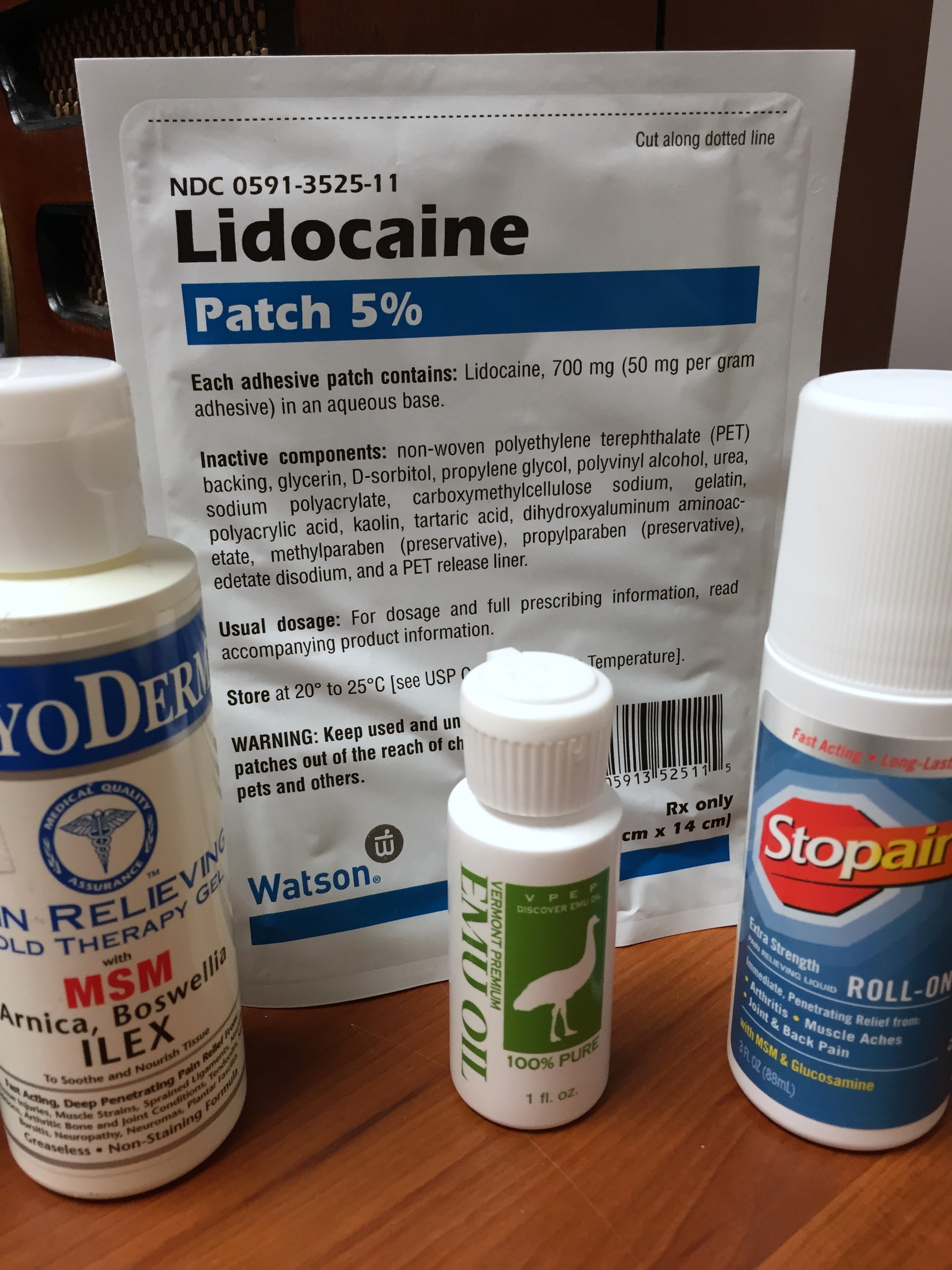
Cryoderm has been my go-to for years, because it is, as they claim, “as cold as ice.” It has 10 percent menthol and also contains arnica and boswellia, the former of which has been used for centuries to control bruises and swelling. The latter is a solid anti-inflammatory agent. Cryoderm also makes a number of heat-producing products, one of which I own.

I use it on very cold winter days when the temperature makes me want to crawl back into bed. If I put it on during the rest of the year, I prematurely begin the process of menopause.

Anyway, just because I am a big fan of Cryoderm does not mean I haven’t tried other things, such as…

Emu oil: Last year I was at the Big E (only the greatest annual fair in the northeast, where all food is deep fried, even the Kool Aid) when, naturally, I gravitated toward a booth that was hawking pain relief products. They all centered around emus. Yes, that flightless bird from Australia. Apparently its oil can be used for anything, from cracked heels to unsightly patches on your skin. I used it for pain purposes, and I found it to be lacking. Not only was it difficult to apply, but it was ineffective. My search continued.

Arnica cream: This took the inactive ingredient in Cryoderm and went whole-hog by making it the active ingredient -- nay, the only ingredient. I think this would do a bang-up job of healing something acute, like bruises immediately following an injury. But for chronic, long-term pain, I was left wanting.

Lidocaine patches are available by prescription only, though there are some almost-as-powerful creams and patches online. I only get 10 at a time because they normally are not covered by my insurance.

These things are fantastic. If I could wrap myself in one like a big numb burrito, I would.

It contains 700 mg of lidocaine, which, based on the word’s suffix, you might recognize as a numbing agent similar to novocaine.

You can slap one on for 12 hours at a time; however, like any other sticky product, it can irritate the skin. These are perfect for very bad days, but what’s the next best thing if you can’t get your insurance to cover them?

Stopain. I have to admit, I was skeptical when my grandmother suggested this. Here is a close transcript our conversation:

“Honey, I saw this thing on TV that works on bad backs. You gotta get it.”

For reference, my grandmother is a Jew from Brooklyn in her upper eighties. She wears tracksuits with heels, always has makeup on, and has the best white Jewfro you could possibly imagine. Since friends and relatives are always suggesting pain relief products (which I do appreciate), I didn’t put much stock in what she said.

“Grandma, you can’t always believe that ‘As seen on TV’ stuff.'"

I didn’t actually say “stuff.” I said another word that starts with “S.”

“You watch your mouth with me, kiddo. Give it a try. C’mon, do it for me. The commercial said it really worked!”

So I bought it to humor her and let it sit in its packaging for about a week once it arrived. Then, when I ran low on my Cryoderm bottle, I gave it a whirl. I was prepared for it not to work, since the Cryoderm has 10 percent menthol and Stopain only has 8 percent, but... I was incredibly surprised.

I’ve been using it for a few weeks now, and I think it actually works better than the Cryoderm despite having less menthol. What it lacks in that ingredient, it makes up for in boswellia, arnica, eucalyptus oil, peppermint oil, and other things I can’t pronounce. It’s a veritable cornucopia of pain-relieving ointments.

So there you have it. Hopefully my experiences have saved you some time, and if not, at least you will smell delightful to any feline companions.

J. W. Kain is an attorney in the Greater Boston area who also works as a writer and editor in her spare time.  She has chronic back and neck pain after two car accidents.

You can read more about J.W. on her blog, Wear, Tear, & Care.  

The information in this column should not be considered as professional medical advice, diagnosis or treatment. It is for informational purposes only and represents the author’s opinions alone. It does not inherently express or reflect the views, opinions and/or positions of Pain News Network.