By Pat Anson
The DEA’s recent decision to classify concentrated forms of the kratom alkaloid 7-OH as an illegal controlled substance has resurrected an old argument: Is kratom itself an opioid?
Kratom comes from the leaves of the Mitragyna speciosa tree in southeast Asia, where it has been used for centuries as a natural stimulant and pain reliever. Kratom is a botanical cousin of the coffee plant, which relieves pain through a natural alkaloid we all know: caffeine.
No one calls caffeine or coffee an opioid, do they?
Only in recent years has the “opioid” label been attached to kratom, mainly by government regulators and the addiction treatment industry. Former FDA commissioner Scott Gottlieb, MD, was the first to do so, warning in 2018 that kratom should not be used to treat pain or any other medical condition.
“Claiming that kratom is benign because it’s ‘just a plant’ is shortsighted and dangerous,” said Gottlieb, who now serves on the board of directors for Pfizer. “It’s an opioid that’s associated with novel risks because of the variability in how it’s being formulated, sold and used recreationally.”
Gottlieb’s remarks were based on an FDA computer analysis of kratom, which found that 7-hydroxymitragynine (7-OH), mitragynine and other kratom alkaloids share similarities with opioid analgesics.
Like morphine and oxycodone, the alkaloids bind to mu-opioid receptors in the brain and relieve pain. But unlike opioids, they are partial agonists that do not cause respiratory depression. The vast majority of kratom-related “overdoses” occur because people mixed kratom with other substances that depress breathing, such as alcohol or benzodiazepines.
Nevertheless, Gottlieb insisted on calling kratom an opioid.
“Based on the scientific information in the literature and further supported by our computational modeling and the reports of its adverse effects in humans, we feel confident in calling compounds found in kratom, opioids,” Gottlieb said.
Critics called the FDA analysis “junk science,” citing numerous errors and signs of bias.
One such critic was Brett Girior, MD, Assistant Secretary for Health and Senior Advisor for Opioid Policy at HHS, who said the FDA analysis of kratom was based on "embarrassingly poor evidence.” It was Girior who put a temporary end to the FDA’s efforts to have the DEA classify kratom’s alkaloids as Schedule One controlled substances.
“While mitragynine and 7-hydroxymitragynine have many properties of an opioid, scheduling these chemicals at this time in light of the underdeveloped state of the science would be premature,” Girior wrote in a 2018 letter to the DEA administrator. “There is significant risk of immediate adverse public health consequences for potentially millions of users if kratom or its components are included in Schedule I.”
‘The DEA Should Control Kratom’
Flash forward 8 years, and the FDA is once again trying to schedule 7-OH and kratom is being called an opioid, although the science behind that claim really hasn’t changed.
“Like other opioids, kratom is highly addictive: Repeated use leads to tolerance, dependence and the need for progressively higher doses,” wrote Andrew Kolodny, MD, an addiction treatment psychiatrist, in a recent op/ed in the The Washington Post.
“The DEA should control kratom in all its forms. Until it does, an opioid will be available for purchase without a prescription, the number of Americans suffering from opioid use disorder will keep rising, and there will be no end to the opioid crisis in sight.”
Kolodny is a familiar name to many pain sufferers. He is the founder and president of Physicians for Responsible Opioid Prescribing (PROP), an anti-opioid activist group that played an influential role in getting the CDC to draft its controversial 2016 opioid prescribing guideline.
The CDC’s recommendations led to millions of patients being abruptly taken off opioids or reduced to ineffective doses. Some died by suicide or turned to the black market for relief, which helped fuel the fentanyl crisis.
Meanwhile, Kolodny and several other PROP members went on to make millions of dollars testifying as “expert witnesses” in opioid litigation cases. Their demonization of opioid medication is what led many Americans to start using kratom as a pain reliever.
That irony isn’t lost on pain patients, who left some choice comments about Kolodny and his op/ed on PNN’s Facebook page.
“He's a pain grifter making his $$$$ off people suffering from chronic pain,” said one.
“He'll naturally piss on any treatment for chronic pain that doesn't include Suboxone or a shrink trying to gaslight you into saying nothing is wrong!” said another.
“If kratom hadn't saved my life over 20 years ago, I wouldn't be alive to be able to type this comment and call this article out as blatant misinformation,” wrote another pain sufferer.
Koldony testified in federal court a few years ago that he stopped treating patients when he became Medical Director for Opioid Policy Research at Brandeis University. In his op/ed, Kolodny said he was treating addiction again and that “a growing share” of his patients developed opioid use disorder by consuming kratom.
At a recent public hearing in Georgia, Kolodny went further, claiming “all of the patients” he was treating had become addicted to kratom. He said a substance doesn’t have to come from the opium plant to be an opioid, citing the skin of the waxy monkey tree frog, which contains “an extremely potent opioid” that is stronger than morphine.
Kolodny also cites a misleading CDC study that found “poisonings and hospitalizations involving kratom have risen 1,200 percent over the past decade.”
That 1,200% increase sounds horrific, but it is based on fairly small numbers. The total number of “adverse events” involving kratom was 538 in 2025, compared to 43 cases in 2014. That’s where the 1,200% figure comes from. About half of those reports were considered “intentional misuse” or suspected suicide attempts.
The 1,200% spike in cases reflects the simple fact that more Americans are using kratom today than in 2014. Conservative estimates put the number at 2 million, although the kratom industry has a much higher estimate of 20 million. Either way you slice it, 538 cases out of 2 or 20 million kratom users is a very low rate for adverse events.
Coincidentally, in 2025 the FDA received 538 reports of adverse events involving Suboxone, a medication used to treat opioid use disorder. And there were over 4,800 adverse events involving aspirin that same year.
No one talks about banning Suboxone or aspirin, or protecting us from waxy monkey tree frogs.
Kratom Treats Addiction
Just like the labeling of kratom as an opioid, the term "kratom use disorder" is also a recent invention, first used in 2021 by a group of addiction psychiatrists seeking to establish a clinical consensus for diagnosing and treating kratom addiction with Suboxone.
One of the ironies in that framing of kratom is that the National Institute of Health recently announced plans to investigate the kratom alkaloid mitragynine as a treatment for addiction.
Many kratom users are already doing so. In a 2016 PNN survey of over 6,000 kratom consumers, about one in ten said they used kratom to reduce their cravings for opioids or alcohol, with over 90% saying it was “very effective.”
“This is an herbal blessing that has kept me from drinking,” said one. “If it becomes illegal, I fear we may never truly be able to study and treat ailments that kratom helps with.”
A more recent survey by 7-Hope Alliance, a 7-OH advocacy group, found that 23% of 7-OH consumers use it to self-treat opioid addiction. The vast majority – 74% – use it to relieve chronic pain.
Mac Haddow, a lobbyist and spokesman for the American Kratom Association (AKA), thinks the effort to frame kratom as an opioid is being driven by the addiction treatment industry.
“I think the more difficult problem is with addiction recovery centers because they’ve become very active in the kratom space, and they're calling it an opioid. They want to say that because they have to be able to qualify a so-called kratom addicted person in order to be reimbursed for the treatments that they provide,” Haddow told PNN.
“To me, that's problematic because that's a profit-centered assessment as opposed to a medical assessment, and clearly they are in the business of calling it an opioid so they can get reimbursement.”
‘7-OH Opioid Products’
One of the weirder ironies in the labeling of kratom is that the AKA, which represents natural leaf kratom vendors, is leading the fight to have concentrated 7-OH products banned. The AKA has even resorted to calling 7-OH an opioid, just like Kolodny and Gottlieb.
In a recent PNN op/ed, Haddow said 7-OH manufacturers have created “7-OH opioid products.”
“They took a naturally occurring trace alkaloid found in kratom leaf and chemically manipulated it into highly concentrated 7-OH-dominant opioid products, then pushed those products into the marketplace without the guardrails that would apply to any legitimate opioid drug product,” Haddow wrote.
7-OH advocates say the AKA is trying to drive out competitors who have cornered a large share of the kratom market with a superior product. Asked to explain how 7-OH could be an alkaloid in small amounts but an opioid in larger doses, Haddow said 7-OH manufacturers turn it into a “completely different compound.”
“I could be wrong, but I think that the conversion from its trace amounts into a highly concentrated amount, then its activity on the new opioid receptors, is what distinguishes it,” Haddow explained. “It's not natural. There's nothing natural about the 7-OH that's sold in these highly concentrated forms because it's been chemically managed.”
The DEA disagrees. In its scheduling order for 7-OH products in the Federal Register, the DEA says the 7-OH molecule chemically remains the same – whether in natural leaf kratom or in concentrated versions.
“Despite the different origins of 7-hydroxymitragynine, the chemical structures of synthetic and naturally occurring 7-hydroxymitragynine are identical. Consequently, the intrinsic pharmacological profile, receptor affinity, and mechanism of action of 7-hydroxymitragynine molecule remain unchanged regardless of its source.”
They may share the same molecule, but the DEA is not seeking to ban natural leaf kratom, only the concentrated 7-OH formulations. It says those products “pose significant safety risk to unsuspecting consumers by exposing them to high doses of opioids.”
There’s that pejorative word again: opioids.
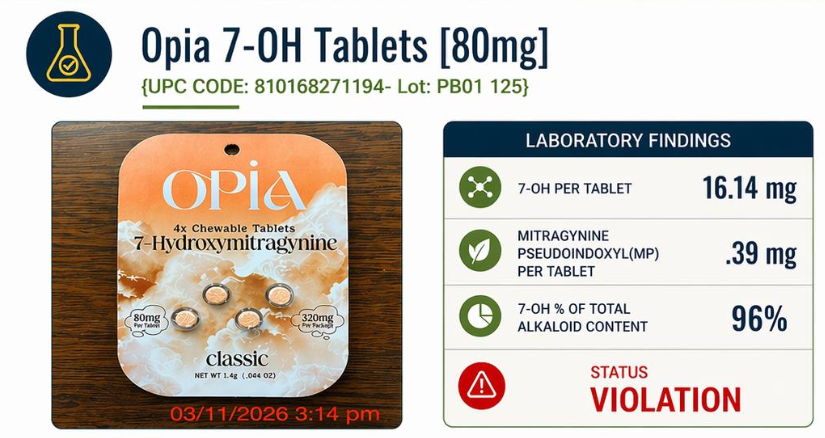
To be clear, 7-OH products are potent analgesics. And like any drug, when used excessively or irresponsibly, they can pose safety risks. 7-OH manufacturers haven’t done themselves any favors by selling their products without warning labels and in child friendly packaging that resembles candy.
7-OH products have been easy to get in gas stations, smoke shops and online, but that era is rapidly coming to a close. Several states and dozens of cities and counties have already banned 7-OH products, and soon there will be a nationwide ban on them.
Like other attempts at prohibition, whether for alcohol, marijuana or prescription opioids, there will be unintended consequences. 7-OH products seem destined to become hot items on the black market and it’s reasonable to assume that drug cartels will start selling counterfeit 7-OH tablets or exotic new formulations of kratom alkaloids.
The DEA will have new drugs to target and more people to arrest. And the addiction treatment industry will have millions of new patients to prescribe Suboxone to.
No one called kratom an opioid until they wanted it banned. And figured out a way to make money from it.
“That's a fair assessment. I agree,” says Haddow.