Hospital’s Opioid Guidelines Had Significant Impact

By Pat Anson, Editor

An opioid prescribing guideline adopted in 2013 at Temple University Hospital in Philadelphia may provide a sneak peek at the possible impact of similar guidelines being considered by the Centers for Disease Control and Prevention (CDC).

Temple University’s guidelines, which discourage opioid prescribing for many emergency room patients suffering from acute or chronic pain, resulted in an “immediate and sustained impact” on rates of opioid prescribing, according to research published in the Journal of Emergency Medicine.

In a study of over 13,000 patient visits, the rate of opioid prescribing was quickly reduced by about a third, falling from nearly 53% of emergency room visits before the guideline to about 34% a year later. The patients were being treated for dental, neck, back and chronic non-cancer pain.

The opioid guidelines were supported by all 31 of the hospital’s emergency room physicians who completed a survey on their prescribing practices. Most of the doctors (97%) felt the guideline facilitated discussions with patients when opioids were withheld, and nearly three-quarters said they encountered “less hostility” from patients since adoption of the guideline.

temple university hospital

temple university hospital

Only 13% of the doctors believe patients with legitimate reasons for opioids were denied appropriate care. A large majority – 84% of the doctors -- disagreed or strongly disagreed that patients were denied appropriate pain relief.

The researchers did not ask any pain patients what they thought about their hospital care.

“Emergency physicians have identified themselves as targets for patients who seek opioids for nonmedical purposes, yet it can be difficult for clinicians to distinguish drug seeking behavior from legitimate need. Recognizing the importance of clinician discretion at the bedside, adherence to our guideline was voluntary,” said Daniel del Portal, MD, Assistant Professor of Clinical Emergency Medicine at the Lewis Katz School of Medicine at Temple University, who was principal investigator of the study.

The CDC also considers its draft guidelines voluntary for primary care physicians, although many experts believe they will quickly be adopted as “standards of practice” by all doctors who prescribe opioids – just as they were at the hospital.

The Temple University guidelines differ from those of the CDC because they are designed specifically for emergency room physicians. They discourage doctors from prescribing opioids for dental pain, back pain, migraines, gastroparesis or chronic abdominal pain; and recommend that patients not be discharged with more than 7 days supply of opioids (the CDC recommends 3 days supply). The hospital’s guidelines also recommend that long acting opioids such as OxyContin, morphine and methadone not be prescribed; and that “less addictive therapies” such as NSAIDs or acetaminophen be used instead for pain relief.  

“We acknowledge the myriad challenges to addressing issues of chemical dependence and opioid abuse. We do not pretend that a guideline alone will solve this problem, but rather we believe that guidelines are one of a number of tools that should be considered in parallel,” said del Portal.

In contrast to electronic prescription drug monitoring programs, which show promise but require significant infrastructure and regulation, an easily implemented guideline empowers physicians and protects patients from the well documented dangers of opioid misuse.”

He also acknowledged that limits on opioid prescribing may result in more drug abuse and addiction.

Heroin overdose deaths have continued to rise, even more dramatically since the plateau of nationwide opioid prescriptions
after 2011. While experts point to the rise in opioid prescriptions as a major contributor to heroin deaths, we are mindful that limiting the supply of opioids may provide a catalyst for drug substitution,” he said. 

The public comment period on the CDC's draft guideline continues until January 13th. You can make a comment by clicking here

The proposed prescribing guidelines and the reasoning behind them can be found in a 56-page report you can see by clicking here.


Imaging Identified as Most Wasteful Medical Test

By Pat Anson, Editor

Should you get an MRI for your headache?

What about a CT scan for low back pain?

Or a bone-density scan for someone under the age of 65?

In most cases, the answer to all of those questions is no, according to the Choosing Wisely campaign of the ABIM Foundation, which seeks to reduce the use of hundreds of unnecessary and costly medical tests. Experts say an MRI or CT scan of the lower back can cost over $1,200 and does nothing to relieve your back pain.

Since Choosing Wisely was launched in 2012, over 370 wasteful procedures have been identified by over 70 medical societies, such as the American Academy of Sleep Medicine and the American Academy of Neurological Surgeons. Each organization was asked to identify an initial list of five medical services that may be unnecessary. Many societies went far beyond that, returning with two or even three lists.

A neurologist at the University of Michigan says the list of recommendations from the American Academy of Neurology (AAN) only scratches the surface. Brian Callaghan, MD, has identified 74 tests and procedures related to neurology that are often unnecessary. Many involve the use of imaging.

“The two biggest areas that might be done more than they should are imaging for low back pain and imaging for headaches,” Callaghan said. “It’s a big problem and it costs a lot of money – we’re talking a billion dollars a year on just headache imaging.”

According to a recent study at the University of Michigan, one in eight visits to a doctor for a headache or migraine end up with the patient going for a brain scan. Often a doctor will order a CT or MRI scan to ease a patient’s fear that they may have a brain tumor or some other serious issue causing their pain. Physicians could also order a scan to protect themselves legally in case of a future lawsuit.

In most cases, however, the brain scan will be useless. Previous research found that only 1 to 3 percent of brain scans of patients with repeated headaches identify a cancerous growth or aneurysm that's causing the problem. Many of the issues that a scan might identify don’t pose a serious threat or may not require treatment right away. There is also the risk of a false positive that could generate unnecessary fear and alarm.

“These are all areas where lots of physicians agree that you’re more likely to get harmed by doing the procedures,” said Callaghan, whose study was recently published in the journal Neurology.

Callaghan isn’t encouraging you to say no if your doctor wants to image your brain or lower back, but he hopes his research will inspire a thoughtful discussion between doctors and patients about the purpose of the test and its value

“Ordering an MRI for a headache is very quick, and it actually takes longer to describe to the patient why that’s not the best route,” Callaghan said. “These guidelines are meant for physicians and patients both, to trigger a conversation.”

Besides imaging, another treatment that is widely questioned is the use of opioid pain medication to treat headaches and migraine. The Choosing Wisely campaign recommends that opioids only be used as a last resort for severe headaches, including migraine. Overuse of any pain reliever – even over-the-counter medications -- are known to make headaches worse.

Chronic Pain? There’s an App for That

By Pat Anson, Editor

Smartphones have revolutionized the way we communicate. And they are fast becoming a tool in the treatment of chronic pain.

Wearable medical devices linked to smartphones can not only do simple things like track your pulse and blood pressure, they can help relieve some types of chronic pain without the use of drugs. Several of these new medical devices are being showcased next month at the 2016 International Consumer Electronics Show (CES) January 6-9 in Las Vegas.

One device making its debut at the trade show is the iTens, the first FDA-cleared wireless TENS device that works via an iPhone or Android based app.

Transcutaneous Electrical Nerve Stimulation (TENS) has been used for decades to relieve pain by using electrical stimulation to block or mask pain signals. But the old TENS units typically come with many wires, are anything but portable, and could only be used for limited 30-minute periods.

images courtesy of itens

images courtesy of itens

“The iTENS device was created for people who are in need of a portable, convenient method of pain management that doesn't involve taking prescription medication,” says iTENS CEO Joshua Lefkovitz. “We designed the iTENS to be thin, flexible, discreet, and easy to operate with the push of a button from the iTENS app.”

The iTens uses peel ‘n’ stick gel pads that can be directly applied to painful areas. The pads are powered by a lithium-ion rechargeable battery that can provides relief for up to 24 hours.  During that time, the iTENS app measures a user’s pain scale, tracks their results, and charts their progress.

“We’ve got the first clearance from the FDA that has a Bluetooth enabled app,” Lefkowitz told Pain News Network. “There are other wireless TENS devices out there, but none of them are app-enabled.

“It’s really cool, because with an app you can roll in new settings. We’ve got body part settings, condition-specific settings, and you’ve got manual settings so you can pre-program whatever settings you want.”

The iTens device will become commercially available in March for $89.95. No prescription is needed and the device is “FDA-cleared” – meaning the Food and Drug Administration has approved iTens’ safety, but not necessarily its efficacy.

Device makers have a huge advantage over pharmaceutical companies because they are held to a lower regulatory standard and often can get fast track approval from the FDA without any clinical studies – as long as the new device is substantially the same as an old device already on the market.

One disadvantage to that approach is that without full FDA approval, few insurance companies are likely to offer reimbursement for a wearable medical device and physicians are less likely to recommend them.

That conundrum will be addressed at the CES trade show in a panel discussion titled “Roadmap to FDA Approval.” One of the speakers is Shai Gozani, President and CEO of NeuroMetrix Inc., maker of the Quell pain relief device, a neurostimulator worn below the knee

“If wearable technology is going to achieve its tremendous potential it must move beyond wellness to tackling fundamental health problems such as chronic pain, diabetes, and heart disease. This necessarily implies regulation by the FDA,” said Gozani. “I hope this panel will start to demystify the regulatory process and encourage technology companies to embrace the opportunity of consumer medical technology.”

The FDA issued guidance earlier this year on the types of apps that would be subject to regulatory review. The agency said it was not trying to stifle innovation and the regulations would only apply to a  “small subset of mobile apps that are medical devices and present a greater risk to patients if they do not work as intended."

The goal is not to regulate “wellness” apps that keep track of things like fitness and nutrition, but apps that make specific claims about diseases and conditions.

According to industry estimates, by 2018 over half of the world’s 3.4 billion smartphone and tablet users will have downloaded mobile health applications

Most Patients Still Prescribed Opioids After Overdose

By Pat Anson, Editor

The vast majority of chronic pain patients continue to be prescribed opioids after a non-fatal overdose, usually from the same doctor who prescribed the pain medication that led to the overdose, according to new research published in the Annals of Internal Medicine.

In the study of nearly 2,850 patients who were treated for an opioid overdose, 91% were prescribed another opioid within 300 days of the overdose. About 70% of the prescriptions were written by the same provider. Data for the study was collected from insurance claims filed from 2000 to 2012.

"Our finding that almost all patients continue to be prescribed opioids after overdose is highly concerning,” wrote lead author Marc Larochelle, MD, Boston Medical Center. “The overdoses we detected were captured in routine claims data and treated in emergency departments or inpatient settings and thus represent identifiable events when information sharing might lead to improved care and outcomes. Further research is needed to determine whether providers continuing to prescribe opioids after an overdose are aware of the event and, if so, how they respond in counseling patients.”

The researchers found that about 7% of pain patients had a second overdose and those who were prescribed high doses of opioids had twice the risk of a repeat overdose.

Even more disturbing is that over half of the overdose patients (58%) were prescribed benzodiazepines, anti-anxiety medication that includes brand names such as Valium and Xanax.

Benzodiazepines are known to greatly increase the chances of an overdose. A recent CDC study found that about 80% of unintentional overdose deaths associated with opioids also involved benzodiazepines.

Due to limits in the data, researchers had no way of knowing why physicians continued to prescribe opioids after their patients overdosed.

“We could not determine reasons for the treatment patterns after the overdose; however, some prescribers may have been unaware that the opioid overdose had occurred,” said Larochelle. “In some cases, overdoses may have reflected therapeutic error rather than opioid misuse. In these and other cases, providers may have believed that the risk–benefit ratio favored continued opioid prescribing.”

In an editorial published in the Annals of Internal Medicine, Jessica Gregg, MD, called the study’s findings “astonishing.”

“Prescribing guidelines are clear that adverse events, such as overdose, are compelling reasons to withdraw prescription opioids. Therefore, it is tempting, and it would be easy, to attribute these results to poor care, bad decisions, or sloppy prescribing,” wrote Gregg, who is an associate professor of medicine at Oregon Health & Science University. “However, the problem goes well beyond individual prescribers' practices. These prescribing behaviors occur in a context in which substantial -- even deadly -- mistakes are inevitable. For instance, it is likely that many of the prescribers in the study did not know about their patients' overdoses.

“There are currently no widespread systems in place, either within health plans or through governmental organizations, for notifying providers when overdoses occur. Until such systems exist, providers will be left to act with dangerously limited knowledge. They will be unlikely to decrease or withdraw a patient's opioid prescription after an overdose if they have no knowledge that the event occurred.”

To make doctors more aware that their patients may have had overdoses, the researchers recommend that overdose data be included in prescription drug monitoring programs (PDMPs) which are now currently used to track prescriptions.

Give and Take Needed on CDC Guidelines

By Fred Kaeser, Guest Columnist

I wish we could all get along. Millions of people in chronic pain usually need opioids in adequate supply in order to manage their day and have some semblance of a quality of life. At the same time, tens of thousands of people's lives are destroyed, ruined, and ended each year from the very same drugs we pain sufferers find comfort from.

Looking objectively at the situation, there needs to be humane action on both sides of this conundrum. Whatever the result of the CDC's new prescribing guidelines, people in chronic pain must not be denied adequate access to opioids when absolutely needed, and yet some action needs to occur to reduce the outrageous rates of opioid addiction.

Think of what has happened in 15 very short years. We have gone from thinking that long term opioid use should only be provided for end-of-life care; to thinking that it is appropriate and acceptable to provide opioids on a regular basis for a myriad of pain causing illnesses and syndromes; back to thinking they are too dangerous and should be sharply limited. All within a 15-year period.

Yes, opioids reduce pain, just what all of us pain sufferers want. And yes, opioids destroy lives, something none of us want.

The truth is there have been no studies of long term opioid usage. And we know very little about just who is more prone to succumbing to the addictive aspects of these drugs once they are used for any length of time.

I do think there has got to be some give and take on both sides. The CDC has to understand that many, many chronic pain sufferers do indeed improve the quality of their lives by taking opioids. And I do think that we pain patients have to show a good faith effort that we are doing all we can to mitigate our pain through alternative pain treatments.
If you look at the CDC survey results attached to this website, you will see that almost 100% of pain respondents report little or no relief from alternative pain strategies. Over half of us say alternative strategies don't work and over a third of us say that they provide little relief.

Yet, if one explores the rich empirical research that exists on exercise, yoga, mind-body techniques like meditation and guided imagery, and their various permutations, we see that they can have a profound effect on reducing pain and discomfort. There is a huge body of research that supports just how powerful of an effect these modalities can have on reducing pain. Yet, almost all of us say they have little if any effect.

So, how can this be? I can only speak for myself, but when my pain started to become constant and severe I too did not think any of these alternative techniques were worth it. The time, energy, and sometimes additional pain that went in practicing them just didn't seem worth it. After all, I could find significant relief in 20 minutes or so just by taking 10 milligrams or so of oxycodone.

So why go through all that other stuff when I could be feeling relief in less than a half hour? But as my pain became every day, all day, I decided that I wasn't going to walk hand-in-hand the rest of my life with a drug that could very easily do more harm to me than the medical condition I was taking it for.

Days, weeks, and months went by of every day hard work. Exercise, stretching, yoga techniques, learning different meditation strategies, etc. were not easy. Amazingly, none of it cost much in terms of money, but the cost in terms of energy and time that went into practicing them was considerable. BUT, there came a time when it all started to pay off.

The research is correct: alternative pain techniques do work. Maybe not for YOU, but enough so that many of us could be finding significantly more relief than just from our medication. And it doesn't necessarily mean that we still don't need pain medication to get through our pain, but it will likely mean we'll need less of it.

I do think this is what is needed. Some give and take from both sides of the equation.

Fred Kaeser, Ed.D, has suffered from back pain, osteoarthritis and other chronic conditions for most of his life. He recently wrote a column about how he uses exercise to manage his pain.

Fred is the former Director of Health for the NYC Public Schools. He taught at New York University and is the author of "What Your Child Needs to Know About Sex (and When): A Straight Talking Guide for Parents." Fred enjoys exercising, perennial gardens, and fishing.

The information in this column should not be considered as professional medical advice, diagnosis or treatment. It is for informational purposes only and represent the author’s opinions alone. It does not inherently express or reflect the views, opinions and/or positions of Pain News Network.

Finding the Right Strain of Medical Marijuana

By Ellen Lenox Smith, Columnist

As a medical marijuana patient and caregiver since 2007, I would like to share some thoughts and observations about a recent survey by Care by Design, a medical cannabis company based in California.

They surveyed 621 patients who had been using medical marijuana for over 30 days, asking them about:

1. The conditions for which they are taking cannabidiol (CBD) rich cannabis

2.  The ratio of CBD-to-THC (tetrahydrocannabinol) they are using

3. The impact of CBD-rich cannabis therapy on their pain, discomfort, energy, mood, and overall well being

I would like to address three areas about the survey findings, based on my personal use of medical cannabis and the patients we assist as caregivers.

“Patients with psychiatric or mood disorders and patients with diseases of or injuries to the CNS (central nervous system) system favor CBD-dominant cannabis therapies,” the survey found. “Patients with pain and inflammation favor CBD-rich cannabis therapies with more equal levels of CBD and THC.”

I have to agree with this personally and also through observation of the people we have helped find their correct medical marijuana strain. I now sleep better at night using a night oil made with a high CBD ratio. I found that when I used another strain that has a higher THC ratio, I experienced some strange head sensations that I did not enjoy. But when I use the higher CBD mix, I do not experience those odd sensations and can safely get out of bed without concerns.  

One patient, who has numerous medical issues including depression and post-traumatic stress disorder (PTSD), has found she does well mixing a day sativa plant with the highest CBD plant we have (24% CBD/1% THC) called ACDC. She uses this mixture both day and night and finds it addresses her levels of pain more effectively. Just using the high CBD strain does not address her pain.

Another patient, a scientist, was just thrilled switching to the new high CBD plants we grow. He has found that his mood is calmer and his PTSD is under control. He is a thriving, productive worker again with no negative side effects

I correspond with many people online and one person who uses legally pure CBD found that it did address her pain. Many will not be that successful with just pure CBD and most need some THC to address pain.

The Care by Design report also states that “THC matters. A higher ratio of CBD to THC does not result in better therapeutic outcomes. Patients using the 4:1 CBD-to-THC were the most likely to report a reduction in pain or discomfort, and improvements in mood and energy.

“Patients using the 2:1 CBD-to-THC ratio reported the greatest improvement in overall wellbeing. This finding is consistent with scientific research indicating that CBD and THC interact synergistically to enhance one another’s therapeutic effect.”

I have to totally agree with the above statement. Most will not be lucky and find success without some THC in their medicine.

People tend to have a negative attitude towards THC because it makes them high and think medical marijuana strains work better without THC or lower ratios of it. But we have not had one patient that just uses the highest CBD plant alone. They appreciate the fewer “head issues” that come from reduced THC, but quickly find that their medical problems are not being addressed successfully until they use a mixture with more THC.

Finally, they survey report states that, “CBD-rich cannabis’ does not appear to have a significant impact on energy levels (as compared to pain, discomfort or mood).”

I am living proof of that, as are all the patients we have worked with using medical marijuana. When I need a boost on a tough pain afternoon, I find vaporizing or using tincture from the high CBD plant does not provide an increase in energy. However, when I use the 2:1 ratio that includes more THC, I not only get pain relief but also increased energy and interest in being involved with life again.

As the study found and we have found, you still have to experiment with dosage and ratios to find the correct type of medication strain to successfully alleviate your issues.

Using medical marijuana will never be like it is going to the pharmacy. One pill does not fit all and one strain does not fit all. No single ratio is right for all people, even when dealing with the same conditions.

Ellen Lenox Smith and her husband Stuart live in Rhode Island. They are co-directors for medical marijuana advocacy for the U.S. Pain Foundation and serve as board members for the Rhode Island Patient Advocacy Coalition.

For more information about medical marijuana or to contact the Smith's, visit their website.

The information in this column should not be considered as professional medical advice, diagnosis or treatment. It is for informational purposes only and represents the author’s opinions alone. It does not inherently express or reflect the views, opinions and/or positions of Pain News Network.

Medical marijuana is legal in 23 U.S. states and the District of Columbia, but is still technically illegal under federal law. Even in states where it is legal, doctors may frown upon marijuana and drop patients from their practice for using it.

Don’t Blame CDC for Poor Pain Care

By David Becker, Guest Columnist

Doctors have been undertreating and mistreating people in pain long before the Centers for Disease Control and Prevention (CDC) started recommending guidelines for opioids. Doctors have been doing such since at least the 1970’s.

The CDC doesn't tell doctors to provide half the pain care to blacks and Latinos that white folks obtain -- they do that all by themselves.

The CDC doesn't tell doctors to misdiagnose migraines, interstitial cystitis, RSD, fibromyalgia, and Lyme disease -- doctors do that all by themselves.

The CDC doesn’t tell doctors to tell elderly people that they should be in pain or that children’s pain is inconsequential -- they do that all by themselves.

The CDC doesn't tell pain specialists to ignore marijuana or triptolides or triterpenes or deoxy glucose or intrathecal hydrogen or stem cell therapy for pain -- doctors do that all by themselves.

Doctors were sold on the idea of using opioids for pain because pain specialists were connected to opioid manufacturers, as Sen. Grassley’s Finance Committee ascertained.

What they could have and should have done is require all doctors to have adequate education in pain care and make the best use of all pain treatments for people in pain. Doctors were so averse to having education in pain care that even after the FDA required drug manufacturers to provide free education on opioids, less than 20% of doctors obtained such.

Once doctors have complete education in pain care, then they can be held to a higher standard, and obviously they are opposed to such. Even the pain specialty organizations that allegedly care so much about pain patients didn't support legislation in New York state requiring doctors to have education in pain care.

Poor pain care in any nation is not merely a function of providing opioids or not. That is the reductionist thinking medicine and pharmaceutical companies have promoted. And how often do you see those same organizations promote the use of marijuana or the full use of all resources to treat pain? How often do they even mention stem cell therapies or stacked therapies or treat to target?

The CDC is essentially no different than the FDA, National Institutes of Health or pain specialty organizations -- or the 80 so-called experts that created the National Pain Strategy to essentially promote a simplistic one-size fits all approach. They care little for the input or needs of individuals in pain.

Until individuals in pain have more rights and a greater say over their care, doctors, pain specialists and the CDC will continue to impose their visionless plans on the public and patients.

Too many individuals in pain remain stuck in a Kafkaesque theater of the absurd pain care system with big brother calling the shots. Frankly, to accuse the CDC of being the bad guy misses the fact that too many other organizations in the health care system and in government have done a poor job of caring for individuals in pain.

Without the CDC or with the CDC, pain care will remain poor until real reforms are made in the whole pain care system.

David Becker is a social worker, patient advocate and political activist in New York.

The information in this column should not be considered as professional medical advice, diagnosis or treatment. It is for informational purposes only and represents the author’s opinions alone. It does not inherently express or reflect the views, opinions and/or positions of Pain News Network.

Purdue Settles OxyContin Lawsuit for $24 Million

By Pat Anson, Editor

Purdue Pharma has agreed to pay the state of Kentucky $24 million for misleading consumers about the risks of addiction to OxyContin. The settlement is the latest chapter in Purdue’s seemingly endless string of lawsuits over its popular and potent painkiller.

“Purdue Pharma created havoc in Kentucky, and I am glad it will be held accountable,” said Kentucky Attorney General Jack Conway. “Purdue lit a fire of addiction with OxyContin that spread across this state, and Kentucky is still reeling from its effects.”

Purdue did not admit to any wrongdoing in the settlement.

OxyContin was introduced in 1996 and soon became a blockbuster drug for Purdue, reportedly generating profits in excess of $10 billion. Many critics believe the drug also helped trigger an “epidemic” of opioid addiction and overdoses, causing the deaths of thousands of people nationwide.

Kentucky filed suit against Purdue in 2007 after company executives pleaded guilty in Virginia federal court to a felony count of falsely marketing OxyContin. Company sales representatives were encouraged to tell doctors the pain medication wasn’t additive and was less likely to be abused.

Purdue settled that case for $634 million and offered $500,000 to Kentucky, which the state refused.

This week’s $24 million settlement is over 50 times what Kentucky was originally offered. The money will be used to fund addiction treatment programs in Kentucky.

Purdue is still fighting a similar OxyContin lawsuit in Chicago. Another case in California was dismissed over the summer.

The original version of OxyContin could be easily crushed and liquefied by addicts to inject or snort for a quick high. OxyContin is now sold in an abuse deterrent formula that is harder to abuse.

“We are pleased to resolve this matter that arose from alleged conduct dating before July 2001, and long before we reformulated OxyContin to include abuse-deterrent properties.  This enables Purdue to focus on bringing additional innovative abuse-deterrent medicines to patients,” stated Philip C. Strassburger, Purdue Pharma’s General Counsel.

The reformulation hasn’t stopped the abuse of OxyContin. According to a large nationwide survey of nearly 11,000 opioid addicts who entered a treatment facility in 2012, over a quarter had used OxyContin at least once to get high in the previous 30 days.

Nearly 1,100 people died of overdoses in Kentucky last year, giving the state the dubious distinction of having the 4th highest overdose rate in the country. Many of those deaths are blamed on heroin, as well as prescription opioids.

Purdue as recently as this year was still trying to rein in aggressive marketing by its sales staff. In August, Purdue reached a settlement with New York’s Attorney General, admitting that its sales representatives contacted doctors in New York who were on a “No Call List.” The doctors had been red flagged by the company for possible abuse and diversion of opioids.

Purdue’s sales representatives, who amazingly were not required to check the company's No Call List, made over 1,800 sales calls to doctors on the list, even buying meals for about a third of them.  Some of those doctors were later arrested or convicted for illegal prescribing of opioids.

A company spokesman told Pain News Network that sales calls could have also been made to doctors on Purdue No Call Lists outside of New York.

Under the terms of the settlement, Purdue agreed to adopt more “red flags” to identify doctors who may be prescribing opioids inappropriately or illegally. Sales representatives will also be required to check the No Call List before contacting a provider and will be disciplined if they don’t

PROP and the ‘Opioid Lobby’

By Pat Anson, Editor

With its signature accomplishment under fire from pain patients, health professionals and even some congressmen, Physicians for Responsible Opioid Prescribing (PROP) is now engaged in a public campaign to discredit critics by labeling them as pawns of the “opioid lobby.”

PROP, an advocacy group funded by the addiction treatment chain Phoenix House, played a key role in drafting the controversial opioid prescribing guidelines developed by the Centers for Disease Control and Prevention (CDC). Five PROP board members serve on CDC panels that helped develop the guidelines, which discourage primary care physicians from prescribing opioids for chronic pain.

As many as 11 million Americans use opioids for long-term, chronic pain and many fear losing access to opioids if the guidelines are adopted.

The CDC planned to finalize the guidelines next month, but a wave of criticism that the guidelines are too restrictive, along with allegations that the agency violated federal law while secretly drafting them, forced the agency to reconsider.

“CDC’s plan was effectively blocked by intense pressure from the opioid lobby, which sees more cautious opioid use as a financial threat,” wrote PROP founder and Executive Director Andrew Kolodny, MD, in newsletter emailed Wednesday to PROP supporters. Kolodny is chief medical officer for Phoenix House.

“CDC was pressured into opening a federal docket on its draft guideline. This will tack months onto the process – it is also highly unusual – federal dockets are typically opened for public comment on proposed regulations – not for medical guidance issued by CDC,” Kolodny wrote.

In his “urgent request” to supporters, Kolodny asks them to visit this federal website and post comments in favor of the guidelines. He even offers several suggestions on what to write.

Over 600 comments have been received since the comment period opened on December 14 and many of the recent ones apparently are from PROP supporters. They often parrot instructions made by Kolodny in his newsletter.

“The medical community is urgently in need of guidance from CDC because aggressive opioid prescribing is harming pain patients and fueling an epidemic of addiction and overdose deaths,” wrote Janis McGrory, in a word-for-word rendition straight from Kolodny’s newsletter.

prop statement.jpg

"I am in full support of the CDC guideline calling for more cautious opioid prescribing. My son died at the age of 26. He was a heroin user that started from prescribed opioids for a back injury," wrote Veronica Deborde. "I am sure if the opioid lobbyist lost a child to opioid use they wouldn't even consider blocking the CDC."

"The havoc that drug addiction can reap, not only on individuals but their entire family, is beyond devastating. Please don't let big pharma and financial implications weigh in on the issue of public safety," wrote pharmacist Sarah Randolph.

"Opioid Lobby" Funding

It’s not unusual for advocacy groups to urge their supporters to take action or to instruct them on what to do. Several groups opposed to the guidelines have been doing the exact same thing. But Kolodny takes it a step further, by challenging the integrity of non-profits, medical societies and others who oppose the guidelines.

“This is a big win for the opioid lobby,” Koldony said last week in a widely reported Associated Press story about the CDC’s decision to delay implementing the guidelines.

“The story here is how the opioid lobby is using the Cancer Action Network to discredit a public health effort to limit opioid prescribing,” Kolodny told The Hill.

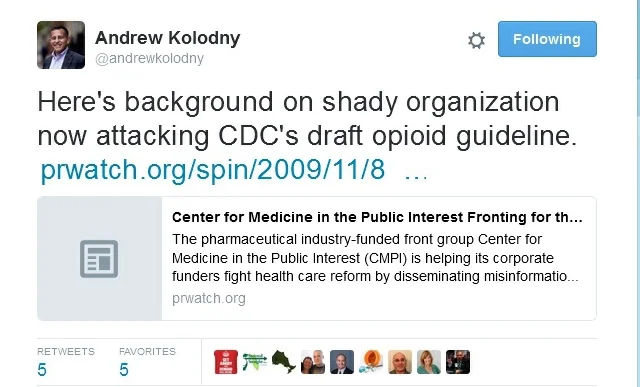
“Here’s background on shady organization now attacking CDC’s draft opioid guideline,” Kolodny wrote in a Tweet.

As far back as September, Kolodny apparently knew the guidelines would generate controversy. That’s when he told the Milwaukee-Wisconsin Journal Sentinel that the U.S. Senate Finance Committee should release details of a 2012 investigation of opioid manufacturers’ ties to medical groups.

Why dig up a 3-year old investigation? Kolodny told the Journal Sentinel his goal was to discredit pain organizations who might oppose the guidelines.

"By making the findings of the investigation public and exposing the financial relationships between pain organizations and opioid makers, it will be harder for them to claim that it is the interests of pain patients they are lobbying for," he said.

Kolodny has found many other eager listeners in the news media, who have adopted his views about opioids, the addiction and overdoses they can cause, and the alleged influence of the so-called opioid lobby.

For example, in a story this week headlined, “Makers of OxyContin Bankroll Efforts to Undermine Prescription Painkiller Reform,” The Intercept reported that opioid manufacturers “are funding nonprofit groups fighting furiously against efforts to reform how these drugs are prescribed.”

Among the groups singled out in The Intercept’s “investigation” was the Power of Pain Foundation, which has accepted funds from Purdue Pharma, the manufacturer of OxyContin.

Power of Pain President Barby Ingle, who is also a PNN columnist, is furious her non-profit was dragged into the controversy over a relatively small amount of money.

“Yes, to date (over the past 9 years) Purdue has given $15,000 total, all unrestricted grants to our foundation. A bulk of it is being used to produce our Music Moves Awareness project which will feature the stories of 20 pain patients with different pain diseases, all doing different pain treatments, representing youth, young adult, adult, and elderly patients,” said Ingle, a pain sufferer who happens to be allergic to OxyContin.

“None of our 10 voting board members takes opioid medications for any chronic illness. I also personally serve on the 2015 Purdue Pharma Patient Board of Advisory which paid me $100 for my personal opinions on the pain community and access to care issues.”

Another group often singled out as being part of the “opioid lobby” is the American Academy of Pain Management, which reportedly gets 10% of its revenue (about $300,000) from opioid manufacturers.

“Some have said that this delay (in the CDC guidelines) is a victory for ‘the opioid lobby,’ but I think it’s not really a victory for anyone,” said Bob Twillman, Executive Director of the American Academy of Pain Management. “It might be a victory for tried-and-true methods of developing practice guidelines, and a victory for transparency, but a delay in producing reasonable, workable guidelines actually does everyone a disservice. That could have been prevented, had CDC used a proper process from the beginning.”

The CDC’s public comment period on the guidelines continues until January 13th. You can make a comment by clicking here

The proposed prescribing guidelines and the reasoning behind them can be found in a 56-page report you can see by clicking here.

(For the record, Andrew Kolodny and I had a somewhat cordial and professional relationship until a few months ago, when he became unhappy with Pain News Network coverage of opioid issues and stopped communicating with me. PROP President Jane Ballantyne also has not responded to repeated requests for comment on various articles we’ve written about her.

PROP has a standing invitation from PNN for an op/ed column about its views on opioids and/or the CDC guidelines, which we would be happy to publish. The same offer is extended to other groups with similar views.)

Power of Pain: Making a Hospital Stay Easier

By Barby Ingle, Columnist 

Just as you should take a personal medical history to your doctor visits, being prepared for emergency room visits and hospital stays is also a good idea. A safe, smooth visit is exactly what you need when you are a chronic pain patient who is trying to heal or fight an illness.

I have unfortunately been to the hospital too many times now over the past 18 years. In the beginning, I did not go prepared. Nevertheless, through multiple visits, I have found a few things that allow me to get better treatment from the staff. 

For a better hospital stay, I now ask for a room in a quiet part of the hospital, as sharp and sudden noises exacerbate my pain. Most hospital rooms now have their own thermostat, so you can control your own temperature. If your room does not have its own, you can ask the nursing aide to assist with making you more comfortable, such as getting warm blankets.

When I am assigned a roommate, I ask for my bed to be farthest from the door so that their visitors don’t accidentally bump into me, and I can have less interruption with my resting. When possible, before their guests arrive, my husband or I inform them of my condition and how noise raises my pain levels. It is best to explain it to your roommate prior to his or her guest’s arrival so that he or she may explain it to them for better cooperation.

I have also learned to bring blankets and pillows from home. They are typically softer and my quilts are more comforting, both in warmth and as a reminder of home.

Most of the hospitals I have stayed in now offer an air mattress that can be used to adjust the bed to your preference. Comfort should be a big consideration so that you can heal faster.

It is almost unavoidable to not get poked with a needle as a patient in the hospital. They typically check blood at least once a day and use IV fluids to keep you hydrated. Medications are also administered with needles or through your IV. When they are drawing blood or putting in IV needles, ask for pediatric needles because any new trauma can cause RSD to spread to a new site.

If a person takes my blood and I find them to be supportive and cooperative, I have asked that they be the one to check my blood every time during that visit. I even had a nurse who agreed to come in to take my blood, even though she was off duty for one of the days I was in the hospital. I now have a “portacath” – a small catheter connected to a vein. I ask them to take blood draws from it for less needle poking.

While you are asking for better ways to get through a blood draw, have a nurse place a sign above your bed designating your affected limb(s). I had a nurse at the last hospital who put a red bracelet on my unaffected limb and a red sticker on my chart. This served as a good reminder to the nurse and aides as they walked into the room. They see multiple patients on your floor, and as patients come and go often, you want to stay on top of your care. Be your own “chief of staff” and employ the same practices at the hospital that you do with your regular doctors.            

I also bring to the ER and hospital a list of medications. Sometimes I have had to have my own brought in. I think it is good to have my own supply there so I can control when I take them. Otherwise, have the nurse check with the hospital pharmacy to see if they carry all of your medications. Nurses can’t always be there at the appropriate time to administer medications or help with other needs due to an overload of patients. Therefore, if you have your meds available, you can stay on schedule.

I also have found that the hospital has charged me for taking my own medications, even when I brought them from home, although the cost will be less than having them providing you the medication. This can also save you from mix-ups in medications by their pharmacist. When you are on pain medication at the hospital, make sure to not wait until it is worn off before asking for more. Hospital employees often times are taught to order your medications 30 minutes after you ask for them, so it could be 45 minutes or more before they actually arrive to your room from the time you ask for them. Keeping pain low is easier then lowering pain after it has skyrocketed again.                       

Something I do at home is keep items on the bedside table for easy reach and use. In the hospital, I use my tray table to serve the same purpose.  I have it placed in a position so I do not bump into it when resting, but it is close enough to utilize it for my things.  Also, if a nurse moves it to assist me or take blood pressure, I am sure to ask her to move it back into position when she is finished.

Healthcare institutions that are accredited to assess and treat your pain have been mandated to treat pain as the fifth vital sign.  You have the right to be taken seriously, believed and demand pain control. If you feel that your needs are being overlooked or intentionally ignored, ask to speak with hospital administration as soon as possible. Remember to be calm when complaining or they may not take you seriously. 

It never hurts to ask for things that can make your stay more enjoyable and comfortable.

Barby Ingle suffers from Reflex Sympathetic Dystrophy (RSD) and endometriosis. Barby is a chronic pain educator, patient advocate, and president of the Power of Pain Foundation. She is also a motivational speaker and best-selling author on pain topics.

More information about Barby can be found at her website.

The information in this column should not be considered as professional medical advice, diagnosis or treatment. It is for informational purposes only and represents the author’s opinions alone. It does not inherently express or reflect the views, opinions and/or positions of Pain News Network.

Researchers Say Chronic Pain Rewires Brain

By Pat Anson, Editor

Researchers at Northwestern University say a brain region that controls whether we feel happy or sad is rewired by chronic pain.

Their research on laboratory rats, published in the journal Nature Neuroscience, may have also uncovered a new treatment strategy that restores the brain and dramatically lessens pain.

'It was surprising to us that chronic pain actually rewires the part of the brain controlling whether you feel happy or sad," said corresponding author D. James Surmeier, chair of physiology at Northwestern University Feinberg School of Medicine. "By understanding what was causing these changes, we were able to design a corrective therapy that worked remarkably well in the models. The question now is whether it will work in humans."

The new treatment combines a Parkinson's drug, L-dopa, and a non-steroidal anti-inflammatory drug (NSAID), both of which are FDA approved. The combined drugs target brain circuits in the nucleus accumbens and completely eliminated chronic pain behavior when administered to rodents. The key is administering the drugs together and soon after an injury.

The scientists hope to begin a clinical trial on humans to further test their theory.

"The study shows you can think of chronic pain as the brain getting addicted to pain," said A. Vania Apkarian, a professor of physiology at Feinberg. "The brain circuit that has to do with addiction has gotten involved in the pain process itself."

The researchers found that a group of neurons thought to be responsible for negative emotions became hyper-excitable within days after an injury that triggers chronic pain. This change was triggered by a drop in dopamine, a neurotransmitter.

"These results establish chronic pain cannot be viewed as a purely sensory phenomenon but instead is closely related to emotions," Apkarian said.

When scientists gave the rats the NSAID and L-dopa, which raises dopamine levels, the changes in the brain were reversed and the animals' chronic pain behavior stopped. That suggests supplementing anti-inflammatories with a medication that activates dopamine receptors or raises dopamine levels might be an effective way of treating chronic pain or preventing the transition from acute to chronic pain.

Scientists also treated the rats with another Parkinson's drug, pramipexole, which activates dopamine receptors and mimics dopamine's effect. That drug also decreased the animals' pain-like behavior.

"It is remarkable that by changing the activity of a single cell type in an emotional area of the brain, we can prevent the pain behavior," said Marco Martina, an associate professor of physiology at Feinberg.

In addition to Parkinson’s, L-Dopa is used to combat anxiety and depression, and to improve the ability to concentrate and focus. L-Dopa is sold under the brand names Levodopa, Sinemet, Madopar, Stalevo, and Prolopa.

A recent study by British researchers also found that brain chemistry is changed by chronic pain.

Researchers at the University of Manchester used PET scans to measure the spread of opioid receptors in the brains of 17 arthritis sufferers and nine healthy control subjects. The number of opioid receptors was highest in the arthritis sufferers, suggesting their brain chemistry had changed and made them more resilient to pain. That could explain why some people are better able to cope with pain than others.

The University of Manchester study is being published in Pain, the official journal of the International Association of the Study of Pain.

Congress Investigating CDC’s Opioid Guidelines

By Pat Anson, Editor

A congressional committee has launched an investigation into efforts by the Centers for Disease Control and Prevention (CDC) to develop new guidelines for the prescribing of opioid pain medication. The controversial draft guidelines discourage primary care physicians from prescribing opioids for chronic pain. As many as 11 million Americans take opioids daily for long term, chronic pain.

In a letter to CDC director Thomas Frieden, the chairman of the House Committee on Oversight and Government Reform questioned whether the agency broke federal law by appointing a biased advisory panel and refusing to disclose the identities of its members. Rep. Jason Chaffetz (R-Utah) asked Frieden to supply documents and information about the guidelines process “as soon as possible.”

At issue is the “Core Expert Group,” a panel composed of 17 members, most of them health researchers, state regulators and addiction treatment specialists. Although the CDC never publicly disclosed who was on the panel, their identities were leaked to Pain News Network and other websites. Critics charged that some members had conflicts of interests and strong biases against opioids. No patients or active pain management physicians are on the panel.

“Some groups have raised concern that the proposed guidelines may be insufficient to treat those suffering from chronic pain,” wrote Rep. Jason Chaffetz (R-Utah).  “We expect CDC’s guidelines drafting process to seek an appropriate balance between the risk of addiction and the need to address chronic pain. The CDC has utilized a ‘Core Expert Group’ in the drafting and development of opioid prescribing guidelines, raising questions as to whether CDC is complying with FACA (Federal Advisory Committee Act).”

Chaffetz’s letter was co-signed by five other committee members; Rep. Elijah Cummings (D- Maryland), Rep. Jim Jordan (R-Ohio), Rep. Matt Cartwright (D-Pennsylvania), Rep. Mark Meadows (R-North Carolina), and Rep. Gerald Connolly (D-Virginia).

Two members of the Core Expert Group are Jane Ballantyne, MD, and Gary Franklin, MD, who are the President and Vice-President, respectively, of Physicians for Responsible Opioid Prescribing (PROP), an advocacy group funded by Phoenix House, which runs a chain of addiction treatment centers.

Ballantyne and Franklin, who have been vocal critics of opioid prescribing, played key roles in the development of opioid regulations in Washington State, which has some of the toughest prescribing laws in the nation.

Ballantyne has served as a paid consultant to a law firm that is suing pharmaceutical companies over their opioid marketing practices. She also recently came under fire for co-authoring an article in the New England Journal of Medicine that said reducing pain intensity should not be the goal of doctors that treat chronic pain.

In all, five PROP board members are advising the CDC in different capacities, including its founder, Andrew Kolodny, MD, who has called opioid pain relievers “heroin pills.”   

Another member of the Core Expert Group is Lewis Nelson, MD, an emergency physician and toxicologist at New York University Langone Medical Center. Nelson has also compared prescription opioids to heroin and said the risks of taking them outweigh the benefits.

"As a civilization we somehow managed to survive for 50,000 years without OxyContin and I think we will continue to survive," Nelson recently told the Associated Press.

In his letter to Frieden, Chaffetz asked the CDC to provide all documents related to the selection of the Core Expert Group, as well as any documentation related to their meetings or advice they gave to the agency. They asked Frieden to provide the information by January 8th.

"CDC has received the letter and is complying with the request," a spokesperson for the agency told PNN.

The CDC recently announced it would delay implementing the guidelines, reopen a public comment period, and have the guidelines reviewed by its scientific advisory committee. As Pain News Network has reported, the agency also said the Core Expert Group and other outside advisers are expected to continue advising the CDC. 

Fed Panel 'Appalled' by Guidelines

Some of the sharpest criticism of the CDC has come from officials in other federal agencies, such as the Food and Drug Administration, which normally plays a lead role in setting guidelines for prescription drugs.

“I think we need to recognize that CDC wants to substantially limit opioid prescribing. Period,” said Sharon Hertz, director of the FDA’s Division of Anesthesia, Analgesia and Addiction Products, at a recent meeting of a federal pain research panel.

Hertz said the evidence cited to support the guidelines was “low to very low and that's a problem." She also told the National Institute of Health’s Interagency Pain Research Coordinating Committee that the FDA “did have an opportunity to look at the product and comment,” but otherwise was not involved in its development.

Other panel members expressed alarm that, although “voluntary” and meant for primary care physicians, the guidelines could quickly become policy throughout the country.

“I see how our state health department looks at CDC. They really take direction from CDC.  CDC has a great name for good reason. They’ve done incredibly good work in many areas,” one panel member said. “And I have to say this has really diminished my respect for CDC. I have to say that this process was horrible. I’m appalled, appalled at the process CDC used to develop these in secrecy, not allowing input from the pain community and pain physicians.”

“I think we cannot for one minute be naïve enough to imagine that these will be seen as recommendations and that state medical societies, boards of healing arts, legislators, will not jump all over this,” said Myra Christopher, of the Center for Practical Bioethics.

"This is a ridiculous recommendation from my perspective. Very low quality of evidence, yet a strong recommendation. How do you possibly do that?” asked Richard Ricciardi, PhD, of the Agency for Healthcare Research and Quality.

I would be remiss and I’m certain so would many of my government colleagues if I didn’t go back to my director and say there’s a report coming out of the CDC that has very low quality of evidence and there’s a strong recommendation. That’s an embarrassment to the government.”

The CDC’s own briefing papers make clear that the agency’s ultimate goal is for the guidelines to be widely adopted.

“Efforts are required to disseminate the guideline and achieve widespread adoption and implementation of the recommendations in clinical settings,” the agency says in documents obtained by Pain News Network.  “CDC is dedicated to translating this guideline into user-friendly materials for distribution and use by health systems, medical professional societies, insurers, public health departments, health information technology developers, and providers, and engaging in dissemination efforts.”

Even though the guidelines may be several months away from being finalized, Congress last week passed and President Obama signed into law a federal spending bill that requires the Veterans Administration to adopt the CDC’s guidelines as official policy when VA doctors treat veterans suffering from chronic pain.

VA to Adopt CDC Opioid Guidelines

By Pat Anson, Editor

The massive $1.1 trillion spending bill passed by Congress and signed into law by President Obama last week contains an early Christmas present for the nation’s veterans.

Or it could be a lump of coal -- depending on your view about opioid pain medication.

Buried in the 2,009 page document is a provision requiring the Veteran’s Administration to implement a number of measures to stop the “overdose epidemic” among veterans, including adoption of the controversial opioid prescribing guidelines being developed by the Centers for Disease Control and Prevention (CDC).

Those guidelines, which discourage primary care physicians from prescribing opioids for chronic pain, have now become official government policy at a federal agency before they’re even finalized. 

“To address mounting concerns about prescription drug abuse and an overdose epidemic among veterans, the bill directs VA to adopt the opioid prescribing guidelines developed by the Centers of Disease Control; to develop IT systems to track and monitor opioid prescriptions; to ensure all VA medical facilities are equipped with opioid receptor antagonists to treat drug overdoses; and to provide additional training to medical personnel who prescribe controlled substances,” Sen. Barbara Mikulski (D-Maryland), Vice Chairwoman of the Senate Appropriations Committee, said in a summary of the omnibus bill sent to colleagues.

The VA was also instructed to report to Congress within 90 days on alternative treatments to opioids, as well as “how VA can better facilitate the use of safe and effective complementary and integrative health therapies for pain management.”  

The CDC, which recently delayed implementation of the opioid guidelines after widespread criticism from patients and advocacy groups, has repeatedly said the guidelines are “voluntary” and not intended for anyone other than primary care physicians.

But adoption of the guidelines by a federal agency that provides health care services to over 6 million patients is an early sign they will have a much broader impact, voluntary or not. Critics have warned that state regulators, licensing boards and professional medical societies could also adopt the CDC's guidelines, which would likely have a chilling effect on all doctors who prescribe opioids.

"This is disturbing. It doesn't help solve the opioid problem by codifying low evidence or no evidence recommendations," said Lynn Webster, MD, past president of the American Academy of Pain Medicine.

"The opioid crisis is serious, requiring thoughtful interventions that are evidence based.  There are many evidence based recommendations that could be promulgated but have been ignored.  I am very concerned that the soldiers who have sacrificed so much are not going to receive the treatment they deserve."

According to an Inspector General’s study, more than half of the veterans being treated at the VA experience chronic pain, as well as other conditions that contribute to it, such as post-traumatic stress disorder. Because veterans are at high risk of opioid abuse and overdose, the VA implemented the Opioid Safety Initiative in 2013 to discourage its doctors from prescribing the drugs. The number of veterans prescribed opioids fell by 110,000, but alarms were raised when some vets turned to street drugs or suicide to stop their pain.

"Veterans are now required to see a prescriber every 30 days, but at the El Paso VA, they are unable to get an appointment, so they go without, or they do something they shouldn't — they buy them on the street," Rep. Beto O'Rourke, (D-Texas), told Military Times. “At a minimum, these veterans are suffering and in some cases, I would connect that suffering to suicide."

Several veterans have written to Pain News Network recently about their difficulty obtaining opioids from the VA for their chronic pain.

“The VA will only prescribe 10 mg oxycodone 3 times a day. This gives me no relief at all and now I'm very worried about what may come next,” wrote an Army veteran with diabetic nerve pain who had a toe amputated. “When I asked to have this increased my VA PC (primary care) doc raised my gabapentin script and says if that doesn't work for my increased pain levels we may try Lyrica next . He ignores my statement that 15 mg of Oxy works in reducing my pain by 30%”

“After taking opiate pain meds for nearly 15 years, the VA has now decided to take them away. I had a decent life while on these, and now they have cut them in half, I am in constant pain. I wish some of these people that make these stupid decisions had to live like I do,” a Vietnam veteran who had a leg amputated above the knee wrote to PNN.

“The pain meds allowed me to have some semblance of a normal life. Now that is gone. I don't know what I am going to do. I can understand now why vets turn to alcohol and other street drugs, because you have to do something to take the edge off this constant pain. But do they care? Not one whit. They practically throw this stuff at you when I first started going, now it is up to me to figure out how I am going to make it without any of it.”

The federal spending bill provides $7.2 billion in funding for the CDC, which is $278 million more than last year.  That includes $70 million to support state efforts to address prescription opioid abuse – more than triple the amount included in last year’s bill. 

The bill also provides $3.8 billion to the Substance Abuse and Mental Health Services Administration (SAMHSA), which is $160 million more than last year.  Nearly $50 million is directed to address the “epidemic” of prescription drug and heroin overdose, $25 million is for addiction treatment in high-risk states, $12 million for naloxone distribution in 10 states; and $10 million for drug abuse prevention efforts in up to 20 states.

A Pained Life: Time for a New Direction

By Carol Levy, Columnist

I keep reading comments and articles from those who live with chronic pain, or care for a pain sufferer, decrying the lack of treatment for chronic pain, and what is going on in the academic and regulating communities regarding opioid prescriptions.

It seems to me there is a major component missing: the term “chronic pain,” even if it is a disease unto itself, is a disputed theory and possibly a term in search of a meaning.

I am not a doctor or medical person. I am merely someone who has lived for decades with chronic disabling pain.

Some surgery worked, but most did not. Medications, including opioids, worked somewhat, slightly, or not at all. One reaction to the drug that worked best, a precipitous rise in my white blood count, was so potentially harmful I was told never, ever to take it again. So where does that leave me?

Where does that leave any of us when all the various medications do not work or we are unable to take them?

More importantly, where does it leave the pharmaceutical industry, particularly in terms of research and development?

Why do we keep seeing newer forms of opioids at the same time they are being denounced as evil and the cause of the "painkiller epidemic"?

Why condemn opioids when it appears no other drugs, with different forms of action against pain, are being created or brought to market?

There are drugs for the various miseries that cause pain, such as multiple sclerosis, lupus, trigeminal neuralgia, rheumatoid arthritis and so on. The one commonality is they all cause chronic pain, but the pain is not a common ancestor, if you will, that links them altogether.

So why should all of us benefit from one specific drug?

Is there ongoing research to try and isolate a pathway, a chemical release, or a biological, neurological, and anatomical mechanism that may be specific to all the disorders that cause chronic pain? I don't know. I do know that if there was, I’ve never heard about it.

Craziness is defined as doing the same thing over and over again and expecting a different result.

We keep banging our heads against a wall, crying out: stop regulating, stop calling us addicts, stop saying that opioids are crutches and of no real help.

I think it would help our cause much more if we did not focus on opioids or the problems we have getting prescriptions written and filled.

Instead, I think we need to redirect our energies and demand that research be devoted to finding non-narcotic pain relievers that have the same level of benefit that many opioids offer in reducing the pain.

Opioids cannot be the only answer.

Our voices are ignored when many of us say we hate the feeling of being narcotized. We need and want drug options that do not leave us feeling cloudy, cotton mouthed, and detached.

Only the pharmaceutical industry can change this. I believe that is where we need to direct our energies.

Carol Jay Levy has lived with trigeminal neuralgia, a chronic facial pain disorder, for over 30 years. She is the author of “A Pained Life, A Chronic Pain Journey.” 

Carol is the moderator of the Facebook support group “Women in Pain Awareness.” Her blog “The Pained Life” can be found here.

The information in this column should not be considered as professional medical advice, diagnosis or treatment. It is for informational purposes only and represent the author’s opinions alone. It does not inherently express or reflect the views, opinions and/or positions of Pain News Network.

Illegal Fentanyl Major Cause of Rising Overdose Deaths

By Pat Anson, Editor

Drug overdose deaths in the United States rose by 6.5% last year, in large part fueled by the increasing use of illicit fentanyl in many parts of the country. Over 47,000 poisoning deaths were reported in 2014, according to a new report from the Centers for Disease Control and Prevention (CDC).

After declining in the two year previous years, the CDC said there was a 9% increase in the number of deaths involving opioids. In 2014, opioids were "involved" in 28,647 deaths, or nearly two-thirds of all overdoses.

The agency admits, however, that some deaths may have been misclassified and some of the data is suspect. For example, if a doctor or medical examiner reports that an opioid was found in someone’s system after they die, the agency considers the death “opioid related” whether the drug was used medically or non-medically. Overdose deaths from specific drugs identified on death certificates also vary widely from state to state, an indication some of the data may not be reliable.

The statistics are further muddied by the fact that legal and some illegal opioids are lumped together in the same category.

“Historically, CDC has programmatically characterized all opioid pain reliever deaths (natural and semi-synthetic opioids, methadone, and other synthetic opioids) as 'prescription' opioid overdoses,” the agency acknowledged in its report.

The largest increase in the rate of drug overdose deaths involved synthetic opioids, primarily fentanyl and tramadol, which nearly doubled from 1.0 deaths per 100,000 to 1.8 per 100,000.

Tramadol is a weaker acting opioid that many doctors began prescribing for pain after hydrocodone was reclassified as a Schedule II medication in 2014, making it harder for many patients to obtain hydrocodone. The number of tramadol prescriptions dispensed in the U.S. has nearly doubled since 2010, coinciding with a decline in hydrocodone prescriptions.

Fentanyl, which is also classified as a Schedule II controlled substance, is a powerful painkiller that is increasingly being abused by addicts. Drug dealers are lacing heroin with fentanyl to make it more potent, while others are cutting up fentanyl patches so they can smoked or ingested.  Earlier this year, the Drug Enforcement Administration issued a nationwide alert about the abuse, diversion and illegal manufacture of fentanyl.

Thousands of people have died from fentanyl overdoses in the U.S. and Canada, but because of the nature of the drug it’s impossible to tell whether it was prescribed legally and used for medical reasons or manufactured illegally and used recreationally.  

“Toxicology tests used by coroners and medical examiners are unable to distinguish between prescription and illicit fentanyl,” the CDC report said. “Based on reports from states and drug seizure data, however, a substantial portion of the increase in synthetic opioid deaths appears to be related to increased availability of illicit fentanyl, although this cannot be confirmed with mortality data. For example, five jurisdictions (Florida, Maryland, Maine, Ohio, and Philadelphia, Pennsylvania) that reported sharp increases in illicit fentanyl seizures, and screened persons who died from a suspected drug overdose for fentanyl, detected similarly sharp increases in fentanyl-related deaths.”

The agency also admits that some heroin deaths might be misclassified as morphine, a prescription drug, because morphine and heroin are metabolized similarly. That might contribute to an underreporting of heroin overdose deaths.

"The increasing number of deaths from opioid overdose is alarming," said CDC Director Tom Frieden, MD. "The opioid epidemic is devastating American families and communities. To curb these trends and save lives, we must help prevent addiction and provide support and treatment to those who suffer from opioid use disorders. This report also shows how important it is that law enforcement intensify efforts to reduce the availability of heroin, illegal fentanyl, and other illegal opioids."

Frieden also used the overdose study to lobby for his agency’s much criticized effort to enact new guidelines for opioid prescribing. Frieden told the Associated Press that Americans were “primed” for heroin use because of their exposure to opioid pain medications.

"We want to make sure we don't go so fast that there are questions about our process, but we certainly don't want to see any further delay," Frieden said, explaining a recent decision to delay implementing the guidelines and seek more public input.

"But there is no way we can wait for better evidence while so many people are dying," he said.