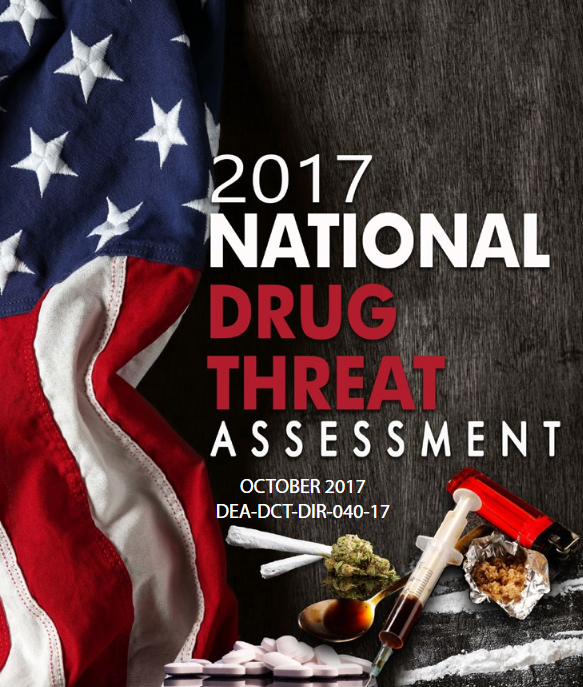
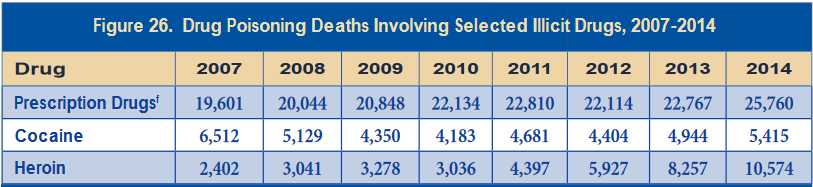
Simply by changing the way they counted overdoses, the DEA and other federal agencies raised the death toll for 2013 by over 8,300 people. We’re only using 2013 as an example. From one report to the next, overdoses grew for every other year as well.
This isn’t the first time the federal government has played around with the overdose numbers. As PNN reported, last December the CDC and the White House Office of National Drug Control Policy released three different estimates of how many Americans died in 2015 from overdoses linked to prescription opioids.
Within one week, the overdose numbers evolved from 17,536 deaths, down to 12,700, and then back up to 15,281 deaths. To use a football metaphor, that is known as moving the goalposts.
Pain Medication Abuse Declining
A closer reading of the 2017 NDTA shows that heroin, illicit fentanyl and other illegal drugs are now driving the overdose crisis, not opioid pain medication. Less than one percent of legally prescribed opioids are being diverted to the black market.
A recent survey of law enforcement agencies, known as the National Drug Threat Survey, found that less than 10 percent of respondents nationwide believed controlled prescription drugs were the greatest drug threat in their jurisdiction -- down considerably from 2014 when over 21.5 percent reported the same
The abuse of prescription opioids is also declining. Fewer Americans are testing positive for hydrocodone, oxycodone and other painkillers in workplace drug tests. And the number of people seeking treatment for abusing pain medication has fallen significantly. From 2011 to 2014, admissions to publicly-funded treatment facilities for prescription opioid abuse fell by nearly a third.
“This decline can in part be attributed to CPD (controlled prescription drugs) abusers switching to heroin or other illicit opioids. Some CPD abusers, when unable to obtain or afford CPDs, begin using heroin as a cheaper alternative offering similar opioid-like effects,” said the DEA.
“Expansion of the counterfeit pill market, to include pills containing fentanyl, threatens to circumvent efforts by law enforcement and public health officials to reduce the abuse of opioid medications; the arrival of large amounts of counterfeit prescription drugs containing fentanyl on the market replaces opioid medications taken off of the street.”
Curiously, the DEA report doesn’t even list kratom as a drug threat – even though the agency considers the herbal supplement a “drug of concern” and tried to ban it last year.
“I think that all of us in the kratom community have a hard time reconciling the lack of a threat listing for kratom and yet still being considered a drug of concern,” said Dave Herman, chairman of the American Kratom Association, a pro-kratom consumer group. “The science tells us that kratom has a low potential for either abuse or addiction and we hope to see that reflected in all DEA materials.”
Whether its kratom or pain medication, the DEA and other federal agencies have a responsibility to be consistent and to get their facts right. Inflating the overdose numbers and blaming opioid medication may make for good headlines, but it diverts funding, resources and policymakers away from other drug problems that truly need more attention. We'll never get a handle on the overdose crisis if we keep moving the goalposts.
A recent editorial in the Journal of Pain Research took the CDC to task for doing just that.
"Transparency, freedom from bias, and accountability are, in principle, hallmarks of taxpayer-funded institutions. Unfortunately, it seems that at least one institution, the Centers for Disease Control and Prevention, continues to struggle with all three," wrote researchers Michael Schatman, PhD, and Stephen Ziegler, PhD.
"What began with a prescribing guideline created in secrecy has now evolved to the use of statistical data and public statements that fail to capture not only the complexity of the problem but also the distinction between licit and illicit opioids and their relationship to the alarming increase in unintentional overdose. This is unfortunately consistent with Mark Twain’s assertion that 'there are lies, there are damn lies, and then there are statistics.'"